
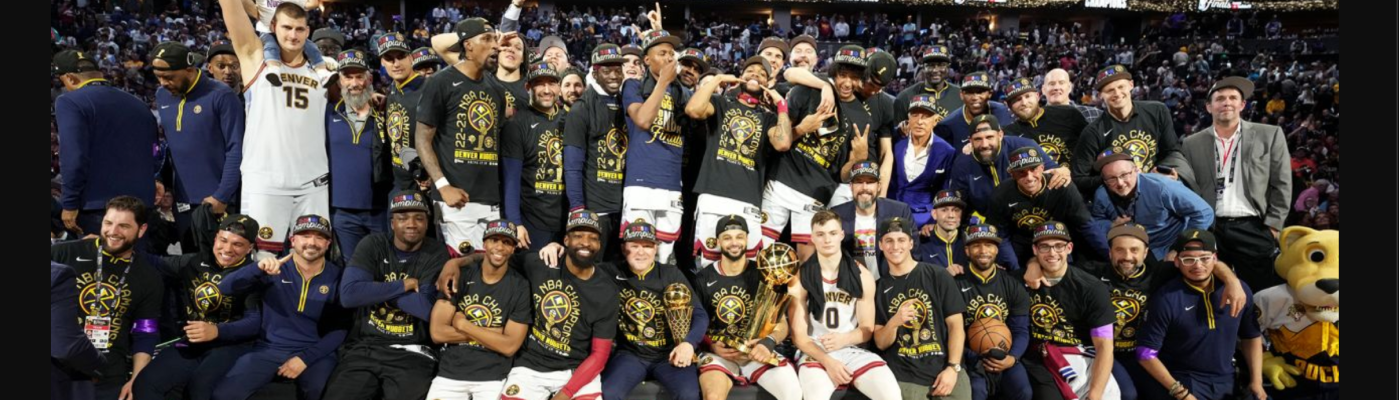
I know this post is a bit late but I still wanted to weigh in on the 2023 Finals.
I had a feeling it would be Denver in 5, but I didn’t want to sell Miami short after they proved me wrong for three rounds in a row, so I picked Denver in 7. I just thought Miami would somehow find a way to nearly get the job done, but that Denver would ultimately prove to be too good in the end.
Turns out Denver was just too good, period.
The one team that nobody in the East could solve, Miami, Denver made short work of them.
Three of Denver’s four wins in the series were blowouts. Game 1, Game 3 and Game 4 Denver just ran Miami off the court. It was almost a sweep: Denver was up 15 at one point but Miami stormed all the way back, took the lead in the 4th quarter and then held on to even the series up. At that point it felt like we had a series on our hands, especially with things heading back to Miami. But Denver easily regained control of the series, even in Miami, and that was that.
Miami had a valiant effort in Game 5 to try to stave off elimination, even taking a 1 point lead into the 4th quarter, but Denver just owned the 4th quarter. The way that just about everyone on the Nuggets was hitting shots–consistently–all throughout the playoffs, it felt very 2014 Spurs-esque. (In the Finals, Denver was 58.5% true shooting as a team, and 55.0% eFG shooting over the 5 games. That’s pretty remarkable for a team. (For comparison, the 2014 Spurs were a blistering 63.5% true shooting as a team and 60.4% eFG.)
I do, however, think that Jimmy Butler’s ankle injury was a major factor and prevented him from playing at his best for most of the playoffs. It was surmountable against New York and Boston, but not Denver. The role players stepped up against New York and Boston, but they shrank in the Finals against Denver.
Real quickly, let’s compare Jimmy’s numbers in the playoffs pre and post-ankle injury. He hurt the ankle in the 4th quarter of Game 1 of the second round against the Knicks–remember when he was a decoy for like the last five minutes of the game and Kyle Lowry took over down the stretch?
Okay, here’s Butler’s numbers for the Milwaukee series and Game 1 against the Knicks:

35-7-5 on 58.5% raw field goal shooting in the first 6 games of the playoffs. Inhuman.
But then, he hurt the ankle late in that Game 1 against New York, missed Game 2, and then these were his numbers the rest of the postseason:

24-6-6 on 41.7% raw field goal shooting over the next 16 games.
I know a sample size of 16 games is going to have much more mean regression than just a six game sample size, which could, in theory, be six outlier games. But Jimmy was never once under 50% from the floor in those first 6 games of the playoffs. In the remaining 16 games, he was only 50% or better from the floor three times.
You can clearly see his stats getting worse throughout the playoffs:

His Milwaukee series was one of the greatest single-series playoff performances we’ve ever seen. Yet against Denver in the Finals, he was not very good (to put it charitably).
But other than a few exceptions, Miami’s role players did not show up in the Finals, either.
Look at Max Strus’ numbers in the Finals compared to his three previous playoff series:

Strus wasn’t really involved much in the Bucks series, only putting up 24 shot attempts. But he still shot 41% from three in that series. The Knicks series was his best, and he was okay against Boston.
But against Denver? Yeesh. 6 points a game on 23.3% field goal shooting and a vomit-inducing 18.8% from three over five games. Max Strus ultimately was 6 for 32 on three pointers in the Denver series. I mean that is just–wow.
Look at Caleb Martin, too. He was phenomenal against Boston–his numbers were clearly and undeniably better than Jaylen Brown’s in the series. But against Denver, he was horrific:

7-4-1 on 37.5% shooting from the floor in the Finals. That’s after going 19-6-2 on 60% shooting in the Eastern Conference Finals.
Miami as a team was 58/169 on three-pointers in the Finals, or 34.3%. That’s the main reason they lost the Finals.
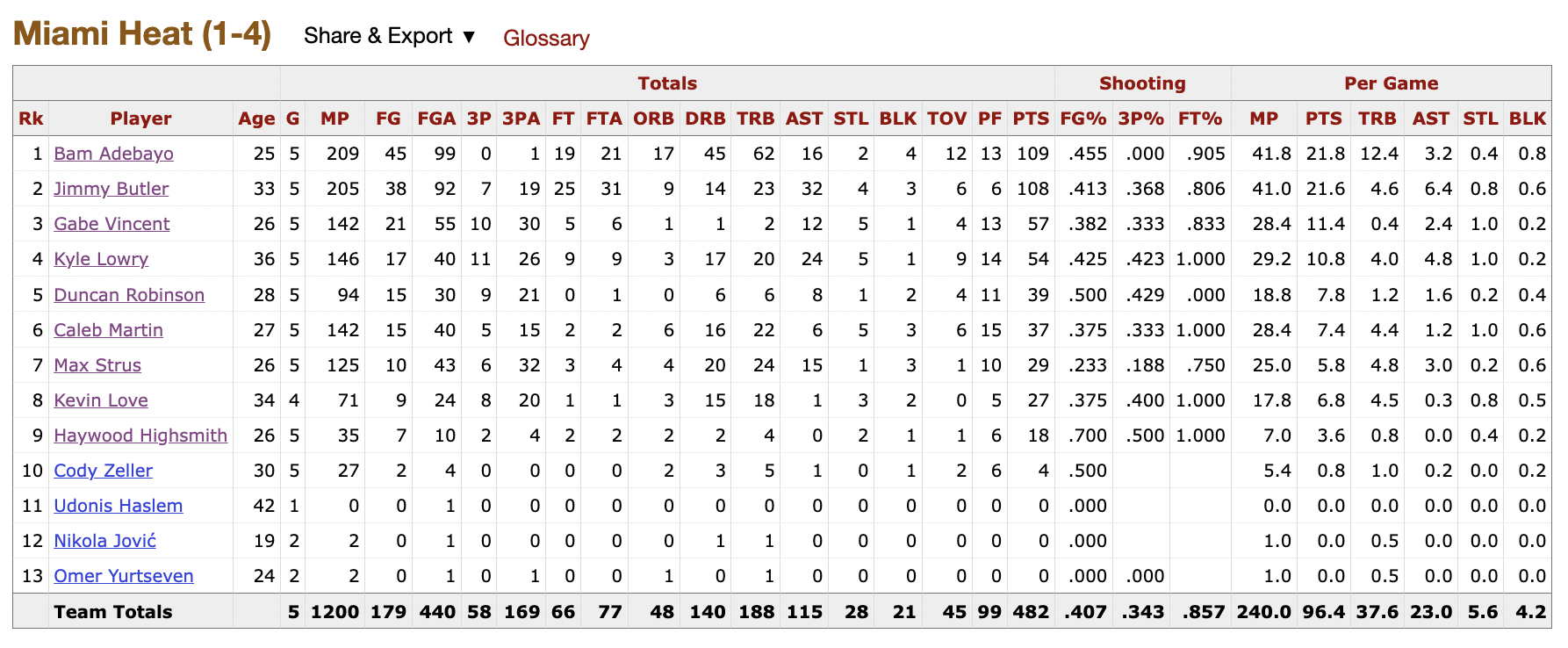
Nobody really had a good series for Miami other than Bam, but even his numbers weren’t all that great. He shot 45.5% from the floor, which is pretty inefficient because he didn’t shoot a single three pointer. Bam had 109 points on 99 shot attempts–that’s inefficiency. He was scoring points but taking a lot of shots to do so.
For the record, I don’t blame Bam or anything–somebody had to step up and try to get the offense going.
Really, though, it was the fact that nobody on Miami could consistently make threes in the Finals. They got to the Finals because they shot the lights out in the previous three series, but went ice cold in the Finals.
I know it’s reductionist to say that the NBA these days boils down to simply which team is better at shooting threes, but you look at the Milwaukee series and Miami was 45% from deep–77 of 171 over five games.
Against the Knicks, they were pretty bad: 30.6% on threes, or 70/229 over six games. But they won the series because the Knicks were even worse, shooting 29.9% from three (63/211).
In the Boston series, Miami was 89/205 over 7 Games from downtown, or 43.4% as a team. That’s really good.
But then regressing to 34.3% from deep in the Finals, that’s why Miami lost.
Now let’s talk about the team that actually won the Championship.
I think I’ve said just about everything that I thought about Denver in my previous posts. There’s really nothing that the Finals proved to me. I knew once Denver beat the Lakers that they were the best team in the league, and so really all that was left for them to do was to just not choke it away. Don’t fumble the bag.
And of course, they didn’t. They went out and took care of business.
It wasn’t all Jokic and Murray. Aaron Gordon had a big game, Christian Braun had a big game, Bruce Brown hit some big shots, KCP did as well.
Michael Porter largely played like crap in the Finals, averaging just 9 and 8 on 32.8% field goal shooting, 14.3% from three. It didn’t matter, though. The rest of the Nuggets were just so much better than Miami that they were able to easily overcome Porter going cold.
Three of Denver’s four wins were by double-digit points, and the one game they lost, they had a 15 point lead with 5:02 left in the first half. I think Denver just got complacent and kicked their feet up at that point, and it let Miami back into the game.
Same kind of thing happened in Game 1: Denver had a 21 point lead going into the 4th, then in just a few short minutes, Miami was only down 10. But Denver was still able to keep them at bay the rest of the game.
Game 3, Denver had a 21 point lead 8:28 to play, then with 1:32 left, Miami is suddenly down just 10 points, and ends up losing by 15.
That’s just kind of how the series went. Game 4 was a smidge closer, but Denver was still up 13 going into the 4th and held a 10ish point lead the remainder of the way.
Game 5 was close until the very end, but Denver is an amazing closing team. They know how to put teams away, they have guys who are not afraid of the moment and not afraid to take the big shot, and they have the personnel to make the plays down the stretch.
The thing, now they’ll only get better in that department. Because the old saying is that when you win a Championship, you instantly get 30% better.
What also happens is your players become more confident, and they play looser in crunch time. Because they know they’ve done it before–they know they are capable of winning the whole thing, and they know what it takes to win. That confidence is huge for late game execution, and now Denver has it in abundance.
So are they the next dynasty?
I still stand by what I said before the Finals: it would not surprise me if this team reels off several more titles over the next 5 years. That’s typically what happens when a young core of guys wins a championship: they win more championships. The last young core to win a championship was the Warriors, and we know how that turned out. It would not be a surprise at all to see Denver follow a similar trajectory.
I also said that Jokic is going to fundamentally change the league similar to how Steph changed the league starting around 2015. After the Warriors won their first championship, the league pivoted towards shooting. Everybody had to be able to shoot the three.
The next pivot is the passing big man–every big man is going to be expected to have a developed passing game, like Jokic.
Obviously Jokic is a one-of-one player, but so was Steph, and it did not stop teams around the league from trying to copy the Warriors’ formula.
For a long time, there was doubt about whether you could actually even still win a Championship with a big man as your best player. Nobody has really done it since the 2000s with Tim Duncan and Shaq.
Part of the reason people didn’t take Jokic seriously until this year was not just that he’d never gotten it done in the playoffs, but that he was a big man, and a mentality had begun to set in that the days of big men leading teams to championships were over.
Jokic is exactly the type of big man who can lead a team to a Championship in the modern NBA: highly skilled, off the charts basketball IQ and passing ability, unselfish, with three-level scoring ability.
Teams are now going to expect their big men to be able to pass. It just makes them so much more dangerous, because then you can’t double them.
Now, I personally think every player in the league should be a willing and capable passer, but it’s not exactly a choice. Some guys are just born with special ability, and Jokic is one of them. He’s always been an elite passer, and it’s not like you can just have any big man in the league practice some passing drills and turn into a Jokic-level passer in three months. Doesn’t work that way. Jokic has been playing this way for years and years.
But I do think teams are going to start expecting more from their big men in terms of passing the ball. It will no longer be acceptable for big men to be terrible passers because we’ve seen what Jokic can do–there’s no longer any excuse for a big man to be bad at passing the ball.
One thing I also said when I was discussing the potential of Denver to become the next NBA dynasty was the fact that the league adapts quickly–they don’t just sit there and allow a team to turn into a dynasty. This is what I wrote:
Obviously in the NBA things can change in an instant. After the 2016 Finals, I thought there was a good chance the Cavs could repeat and probably even three-peat. Then, just a few weeks later, KD joined the Warriors and the whole league was ruined.
So you never know. For all we know, the Lakers could trade for Damian Lillard, or Kyrie. The Warriors could get Giannis. Or Phoenix could pull off a blockbuster deal.
When one team gets really good and looks unstoppable, and it feels like they’re going to win Championships for years to come, typically somebody else will respond by forming a new superteam to usurp the new dynasty in the making. LeBron, Wade and Bosh teamed up in Miami in response to the Boston Celtics superteam. The Warriors recruited KD to get the upper hand on LeBron. It’s just how the league works. Teams don’t just stand by anymore and let somebody else run roughshod.
Well, it turns out the Suns did pull off a blockbuster deal and now have Bradley Beal. I will discuss this move more in a later post, but overall I still don’t think it makes Phoenix a better team than Denver.
But it will make it that much harder for Denver to repeat.
Overall, congrats to the Nuggets. Well deserved for a franchise that has never been to the mountain top before. They are an eminently likeable team, with a humble superstar that plays the game the right way. What a good look for the league that a team like Denver is its champion. There’s really nothing you can take away from this Championship, either. They may not have beaten a terrifying team in the Finals, but the Lakers were the second best team in the league this year and Denver had to go through them. They also beat Phoenix as well. And the Lakers beat Golden State easily so I don’t think you can play the old game of, “Well if Denver would’ve had to play xyz team things would’ve gone differently…”
The only other team out there that I think could’ve given Denver issues was Milwaukee, but they got old before our eyes and lost in five games to Miami. Was part of that because Giannis got hurt? Maybe, but I also think that Milwaukee team is prime to be blown up. It feels like that core has run its course.
I would love to see Giannis vs. Jokic in the Finals because Giannis might be the only player in the league that could give Jokic trouble, and vice versa. But again, Milwaukee’s roster around Giannis needs a lot of work before we can expect to see that matchup.
It does kind of suck that the Finals were underwhelming and we didn’t really get that true heavyweight bout–like the Cavs and Warriors in 2016, or the Heat and Spurs in 2013, or the Lakers and Celtics in 2010. But Finals like those are almost a rarity–where you get two truly great teams squaring off for all the marbles.
I mean, gosh, we went through basically the entire 1990s decade without any truly great Finals matchups–the two best teams of the decade, the Bulls and Rockets, never actually met in the Finals.
The Finals matchups in the 2000s were mostly lopsided as well other than the Pistons vs. Spurs in 2005.
Once you get back to the Lakers vs. Celtics in 2010, I think you have to go all the way back to the late 1980s with the Bad Boys Pistons facing off against Showtime–and then the Bird Celtics going up against Showtime in 1984, 1985 and 1987–to find the last time the league saw two truly great teams meet in the Finals.
So let’s hope we get a great Finals matchup soon–but don’t count on it. It’s much more rare than you think.
 Fade the Public