
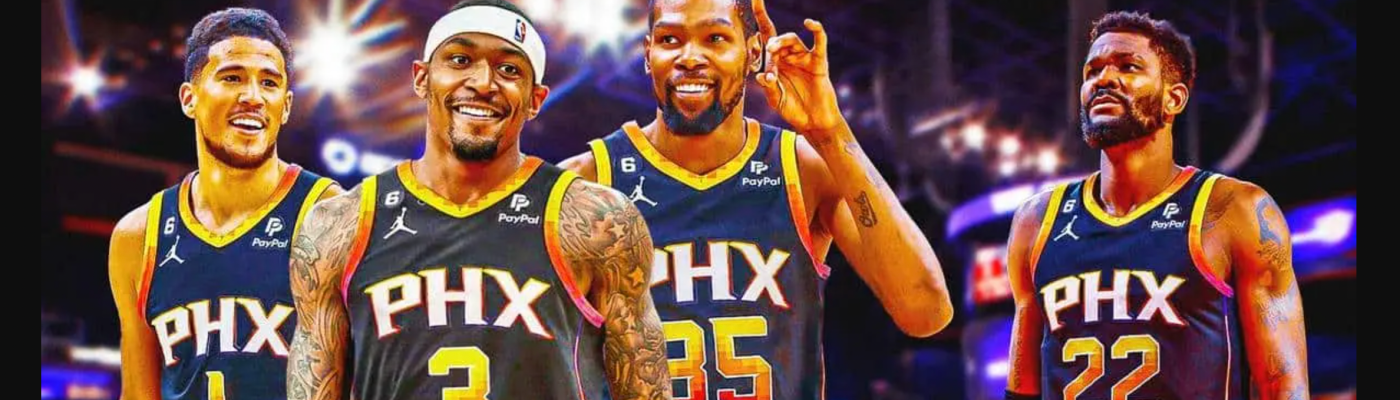
Let’s get this out of the way first: Nobody can fault Phoenix for making this trade. If you can get Bradley Beal without giving up a first round pick, and all you have to give up is Chris Paul (who you were planning on waiving anyway) and Landry Shamet, you do that deal.
Now, the new CBA does complicate things a bit because it is now much more difficult to operate as a luxury tax team with the second apron in place.
The second apron, also known as the “Super Tax” because of how prohibitive it is, is at $179.5 million for next season.
Phoenix, with just KD, Beal, Booker, Ayton, Cam Payne, Jordan Goodwin, Ish Wainwright and Isaiah Todd, plus all their cap holds, is at $175 million in total taxable salaries.
That puts them over the first luxury tax apron of $162 million, and just about $4.4 million shy of the “Super Tax” apron.
So there’s no way Phoenix doesn’t trigger the Super Tax. It’s mathematically impossible.
Over the past few months, discussions around the new CBA and its second luxury tax apron “Super Tax” provision settled around a consensus that the second apron would act as a de facto hard cap because it exceeding it is so punitive no team would ever even dare to try.
The Phoenix Suns just said, forget all that nonsense. It’s a real Leeory Jenkins moment.
Let’s just quickly get into some of the harsh penalties that will befall teams that exceed the second luxury tax apron:
- You can no longer offer the taxpayer mid-level exception contract. If this rule was in effect for the 2023 season, it would’ve prevented the Celtics from signing Danilo Gallinari, the Warriors from signing Donte Divincenzo, the Clippers from signing John Wall, and the Bucks from signing Joe Ingles.
- You cannot sign buyout market players (would’ve prevented the Suns from signing Terrence Ross this past season. Also, and I know it’s a different team, but Kevin Love was a buyout market guy. Andre Drummond for the Lakers in 2021 as well. I think the buyout market is vastly overrated, but there are some okay players on it from time to time).
- Cannot trade first round picks more than 6 years out.
- If you exceed the second apron twice in a four year span (something the Suns are virtually guaranteed to do now given how long they will have Beal, Booker and Durant under contract), then your first round picks (assuming you have any, and Phoenix doesn’t) are automatically dropped to the end of the first round regardless of your record. You could go 9-73 but if you exceed the second apron twice in a two year period you are picking last in the draft.
- You cannot aggregate salaries. So for example, under the old rules, if I wanted to trade for a guy who is making $30 million a year, I would have to send out an equal amount of salary to offset. So what aggregation means is I take three players of mine making $10 million apiece, or two players who are making $15 million apiece, and that offsets the $30 million salary. Under the new CBA, second apron teams are not allowed to aggregate salary in trade.
- What this means is that the Suns have effectively burnt their ships behind them. You know, the old story, whether apocryphal or not, about the famous Spanish conquistador Hernando Cortes, how when he arrived in the “New World” (Mexico), in order to motivate his men, he had all of their ships burned and destroyed. What it did was show them that there was no going back—at least not anytime soon. They were going to have to conquer to survive, and set up a new colony in the New World.
- If for whatever reason this experiment doesn’t work out, Phoenix—I keep wanting to type Brooklyn, because this feels so much like the Brooklyn Nets In The Desert—can’t easily move any of these guys. For the 2025 season, Durant, Beal and Booker will each be making around $50 million. What if they want to ship somebody out? What if KD wants out? Phoenix has to trade for another superstar player making $50 million a year. They can’t trade one of their stars for multiple players on smaller contracts. Being a second apron team prohibits it.
- The only guys they’d be able to trade KD, Booker or Beal for come the 2024-25 season are as follows, and it’s a short list: Steph, LeBron, Embiid, Jokic, KAT, Jimmy, Paul George, Kawhi or Giannis. The trade has to be a guy making the same amount of money—or Phoenix has to find a way to get back below the second apron.
- Phoenix is locked in with the three stars they have. They’ve arrived at their destination and burned the ships behind them.
And of course, this is all in addition to having to pay a heavy luxury tax bill. As far as I can tell it’s still going to be worse for repeat offenders (the dreaded “repeater tax”). The new CBA’s progressive luxury tax thresholds are no longer as harsh as they once were, or at least they’re harder to trigger, so it’s not all bad news for high spenders.
But it’s mostly bad news.
The new CBA was constructed with parity in mind, and its aim is to punish high-spending teams like the Warriors and Clippers who don’t give a shit about their luxury tax bills or even ludicrously high repeater tax bills. The Warriors are selling off assets to pay for their team payroll, but the Clippers’ owner is worth around $103 billion, so what the hell does he care if he has to shell out $200 million in luxury taxes to the NBA? It’s a drop in the bucket for him.
Just think about that for a second. $200 million to Steve Ballmer is like two hundred dollars to someone with a net worth of $100,000. It’s mind-boggling to think about, but $200 million to Steve Ballmer is almost nothing.
So clearly the idea with the new CBA was to place restrictions on your ability to build your roster on teams that are habitual luxury tax spenders. If no amount of money would dissuade the Steve Ballmers and Joe Lacobs of the world from going deep into the luxury tax, then there would have to be some actual roster implications tied to the luxury tax. That was the thinking here.
But the Phoenix Suns and their new owner Matt Ishbia said, “We don’t care. We are not scared of your second apron.” They are now building the exact type of team the new CBA was designed to prevent.
And so that would be the only reason that I, were I in Phoenix’s shoes, would have been hesitant to pull the trigger on this trade.
All else being equal, if it’s Chris Paul, Landry Shamet and some second round picks down the road for Bradley Beal?
No brainer.
But all else isn’t equal now under the new CBA. You have to weigh the luxury tax implications as well. You make the trade for Beal, you are going to incur some fairly significant restrictions on your ability to construct your roster.
Phoenix didn’t care.
Only time will tell if they made the right decision. This is a bold move by them and I’m sure other teams are watching closely. It didn’t take us very long to find the first team in the league that threw caution to the wind and blew past the much-vaunted second apron. Now other teams will be monitoring Phoenix to see if their gamble works out. If Phoenix flaunts the second apron and lives to tell the tale, you can bet other teams will join them.
That’s the real question here: will Phoenix, the guinea pig, look back at the other teams watching from the shoreline and say, “Come on in, the water’s fine!” Or will they frantically run back to the sand with a bite taken out of their ass? (In this analogy I just made up as I was going along, I guess the second apron tax is represented by a shark.)
Now let’s move on to the actual basketball implications here.
There comes a point of diminishing returns on offensive talent in the NBA.
That’s why you rarely ever see teams where three guys can average 20 points per game or more. Typically there aren’t enough shots to go around. The main exception was the KD Warriors, but what made that team so unstoppable was their three main offensive players didn’t need to be ball dominant. This Suns team is not quite like that.
The first thought that popped into my head when I heard about this trade was that it felt like a football team that had two really good wide receivers (let’s just assume an average quarterback), but lots of other needs like defense and offensive line. Yet they go out and get another really good wide receiver. So they’re loaded up at wide receiver but deficient elsewhere.
The problem is that they prioritized wide receiver even though it wasn’t an area of need, and even though they had other glaring weaknesses on their roster that they could’ve addressed.
You do not look at the way Phoenix lost to Denver in the playoffs and conclude, “What they were missing was a guy like Bradley Beal.”
We may be in an era that is often referred to as “positionless basketball,” but to me that’s vastly overblown.
You don’t ever see Chris Paul playing center, do you?
So the league isn’t truly positionless then, is it?
I mean, how many times did you see Kyle Lowry posting up against Jokic in the Finals? I’m not going to bother to look up the numbers but I’d wager it wasn’t very many times.
No, the NBA is always and unavoidably a league of roles. Players come in all different shapes and sizes, and of all different skillsets.
There’s shorter, quicker guys, and there are bigger, slower guys. Typically, speed and athleticism are inversely correlated to size. (Obviously there are some very notable exceptions, but they’re so rare that when you find one there’s a great chance he turns into a top 25 player all time.)
As long as there are players of differing builds and skillsets, there will always be roles on a basketball court.
So there will always be matchups and mismatches.
There have really only been a few truly “positionless” players in league history: LeBron, Magic Johnson, and to a lesser extent Luka Doncic, and to an even lesser extent than that, Draymond Green.
That’s really it.
If the NBA was truly positionless, then Steph Curry would not have been forced into being a point guard, or a combo guard. He would just be what he naturally is: a shooting guard.
But he can’t be a shooting guard, because he’s only 6’2” and that’s way too small to be a shooting guard. He’d be too small to defend the shooting guard position on a night to night basis—he’d either get abused, injured, or, in all likelihood, both.
Every team has players of varying sizes and skillsets, and thus every team has positions and roles.
Now, players are asked to be less specialized and more versatile in their roles today—like for example a lot of bigs are asked to switch onto perimeter players beyond the arc when defending the high pick and roll. More players than just the point guard are bringing the ball up the floor nowadays. And above all, just about every player in the league is expected to be able shoot the three now, even if you’re a center.
But the league is not positionless, nor will it ever be.
And thus the point I’m making here is that roster fit, and filling the traditional roles that exist on a basketball team—that stuff is still critically important.
Think about the two teams that were in the Finals this year: did they play “positionless ball”? No, they each had clear roles for their guys. Just because Nikola Jokic is a center with guard skills does not mean he is a “positionless” player or that his team plays “positionless ball”.
Do roles evolve and change over the years, and sometimes even disappear (like, for example, the stretch four?) Yes, absolutely.
But there will always be different roles/positions, even if the definitions and duties of those roles/positions change over time.
If you watch basketball at all, you’ve heard the announcers talk about one team “exploiting a mismatch.” Right? You’ve heard announcers talk about matchups, and you’ve heard them talk about the coaches subbing players in and out of the game to get optimal matchups?
How would that even be a thing in a “positionless league”?
Okay, so how does this relate to the Phoenix Suns with Bradley Beal?
Because they now effectively have three guys who all do the same thing.
I know KD is taller and thus can play forward, but let’s be real here: Kevin Durant is a 6’11” shooting guard. That’s what he is, that’s what he’s always been, that’s his ideal role.
And look at the statistical comparison between Bradley Beal and Devin Booker. They are almost the same player:

Both are also negative defenders.
The advanced numbers like Beal a little better, and he has a lower career usage rate, but for the most part, they profile out as almost the same exact type of player.
Their shot selection is almost identical as well.
Here’s Beal:
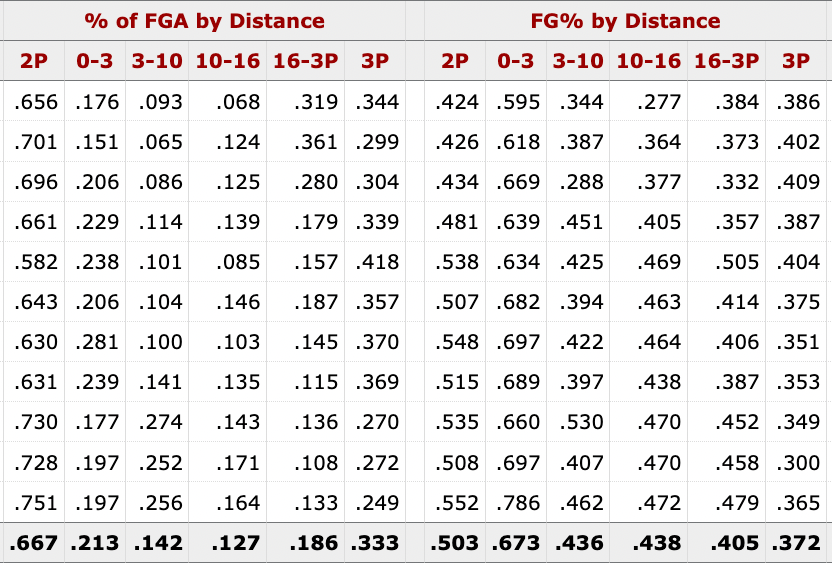
And here’s Booker:

Beal goes to the rim and shoots threes a little more than Booker does, Booker takes more midrange jumpers.
In terms of size, they’re almost identical: Beal is listed at 6’4” 207lbs, Booker is listed at 6’5” 206lbs.
There’s a lot of redundancy here.
It’s not a fatal flaw, though. LeBron and Dwyane Wade had a lot of overlap in their games as well, and they were still able to win a pair of championships.
However, you don’t want a lot of overlap.
When there’s overlap, somebody has to sacrifice and become a lesser version of themselves.
When there isn’t a lot of overlap on a team in terms of its individual players’ roles and skillsets, then it makes it easier for each guy to be the best version of himself.
I’m not saying you want five guys who are each pure and unique specialists with no overlap at all.
Some overlap is actually good—for example, having multiple guys who can handle the ball and initiate the offense is often a good thing.
And you want to at least have some fallback in case certain guys get into foul trouble, or when injuries inevitably happen. That way you do not become completely deficient in a certain area when a certain player is off the floor.
Look at Denver’s starting five: Jokic, Murray, Porter, Gordon and KCP. Those guys all play very different and unique roles, and it works beautifully because they complement each other well and enable each other to be the best versions of themselves.
Look at the Boston Big Three from 2008 after they traded for Ray Allen and KG to play alongside Paul Pierce: different skillsets. Minimal overlap. Each guy could excel in his role without sacrificing all that much. Yes, Ray Allen had to be less ball dominant and turn into more of a catch-and-shoot guy, and people forget what type of player Ray Allen actually was when he was on the Bucks and then later the Sonics. But Ray Allen was also 32 years old when he joined the Celtics—it’s not like he was a 26 year old dynamo who wanted to carry the whole team on his shoulders and do everything.
On the Miami Heatles, LeBron was LeBron—he didn’t sacrifice his game, really at all. Wade did, though. Wade had to become a lesser version of himself with LeBron on the team.
And Bosh had to become not only a lesser version of himself, but a completely different version of himself entirely.
They still made it work because, at least for the first two years, D-Wade was still a top-5 player in the league. And overall, LeBron’s brilliance is able to overcome a whole heck of a lot. But on paper, when LeBron first made his Decision, the pairing of him, Wade and Bosh didn’t seem to make a whole lot of sense. The thought was more, “Well they’re so talented they’ll figure it out somehow,” rather than, “These guys fit together perfectly.”
So my main point here with Phoenix is that instead of getting three star players with minimal overlap who are able to complement each other well, Phoenix has a lot of redundancy. For each of their three stars, the thing they all do best is score. Only one guy can score at a time, so when one guy is scoring, the other two aren’t really bringing a whole lot to the table in terms of rebounding, defense, facilitating, off-ball, etc.
Phoenix is not going to get each guy at his maximum ability. They might get one guy at his very best a night, but the other two are going to have to scale it back because they bring largely the same stuff to the table as the others. It’s like having a band and having three guys who specialize as lead singers.
The other real concern here is injuries.
Beal has not played all 82 games in a season since 2019. In the Covid-shortened 2020 season, he played 57 games out of 72. In the shortened-2021 season, he played 60 of 72. So far so good, for the most part. But then in 2022, he played in 40 of 82 games. Last year, he played in 50 out 82. That’s not a good trend.
KD played 47 of 82 games last season. He played 55 of 82 in 2022. He played 35 of 72 in 2021, although he was still coming off that Achilles rupture he suffered in the 2019 Finals, and obviously missed the whole 2020 season. This is not promising. He’s not going to get more durable and resilient as he enters his age 35 season.
And Devin Booker has usually been pretty good about being on the floor, but last year he played in just 53 out of 82 games. That could be an anomaly, or it could be the start of a troubling trend. But they can’t afford to lose him at all because we’re pretty much baking into the equation KD and Beal missing 25+ games apiece next year, maybe more. So Booker’s health is paramount, and if he’s got to carry the load by himself, that increases the odds of him getting hurt.
Finally, while I’m going to wait to see how Phoenix fills out the rest of the roster, I still see the same issues I saw last year: no defense, no depth, no grit, no edge, and no interior size to deal with Nikola Jokic.
Deandre Ayton is not the answer. They’d be best suited trading him for multiple role players, I think. They need depth. Plus, Ayton is a Chris Paul Merchant, and Chris Paul is gone.
They are a soft team, and they doubled down on softness and finesse with Beal.
Maybe they’ll prove me wrong and the Brooklyn Nets in the Desert will win a title. But I just don’t see it.
Header photo credit: ClutchPoints
 Fade the Public