
The last time the Gamecocks beat the Bulldogs was in 2019. This was also the last time Georgia lost a home game—they’re 20-0 at home since then.
And with Alabama losing to Texas in Tuscaloosa last weekend, Georgia now has the longest active home win streak in college football. That does not appear likely to change this Saturday against the school known in the south as USC (they refer to the “other” USC as “Southern Cal”.)
Georgia played about as poorly as a team could possibly play in their 20-17 double OT loss to South Carolina in 2019. Jake Fromm threw a first half pick six, a pick in overtime that should’ve ended the game, and a pick in the 4th quarter while down 17-10 that could’ve lost the game. Fromm also lost a fumble early in the 4th, too.
After Fromm’s pick in OT, South Carolina capitalized by…. Missing a 33 yard field goal. That probably should have been the moment they squandered the game because if the field goal went in, they’d have won. You completely whiff on a golden chance in overtime to beat Georgia in their building, you’re probably not getting another one. But in the second overtime, after South Carolina actually hit their field goal, while Georgia’s famous kicker Hot Rod Blankenship responded by missing a field goal that lost the game. South Carolina escaped with the 20-17 win.
All told, UGA turned the ball over 4 times in the game. Despite out-gaining South Carolina 468-297, picking up 30 first downs to South Carolina’s 16, holding a 36-24 edge in time of possession, and the defense only allowing one touchdown drive to the South Carolina offense, Georgia lost the game because being -3 in turnovers tends to be insurmountable even for the best, most talented teams in the sport. Turnovers are the great equalizer, and while South Carolina has decent talent—top 25 in terms of the composite rankings—they’re nowhere near Georgia’s level. But if you spot them 3 turnovers including one that got run back for a touchdown, they can win.
This is the only way Georgia can lose to South Carolina—a litany of turnovers in critical moments, plus a guy who was at the time recognized as arguably the best kicker in the sport missing a 42 yard field goal.
So basically, unless South Carolina has leveled up massively over the past two weeks, they need Georgia to play their absolute worst possible game, and even then, it’s still 50-50.
South Carolina has been a bit of a disappointment this season after the way they ended last season. They first showed up on the national radar late in the season when they absolutely blew the doors off of a Tennessee squad that was ranked #5 at the time. That was the game where Hendon Hooker blew out his ACL, but I’ll tell you: South Carolina was probably winning that game no matter what. They ultimately scored 63 points in the game and Spencer Rattler was absolutely stellar, completing 81% of his passes for 438 yards, 6 touchdowns, and no picks. It was the moment we’d all been waiting for from Spencer Rattler.
Instead of having an emotional letdown game the following week in their in-state rivalry matchup with Clemson, the Gamecocks actually won by a score of 31-30, their first win over Clemson since 2013 breaking a 7 game losing streak. South Carolina even rallied from an early 14-0 deficit.
South Carolina did go on to lose a thrilling 45-38 Gator Bowl matchup with Notre Dame to close out the season (squandering a 21-7 first quarter lead) but despite the bowl game loss, the wins over Tennessee and Clemson—both ranked in the top 10 at the time—were huge for the program and it seemed like South Carolina had some real momentum. Expectations were fairly high coming into this season, mainly because it appeared Rattler had finally turned the corner and was living up to his potential.
However, this season began with a thud. South Carolina’s first game was against North Carolina in Charlotte, a big rivalry despite the two being in different conferences. UNC won 31-17 and really pulled away in the second half, but Rattler had a decent game: 353 yards passing on 77% completion, no picks, although no touchdowns, either. The issue was that South Carolina ran for…. -2 rushing yards the whole game? That can’t be right, can it?
*checks notes*
No, it’s correct. Well it’s technically correct because college football counts QB sacks as negative rushing yards and Rattler was sacked NINE times for -22 yards. But that still means South Carolina’s running backs only managed 20 yards the whole game.
So they couldn’t run the ball and they definitely couldn’t protect the quarterback, even though Rattler and the passing game were actually able to move the ball pretty when he wasn’t being driven into the turf.
I’m sure this bodes well going up against Georgia, the most fearsome defensive team in college football the past half decade!
Georgia has won the SEC East every year of Kirby Smart’s tenure but twice: 2016, his first year there, and 2020, the Covid year that honestly looks more and more anomalous the further we get away from it.
Every other season—2017, 2018, 2019, 2021 and 2022–Georgia has played in the SEC championship.
I expect Georgia to do so this season, and I really don’t want to spend much time in this article talking about the matchup with South Carolina, but rather the full, comprehensive season outlook for Georgia. It seems like as good a time as any to do so because South Carolina will be the first real team Georgia plays this season.
This is a weird kind of year for Georgia because most of the time they start off the season with a big non-conference game. Last year they had Oregon, the year before that Clemson. Obviously no non-conference games in the Covid year but before Covid they had a home and away with Notre Dame in 2017 and 2019 (not sure why they skipped 2018 and didn’t just do it in consecutive years though).
Georgia’s first two games—a 48-7 win over Tennessee Martin, and a 45-3 win over Ball State—don’t really tell us much.
If there is anything in these first two to worry about with Georgia, it’s that through two games, their defense has produced a grand total of one sack. That’s tied for dead last in the FBS, which is kind of crazy.
They do have 10 TFLs in those two games, but strangely they haven’t been able to get to the quarterback and sack him more than once. If you remember this was also a point of concern for Georgia last year, their pass rush wasn’t getting home. Probably a lot of that was because Nolan Smith missed most of the season with a torn pec, but still, their pass rush clearly took a step back last year from where it was in the 2021 season, when it was dominant.
Another possible area of concern: they’re only averaging 4.4 yards a carry on the ground this year. 258 total rushing yards, 58 total carries = 4.4 YPC. That ranks just 65th in the nation—very pedestrian, very mediocre, not a dominant run game at all. You’ve got teams like Florida State, USC and Oregon averaging over 6 yards a carry—and Florida State in particular has already played LSU, so they have played a real team, and they’re still averaging a much better rushing performance than Georgia is.
However, on the flip side, teams like Michigan and Ohio State are hardly better: Ohio State ranks 58th in YPC at 4.6 while Michigan ranks 52nd at 4.7. And those two teams haven’t played anybody, either. Alabama ranks 77th in rush yards per carry at 4.2, and Texas ranks 106th at 3.5 YPC. Penn State is 41st at 4.9 YPC.
So with the exceptions of USC (6.8 YPC—4th in the nation) and Florida State, really none of the top teams are running the ball well.
(It’s most surprising with Michigan, honestly, because they’re the team that brought back both stud running backs from last year—Corum and Edwards. Michigan is supposed to be a rushing powerhouse, but they’re not. It’s probably because they’re focused on padding JJ McCarthy’s stats to make him look like he’s an elite passer, but that’s a story for another day.)
Fortunately for Georgia, they rank 9th in the nation in total average YPP allowed at just 3.8, which is elite. The only top teams ahead of them are Notre Dame (3.5 YPP allowed) and Ohio State (3.4 YPP allowed). Yeah, Ohio State has completely done a 180 this year, it seems: they’re elite defensively but pedestrian on offense, which is something I thought I’d never see under Ryan Day.
Georgia fans can rest assured that despite the disappointing pass rush, their defense is still elite in the one stat that matters most, yards per play allowed. And they should get a chance to register a few sacks this weekend against South Carolina, because remember, North Carolina was able to sack Spencer Rattler nine times when they played South Carolina. So pass protection is a major weakness for the Gamecocks—it’s weakness against weakness but I think Georgia should have the edge just because of their overall talent advantage.
I have no real doubt that Georgia is going to take care of business against South Carolina. South Carolina might make it a bit more interesting that it was last year (Georgia won 48-7) just because of Rattler, but Georgia is almost certainly going to win the game.
I wanted to use this post to give more of a big-picture season preview for Georgia, because I had planned on doing one for them, Michigan, Ohio State and Alabama before the season but just didn’t finish it in time. So I’ll use some tidbits from that along with some of the information we’ve learned through the first two weeks to put together a sort of on the fly season outlook as most of the big time teams around the country head into conference play—which, for everyone other than basically Bama, Texas, Florida State and LSU, is when the season truly begins.
So through the first two weeks of the season, one of the emerging narratives is that the SEC is having a down year. Bama got handled at home by Texas, and I wrote about that at length. You also had LSU getting their doors blown off by Florida State, Texas A&M losing by 15 on the road to Miami, Florida getting handled by Utah in week 1, South Carolina getting beaten up by North Carolina, Ole Miss surviving against a Tulane squad that was playing its backup quarterback, Auburn nearly losing to Cal—basically any SEC team that played a non-conference opponent with a pulse either lost or came perilously close to losing.
The two SEC teams that have survived the chaos thus far have been Georgia and Tennessee. Tennessee beat Virginia in week 1 handily, but then was kind of struggling with Austin Peay in week 2, and it was such an unimpressive performance that the pollsters knocked them down two spots to 11 in the most recent AP Poll.
So as it stands right now, Georgia is far and away the SEC’s best hope to make it to the playoff, in large part because they will play Tennessee later in the season and only one of them can make it to Atlanta for the SEC Championship game as they’re in the same division. Plus, Tennessee has a tougher schedule than Georgia does—Tennessee has to play Bama every year, and that game is October 21st in Tuscaloosa.
But I just wanted to illustrate here that Georgia is in a class of their own in the SEC. Just because the SEC is down doesn’t necessarily mean that Georgia is or will be. Georgia is by far the most loaded team in the SEC this year.
You look at the preseason All SEC teams, the first teams are dominated by Georgia. Georgia has 5 of the 11 players on the preseason SEC First Team Offense: Ladd McConkey, Brock Bowers, OL Amarius Mims, OL Sedrick Van Pran, and OL Tate Ratledge. LSU has three of them, including the quarterback Jayden Daniels. They’ve also got WR Malik Nabers, and OL Will Campbell. Alabama’s got one guy on the first team, OL JC Latham.
Defensively, it’s even more stacked towards Georgia. Georgia has a whopping 6 of the 11 players voted to the preseason All SEC defensive team: DLs Nazir Stackhouse and Mykel Williams, LB Jamon Dumas-Johnson, and that vaunted secondary with Kamari Lassiter, Malaki Starks and Javon Bullard (all three started last year). That’s pure dominance. LSU has 3 of them: DLs Maason Smith, Mekhi Wingo, and LB Harold Perkins. The whole preseason All SEC defensive line is just Georgia and LSU players.
So we can talk about Bama losing, but I thought Bama was overrated coming into the season, and Bama doesn’t have the type of roster Georgia does. Bama should given all the talent they have, but between lackluster player development and poor coaching and scheme, they’re just not anywhere close to maximizing the talent they have down there in Tuscaloosa.
Obviously the media-voted preseason All SEC Teams are not the be-all end-all, but the takeaway here is that Georgia is in a class of their own in the SEC. They’ve got the best roster and it’s really not even close.
The main concerns for Georgia, as I see it, are as follows: attrition, a new quarterback and a new offensive coordinator.
Attrition
Georgia lost a whopping 15 players to the NFL draft from the 2021 Championship team (a record), and 10 players to the NFL draft from the 2022 squad that repeated. They’ve sent 25 players to the NFL over the past 2 seasons, and that is very difficult to overcome. Teams often become the victims of their own success—it’s just hard to reload and maintain the same level of excellence.
Georgia is, per blue chip ratio, the third-most loaded team in college football:
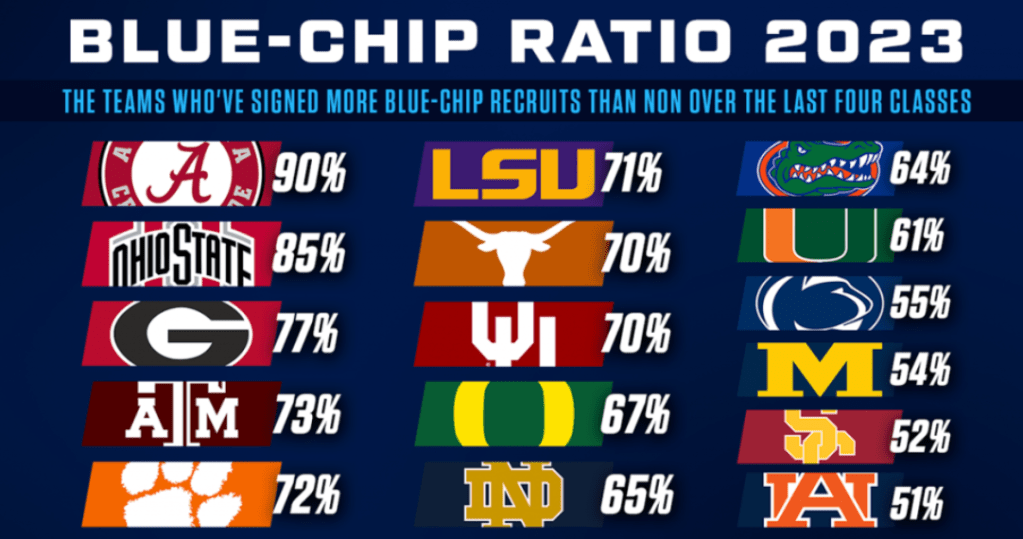
Even after losing 25 players to the NFL the past two years, they’re still one of the most loaded rosters in the sport, and it’s a testament to their elite recruiting.
Talent isn’t going to be an issue for Georgia, but what might be an issue is continuity. We always say that the teams with the most returning talent are the most promising in college football, but the opposite must then be true: teams experiencing a lot of turnover are at a disadvantage.
Georgia ranks 80th in returning offensive production, per ESPN, but 42nd in returning defensive production. Neither number is particularly great, but when you’re a top-flight NFL factory program like Georgia, you’re never going to be near the top of lists like that.
Georgia does have Brock Bowers and Ladd McConkey back which bodes well fro the offense, and while they did lose running back Kenny McIntosh to the NFL, they’ve always been more of a by-committee rushing attack rather than a Michigan-style run team that relies heavily on a bell cow style back.
But what really matters the most in terms of replacing lost production is the quarterback position, and Georgia has to replace the quarterback who led them to two straight National Championships. This leads to our next point.
New Quarterback
Although Matthew Stafford is the best quarterback Georgia has ever had just in terms of talent, Stetson Bennett is without a doubt the most accomplished quarterback Georgia has had. He was underrated, too—people didn’t give him enough credit for how good he was. He was undeniably a plus-player, an asset to the team, and they don’t win two straight Championships without him. He was far from a game-manager, he was a playmaker.
Can Carson Beck be an adequate replacement for him? He’s off to a decent start, with 577 pass yards through two games, completing 72% of his passes, 9.7 yards per attempt, 3 touchdowns to 1 INT and a 164.5 rating on the season.
But we don’t yet know how Beck will hold up once the bullets really start flying in the big games, and that’s something we’ll only find out starting around November, and maybe not even until the SEC Championship game or even the playoff.
But eventually, if they’re going to win the National Championship, Georgia is going to need Carson Beck to be more than just a game manager.
New Offensive Coordinator
I beat this point like a dead horse all the time, but coordinator turnover is maybe the single biggest reason college football teams improve and decline from year to year.
You’re seeing it at Clemson after they lost Brent Venables and Tony Elliott. A big part of the reason Clemson was so good for so long is because they were able to have unusual stability and continuity at coordinator for nearly a decade. (Also, they lost their generational QBs DeShaun Watson and Trevor Lawrence—that had a heck of a lot to do with it).
Zach Smith, former wide receivers coach at Ohio State who now has a great podcast called Menace 2 Sports, constantly talks about how the main reason Ohio State didn’t repeat as National Champions in 2015, despite bringing almost everyone back from the squad that won the whole thing in 2014, was because they lost offensive coordinator Tom Herman and replaced him with the incompetent Ed Warriner. Their offense regressed so significantly that they barely even beat Northern Illinois at home, 20-13. The difference in that game was a pick six by the Ohio State defense, otherwise, the Buckeye offensive production was the same as NIU’s offensive production—13 points.
Alabama’s defense hasn’t been quite the same since Kirby Smart left following the 2015 season. Kirby ran the Bama defense from 2008-2015, and they were elite. Since 2016, Bama’s defense hasn’t been quite as elite—and you’re really starting to see a more significant fall-off now that Saban is losing his touch.
Bama won 4 National Titles in 7 seasons when they had Kirby. They’ve now played 7 full seasons since Kirby went to Georgia, and they’ve won 2 National Championships in that span. Nobody has done as good a job as Saban at maintaining excellence amid coordinator turnover, but even the great Nick Saban cannot fully overcome losing a great coordinator.
Coordinators are massively important in college football, yet one of the biggest challenges big time coaches like Saban, Kirby and Ryan Day have is that when you are consistently elite year in and year out, you lose your coordinators every few years—other teams want to hire them as head coaches. It’s not easy to consistently find new ones that can maintain the same level of play as the old ones because after all, the reason the old one got plucked away was because he was great at his job.
Georgia’s OC Todd Monken left for the NFL to call plays for the Ravens, and Georgia brought in Mike Bobo, who was the OC at Georgia for years under Mark Richt, to reprise his role.
The 2021 Georgia team was so dominant defensively they didn’t need a ton from the offense, but the 2022 Georgia team, which was less dominant defensively, did need to lean on its offense at times, most notably in the Playoff game against Ohio State (aka the Real National Championship Game). They were down 14 points in the 4th quarter and it was Stetson Bennett who rallied them to win—the Georgia defense let up 41 points, that game was a shootout.
Without both Stetson Bennett and Todd Monken calling the plays, is it possible for Georgia to still win these shootout games? It remains to be seen if their defense is going to be as dominant or close to as dominant as it was in 2021, but if it’s not, they may find themselves needing to score 40+ points to win. Will they be able to do that this year with Carson Beck and Mike Bobo calling the plays? Again, it remains to be seen and only time will tell.
And that’s really the answer to just about every question when it comes to this year’s Georgia team. We will not truly know how good they are for at least two months, but I will just say this: people tend to kind of brush off losing coordinators, it’s almost a “whatever” thing to most fans. Like, they just think “Whatever we’ll be fine, next man up, power through it.” But it usually doesn’t work that way.
The bottom line is that the combo of Stetson Bennett at QB and Todd Monken at OC led Georgia to their first two National titles since 1981. It ain’t like Georgia was racking up Natties before those two came to town—there’s a very real chance those two were the ones who put Georgia over the top, and that Georgia regresses with them out of the picture.
It would not reflect poorly on the Kirby Smart or the Georgia football program at all if that happens to be the case. There is no program in the country that can lose an elite coordinator without skipping a beat—not to mention an elite quarterback as well! Urban Meyer couldn’t do it, even Saban has had trouble with it.
It just speaks to the reality that coordinators are extremely important, as are great quarterbacks.
All that said, I do think Georgia is a major favorite to run the table, win the SEC and make it to the playoff as the top seed. They might get jumped just on account of the fact that other teams play tougher schedules. Like if Michigan is undefeated and beats Ohio State and Penn State, they’ll probably jump Georgia in the rankings due to the fact that they’ll have more impressive wins. Same thing with USC: they play at Colorado, at Notre Dame, Utah, Washington, at Oregon and UCLA over the next couple of months. If they run the table on that incredibly difficult schedule, they’re going to be #1 in the nation. There’s no way they don’t—they’ve got SIX currently ranked opponents on their schedule coming up.
Meanwhile, Georgia only has two teams on their schedule that are currently ranked—Ole Miss and at Tennessee, and those games aren’t until November 11 and November 18.
There’s a very real chance Georgia gets jumped in the rankings even if they win all of their games just on account of the weak schedule they play.
The only way I could see Georgia reclaiming the #1 spot in the rankings at the end of the season is if Alabama (or LSU) somehow wins out and gets back up into the top 5, makes the SEC Championship, and then Georgia beats them convincingly, then I could see Georgia going into the playoffs as the #1 seed.
But really, I just think there are other teams out there that have more opportunities to jump Georgia in the rankings. If either Penn State, Michigan or Ohio State runs the table in the Big Ten—and especially Ohio State because in addition to playing Michigan and Penn State they also play at Notre Dame—they’re jumping Georgia. I don’t care how impressive Georgia is against Vandy, Mizzou and Auburn. The CFP committee places a high emphasis on strength of schedule and quality wins, and those are areas where Georgia will be lacking, through no fault of their own.
My gut feeling on Georgia going into this season is that they were destined for a rematch with Ohio State in the playoff, and that game would, whether it takes place in the semifinal as it did last year, or in the actual National Championship, it would be the true National Championship once again.
I don’t think Michigan stands a chance against Georgia. I just don’t think they’re built to beat Georgia. I think Michigan over the past few years is essentially a poor man’s version of Georgia, and we saw them get absolutely demolished by Georgia in the 2021 playoff.
But now I’m not so confident in Ohio State. They look to have taken a significant step back on offense, specifically at the quarterback position. I mean that’s going to be the case when you lose a quarterback like Stroud who goes #2 overall in the NFL draft, but I didn’t think Kyle McCord would look this mediocre. I don’t really remember the last time Ohio State in the last decade-plus had a quarterback this average. Feels like McCord is Todd Boeckman 2.0, honestly.
Without great quarterback play, I just don’t see Ohio State competing for a National Championship—I think they’re a 2-3 loss team if Kyle McCord plays like this for the rest of the season and doesn’t improve significantly. You look at their biggest opponents and their quarterbacks—Notre Dame with Sam Hartman, Penn State with Drew Allar, Michigan with JJ McCarthy—and Ohio State could very well have the lesser quarterback in all three of those matchups.
So I’m pretty low on Ohio State this year after seeing them in two games. I know their defense is improved significantly, but let’s see them play a real team first before we proclaim the defense is fixed and elite. If I would’ve put out that season preview, Ohio State would’ve been my National Championship pick, but now there’s no way I’m picking them. I don’t even think they make the playoff this year.
The upshot is that as it stands right now, I don’t see any Big Ten team capable of beating Georgia. Michigan and Penn State are good but they’re just completely outclassed in terms of roster talent when compared to Georgia.
So I’m looking at teams like USC, Florida State and Texas as the biggest threats to Georgia. Those teams all have really good quarterbacks that could even the playing field when it comes to the talent gap with Georgia.
Texas, in particular, because we’ve already seen them go down to Alabama’s house and kind of control the line of scrimmage. Texas is the one team that has both the high level quarterback play and the overall roster talent—particularly up front—to really challenge Georgia.
Florida State concerns me because while they do have a stud quarterback in Jordan Travis, they’re not even in the top 15 when it comes to the blue chip ratio.
USC has the best quarterback in America and they’re slightly above 50% in the blue chip ratio, but by no means are they anywhere near Georgia’s level in terms of roster talent. 77% blue chip ratio for Georgia and 52% for USC—that’s a massive disparity and I think Georgia would blow them out of the water. USC struggles on defense and against physical teams, and those are Georgia’s specialties. So I really don’t see USC as a real threat to Georgia—plus, USC plays such a tough schedule I can’t see them emerging unscathed. I think the Pac 12 teams might just beat each other up so much that they all have 2 losses or more.
I think that means I’m predicting a Georgia-Texas National Championship. I don’t feel great about the Texas part of it, and the Georgia part kind of scares me as well just because of how difficult it is to three-peat, but I think I have pretty sound logic here, no?
They’ve got a pretty easy regular season schedule, and then at that point it’s just a matter of winning two games. It’s all set up well for them to do something that we have never seen before: three-peat.
I would be surprised if Georgia isn’t at least in the playoff, and I would be downright shocked if they don’t even make it to the SEC Championship game.
That means that, since they went 15-0 last season, finished the 2021 season with a loss in the SEC Championship Game but then won the Natty, and now have won their first two games of this year, they’re on a 19 game win streak.
I expect that to be a 29 game win streak going into the SEC Championship game, then I expect them to make it 30 after winning the SEC.
If they win the Natty and go 15-0 again, it’ll be a 32 game win streak, which would put them just two wins in the 2024 season shy of equaling the greatest win streak of the modern era: Miami’s 34 game win streak from 2000-2002.

As you can see from this list, only three teams since 2000 have reached the 29 game win streak mark–2018-19 Clemson and 2012-14 Florida State. I think Georgia is set up perfectly to at the very least surpass that and get to 30 games.
The playoff is a whole different conversation, but if they are able to go 15-0 and three-peat, that not only puts them in prime position to surpass Miami’s 34 game win streak (although they do open up the 2024 season with a game against Clemson in Atlanta, so it’s no gimme)–but it also gives them the opportunity to do something truly unthinkable: equal Oklahoma’s record 47 game win streak, a college football record that has stood since 1957 and is still to this day thought to be one of the great unbreakable records in American sports.
I know I’m getting way over my skis here because I’m already talking about a four-peat and they still have to three-peat. But given their cakewalk schedule this season and Bama’s decline, I think it’s actually possible.
In fact, now that I think about it, Georgia would actually be able to theoretically break the 47 game win streak next season because the 12-team playoff goes into effect. So the National Champion next year, assuming they run the table (12-0), win their conference (13-0) and secure a bye in the playoff, would have to go 16-0 instead of the current 15-0. You have to win a minimum of three playoff games instead of just two (the playoff field goes from 12 to 8 to 4 to 2). So they could get to 48 wins in a row next season, conceivably.
Obviously the chances of this happening are very slim, because even the strongest teams have a slip up somewhere along the way. Georgia also has to play Alabama and Texas during the regular season in 2024, in addition to Clemson.
But still–if three-peating cements their legacy as one of the all time great dynasties in college football, what would it mean for them to four-peat and break the all time winning streak record? It would be arguably the greatest achievement in American sports history.
Now I want to spend some time in a little bonus content section researching the teams that have either actually completed the three-peat in college football, or teams that have come the closest.
The last time a team in college football three-peated? 1936, Minnesota. They apparently won Championships from 1934-1936. But here’s the thing: the AP Poll era didn’t begin until 1936, so two of those Championships were pre-Poll era, which I really don’t even count.
For instance, in 1934, Minnesota was unbeaten at 8-0 and was named the National Champions, but they didn’t even play a bowl game. The Big Ten at this time didn’t allow its teams to play in bowl games.
Their season ended with the win over Wisconsin on November 24. Alabama was 10-0 that year and actually went to the Rose Bowl and won it 29-13 over a Stanford team that was ranked #2 going into the game, but Bama was not the official National Champion. From what I gather, in the pre-1936 era, there were 13 “selectors” for the National Title, and 8 of them chose Minnesota vs. only 5 of them choosing Alabama.
College football was such a mess back in the day. Shit, it still kind of is, but not as much as it used to be.
The 1935 season had 4 different National Champions declared: Minnesota, SMU, TCU and Princeton, but the sports editor for the AP, a man named Alan Gould, declared–from what I gather unilaterally–that there was a three-way tie for the National Title between Minnesota, TCU and SMU (Princeton’s 1935 National Title was awarded retroactively). The outrage over the three-way tie led to the foundation of the weekly AP Poll. I believe in 1934 and 1935 they just took one poll at the end of November and that was it–those were the final rankings, just one snapshot.
So I guess it’s technically inaccurate to say that the “poll era” began in 1936–it’s more like the weekly poll era that began in 1936.
All this is to say, Minnesota’s three-peat from 1934-1936 is fairly dubious. The polling system, and the system for determining a National Champion, was pretty screwed up, and in my view Alabama was more deserving of the Championship in 1934 anyway.
So what I’m really saying is… I don’t really think anyone has ever truly three-peated in modern college football. If we just go by the poll era starting in 1936, then that’s a factually true statement: no team since 1936 has three-peated, period. And anything that happened in college football prior to 1936 is not really comparable at all to today’s college football.
A Georgia three-peat would be truly historic.
And they’re coming into the season ranked #1, so obviously they have a great chance to pull it off.
The last team that came this close to three-peating was Bama in 2013. They had won back-to-back Championships in 2011 and 2012, came into 2013 ranked #1, and got all the way to the Iron Bowl undefeated. All they had to do was beat Auburn and they’d be heading to the SEC Championship game to face off with a Missouri team that they absolutely would’ve handled. Then it would’ve been a matchup with Florida State in the National Championship Game, and in that game, Auburn actually jumped out to a 21-3 lead in the first half before squandering it and ultimately losing 34-31 at the very end.
The only thing that put Auburn there instead of Bama was the Kick Six.
The Kick Six probably is the only reason Bama didn’t three-peat in 2013. That’s it. And it was during the BCS era so there were only two spots in the Natty. If it were the playoff era, I think Bama still would have gotten in even though they lost to Auburn and didn’t make the SEC Championship Game.
If the playoff existed in 2013, I think it would’ve been Florida State, Auburn, Alabama and Michigan State.
So that’s one disadvantage Bama had back then: there was no playoff, so they didn’t even get a chance to truly defend their back-to-back titles.
But anyway, that’s the closest anyone’s come to repeating in the past 15 years.
Going back further, I guess you could say USC in the mid-2000s came extremely close to doing it. USC was the undisputed National Champion in 2004, then lost that classic thriller to Vince Young’s Texas Longhorns in the 2005 Rose Bowl National Championship Game that would’ve technically been a three-peat.
I say technically because 2003 was a split National Championship between USC and LSU. It’s tough to really say which of those two teams was better. USC was named the AP National Champion, but technically it was LSU that played in and won the BCS National Championship Game, and thus were the BCS National Champions. So I think LSU probably has the stronger claim to the title, just by a hair, but then again, we really can’t say with any degree of certainty because we never got to see LSU play USC that year.
Either way, USC did not get the job done in the 2005 Rose Bowl so even if they were the rightful Champions in 2003, it wouldn’t have been a three-peat. The real debate is whether USC legitimately repeated. But technically speaking, they did come extremely close to a three-peat. Actually even closer than Alabama got in 2013, given that USC made it to the National Championship game in their potential three-peat season of ‘05, whereas Bama didn’t get that far. USC even had a 38-26 lead on Texas in that Rose Bowl with under 7 minutes to play. What a heck of a game that was.
Florida State made it to three National Championship games in a row from 1998-2000, but they only won one of those National Championships–the 1999 one. Neither the 1998 nor the 2000 National Championship games were blowout losses for Florida State, per se, but they weren’t exactly competitive games, either.
Nebraska won National Championships in 1994 and 1995, as well as 1997 (which they had to split with Michigan) and was in the National Championship Game in 1993, but lost to Florida State 18-16 (pretty thrilling ending, controversial, too). 1996 was the key to not only a three-peat but a four-peat, the issue is they didn’t even earn a chance to play for the National Title that year as they lost twice in the regular season.
Then you’ve got 1980 Alabama which was going for a three-peat, albeit a phony one. They won the title in 1978 and 1979, then lost twice in the regular season in 1980, failing to get to the Championship game. But their 1978 split title should’ve belonged to USC fully, because USC had played and beaten Bama head-to-head that season.
You have to go back to the Oklahoma teams of the 1950s, referenced earlier in this post, to find a team that came close to three-peating. Oklahoma went undefeated and were named National Champions in 1955 and 1956, and appeared to be on their way to three-peating in 1957, but they lost a game at home to an unranked Notre Dame squad on November 16, with a score of 7-0 Irish. That snapped the Sooners’ 47 game unbeaten streak, which went all the way back to 1953.
Following a week 1 loss to Notre Dame and a week 2 tie against Pittsburgh in 1953, Oklahoma would not lose again until that Notre Dame game in November 1957. They went undefeated in 1954 but were not named National Champions, they were voted 3rd place. Back then there was a rule that conferences could not be represented in bowl games by the same team for consecutive seasons, so despite being undefeated, Oklahoma could not play in the Orange Bowl that year. The unranked Nebraska team that Oklahoma pounded 55-7 on November 20 was sent to the Orange Bowl, where they lost to Duke 34-7.
So basically Oklahoma got screwed in 1954 and that’s the main reason why they didn’t three-peat, although we have no way of knowing if they still would’ve won in 1955 and 1956, had they would’ve won in 1954 (or rather I should say, had they been named National Champions. Because it’s not like they would’ve played any different of a schedule). You just don’t know. That’s why I don’t like these reverse chronological comparisons.
Anyway, it’s never happened. Teams have come close to three-peating in various ways, but nobody has ever been able to actually seal the deal. USC in 2005 and Alabama in 2013 probably got the closest, and I think Georgia will also get extremely close to doing so this year, with a great chance of actually pulling it off.
Okay, so now we know just how unprecedented it would be for Georgia to pull off the three-peat. I’m willing to say that all things considered, it’s never been done before, even though it’s technically been done before by Minnesota in the mid-1930s. I mean, shit, Minnesota over those three seasons, 1934-1936, went a combined 25-1. And that’s three seasons. Georgia is already 29-1 over the last two seasons. It’s just so much harder nowadays, so there’s really no comparison between this Georgia squad and the Minnesota teams of the 1930s, or even really any team in the pre-Bowl Alliance era (pre-1992). When I think about a three-peat, I think about a team that gets to the Championship game and wins it three seasons in a row, and Minnesota didn’t do this at all back in the day. There’s just no comparison.
One additional factor in the three-peat discussion is the change in quarterback. That’s typically what has tripped up teams gunning for the three-peat in the past.
They have yet to prove that they are like Alabama, where Bama was winning National Titles with Greg McIlroy and AJ McCarron and Jake Coker and Tua and Mac Jones. With Bama, you knew that they could win a National Championship no matter who they had playing quarterback.
We don’t yet know if Georgia can do that. Very few–if any–programs can actually do that. Clemson did it a few years ago, winning with DeShaun Watson and then Trevor Lawrence. But the difference is that those guys were generational QB talents. When Clemson doesn’t have a generational quarterback, not only do they not contend for National Championships, they are hardly even a top-10 program.
Bama is really the only program in America that has shown an ability to remain a top-level elite program regardless of who is playing quarterback (and I think those days are over now for Bama, although we’ll have to wait and see.)
And actually, if you really want to get into it, Bama never repeated as National Champions after switching quarterbacks. They repeated one time: in 2011 and 2012, and both years AJ McCarron was quarterback. He was still the quarterback in 2013 but they failed to repeat. Every other time they won the Championship and then went to a new quarterback the following year, they failed to win the Championship: in 2016 with Jalen Hurts, in 2018 with Tua, and 2021 with Bryce Young.
Now, this isn’t to say it’s never happened before. There have only been three teams to repeat since 2000: 2021 & 2022 Georgia, 2011 & 2012 Alabama, and 2003 & 2004 USC. All of those teams had the same quarterbacks the whole time.
But Nebraska repeated with different quarterbacks in 1994 and 1995. In 1994 they had a quarterback named Brook Berringer and won the National Title, but when they repeated in 1995 and solidified their place as one of the greatest teams in the history of college football, Tommie Frazier was their quarterback.
So it’s possible; it has happened before. It’s been a while, nearly 30 years, but it’s happened before.
This is no small thing for Georgia. Stetson Bennett took that program to another level, and we cannot just assume they will stay there without him. It’s extremely difficult to repeat, it’s even more difficult to three-peat, and it’s even more difficult than that to repeat while changing quarterbacks between years.
 Fade the Public