

I have been traveling on and off basically since Thanksgiving. I’ve been to four different states plus another country all over the past 5 weeks. I typed up a draft of a reaction post following rivalry weekend, then added to it following Conference Championship weekend, and I meant to add in a playoff prediction post as well but just could never get around to finishing anything other than my FSU playoff snub reaction post.
But now it’s the new year, the holidays are over, and I’ve got some time to actually catch my breath and get back to the normal swing of things. It actually kind of works out because my original plan, to simply refine and publish the extra-long draft of what I was working on summing up the past 5 weeks, is essentially obsolete now. I will consult that post for some notes, but now that we are through almost all the bowl games and there’s only one game left to play in the season, the whole context of everything changes anyway.
So basically what this will be is a National Championship preview and overview of how we got this improbable matchup, and then later I’ll write about some of the stuff I missed (namely the way Ohio State’s season ended).
But I will start with the obvious here, which is that Michigan did something I thought I would never see them do: beat an SEC team in the playoff.
Now, I will say, and this is not just me trying to downplay Michigan’s win, but I should not have been so blindsided by them beating Alabama. And to be honest, I wasn’t. I knew Vegas maintained Michigan as the favorite for a month going into the game, and when Vegas has a line that is at odds with what I think will happen, I typically assume that Vegas knows something I don’t rather than the reverse. Plus, my own power ratings liked Michigan as a 7 point favorite over Alabama on a neutral field.
I just thought that so much of Michigan’s stats were accumulated while they were cheating, and so it was hard for me to really trust their numbers, especially since they’ve looked noticeably worse since the cheating scandal was uncovered.
But who has been talking more shit about Alabama over the past year than me? I’ve been leading the parade that Saban is past his prime, “Bama Ain’t Bama anymore”, they have to import all their skill players from the transfer portal nowadays, Saban’s days are numbered, etc.
I fully believed all that, and today I’m reminded that it’s true. But the reason I still chose Bama to beat Michigan was because I figured that even in a reduced state, Bama would still be able to beat Michigan. Shit, after all, Bama beat Georgia, and while I think it’s now crystal clear this year that the “Big Three” (Bama, Georgia, Ohio State) all had down years, I still thought going into SEC Championship weekend that Georgia would win the whole thing.
So I had to give Bama some credit for (seemingly) improving over the course of the season and beating the team that I thought was the best in the country. I thought Bama would beat Michigan purely by virtue of their superior talent alone. I was envisioning Milroe running wild and Michigan’s inferior athletes being unable to keep up with him. I don’t really trust Bama’s skill players, but I figured their defense would simply shut Michigan down and that the Bama offensive line would maul up front. Neither happened, at least not consistently.
I am also heavily deferential to the composite talent rankings, which Bama sits atop by a comfortable margin–and by a significant margin over Michigan in particular.
But there are some factors in college football right now that have, to a large extent, leveled the playing field to the point where talent no longer trumps all. Michigan is the 14th ranked team in the talent composite, while Washington is all the way down there at 26! Yet here we are and those teams will be squaring off for the National Championship next Monday night in Houston.
Look, I will grudgingly admit that Michigan is actually good this season.
But I don’t think they’re great. I think they’re just taking advantage of the fact that the Big Three are down.
This is not some 2019 LSU-level team. They would not beat 2017 Bama, they would not beat 2018 Clemson, 2019 LSU, 2020 Bama, or the past two Georgia Natty squads.
But they don’t have to beat those teams.
It’s the most wide open year since 2007, with no truly elite teams, and Michigan is taking advantage.
In my opinion this is the weakest Alabama has been since 2010, but even still, I thought their sheer talent gap over Michigan would be enough to get the job done. I didn’t think Bama would destroy Michigan. I wanted Bama to destroy Michigan, and tried to convince myself Bama would win in a romp, but deep down I knew it would be a close game because I just never fully trusted Bama.

This is arguably the worst Bama team Saban has ever had other than obviously the 2007 squad, which was his first year there.
I was thinking the game would be close at half, then Bama would pull away a bit in the second half, then fully in the fourth quarter. I was envisioning a score of like 27-13 Bama. I thought they’d be up 20-13 in the 4th quarter and then tack on a late touchdown.
And that’s absolutely the way the game was heading, but Bama made a lot of uncharacteristic mistakes that you don’t normally see a Saban team make. Overall, they felt very disorganized and sloppy.
Bama had 4 three-and-out drives in the first half, and they were lucky to get their lone touchdown off that muffed Michigan punt. The teams traded a pair of three-and-outs in the third quarter, but at the end of the quarter Bama went on a long drive and capped it off with a touchdown to take a 17-13 lead very early in the 4th quarter. I thought that was the turning point for Alabama. Their defense had been stuffing Michigan and they had finally put together a good looking drive on offense.
But then, with three more chances to put the game on ice in the 4th quarter, Bama just imploded.
They got a stop on Michigan and got the ball back, but Milroe fumbled the ball on what was looking to be a promising drive, killing a lot of Bama’s momentum in the game. They started that drive 13:26 to play at their own 33, got 13 yards through the air on their first play, and appeared to be in business just a few short yards away from enemy territory. It was like, okay, they should at least get a field goal here and stretch the lead to 7, and Michigan hasn’t been able to do shit all half, Bama has all the momentum–then, bam, fumble by Milroe. Turnover, Michigan ball.
Michigan didn’t do anything with the turnover (they missed a field goal, actually), but it just killed all of Bama’s momentum and squandered a valuable opportunity to put more points on the board. The ball was recovered at the Michigan 49, so Bama was already into Michigan territory.
Bama also had another promising drive that they screwed up on earlier in the second half. They got the ball to start the half, then moved it all the way from their 14 to the Michigan 47. That’s when their center apparently forgot how to snap the ball. On first and 10 from the Michigan 47, the Bama center Seth McLaughlin dirted the ball and Milroe just had to fall on it for a loss of 13 yards. Wonderful. Then he did it again on the next play, losing a further 6 yards to set up a 3rd and 29 from the Bama 34. It killed an otherwise promising drive. You’re not picking up a 3rd and 29 unless you get a bail out PI flag, basically.
In spite of all this, Bama did have a chance to ice the game about midway through the 4th, score 17-13. Michigan hadn’t done jack shit all half. They missed a field goal off that Bama fumble, setting Bama up at their own 31. Bama advanced the ball to the Michigan 30 yard line, and at this point a touchdown essentially seals the deal, but on first and 10, Bama gets hit with an illegal substitution and has to move back 5 yards. The penalty halted a lot of the momentum they’d regained, and I think at that point, with Milroe having fumbled on the previous drive, they didn’t trust him to run the ball, which really limited the Bama offense a lot.
Bama ended up settling for a 52 yard field goal, which their excellent kicker Will Reichard hit, but it still was just a 20-13 game and as we know, Michigan mustered a comeback and was able to score their only points of the second half on an 8 play, 75 yard drive. Look, I don’t know how Michigan is actually able to move the ball. It feels like it’s all either trick plays or misdirection–there was some element of sneakiness involved in just about every successful offensive play they ran against Alabama, but they are somehow able to get through entire games like that.
I’m watching Michigan’s offense and you can tell exactly what they’re doing: they run the ball a few times, usually to little success, but then they’ll run a play where some guy sneaks out and gets wide open, and they always find him.
On Bama’s final drive of regulation, with the game tied 20-20, they were only able to get the ball up to their own 43 yard line before having to punt. Milroe was 2/4 for 11 yards on the drive, and had a 7 yard scramble. I just don’t think the Bama passing attack is very good, yet for some reason that’s how they tried to win the game. In fairness, they got the ball back with just 1:24 to play so they kind of had to throw it, but really I thought they should’ve just centered that drive around Milroe’s legs.
Anyway, they punt it down to Michigan, and it’s a great punt that the Michigan returner mishandles and nearly loses the game, but he was somehow able to regain control of the ball before the Bama gunners could get to him, and although he was tackled into the endzone he had forward progress at the one yard line, which enabled Michigan to just run out the clock. Michigan was perilously close to one of the all-time blunders–they were a yard away from taking a safety, in a tie game, with just 54 seconds on the clock.
Could you imagine how bad that would’ve been? In a tied playoff game with under a minute to play, you muff a punt for a safety, and that’s how you lose? That’s how your season ends? In front of the whole country? Because when you get a safety, you have to punt the ball back to the other team. The game would’ve been over. It was that close.
Instead Michigan rallies in overtime. They get the ball first, they score pretty easily, and then Bama gets the ball down to inside the 5 yard line. It comes down to a 4th and 4, and guess what? The center screwed it up again–hiked the ball into the dirt. Milroe had to bend over and pick it up, the play was essentially screwed at that point since I believe what they called was a swing pass to the running back. It was blocked up, too–they had the numbers, Bama did. But the snap was bad and Milroe just said “fuck it” and sent it right up the gut, gets completely obliterated, and that’s the ballgame.
Bama had chances to win the game. Their center cost them dearly, Milroe’s fumble cost them dearly, and there were more than a few instances where Michigan lucked out big time, most notably on that near-muffed punt at the end of regulation.
There was also a trick play Michigan ran where it looked like they were running a toss left, but instead the running back turned around and launched it back to McCarthy. It was definitely a backwards pass, and it was about to be a fumble, but McCarthy–and my thoughts on him are well-documented, I think he’s overrated and fraudulent as shit but a good athlete–somehow makes a one-handed, turning around catch, then is able to complete a pass off his back foot downfield for big yardage. This was in the second quarter with about 5:47 to play, game tied 7-7, Michigan with the ball on first and 10 from their own 44. Roman Wilson the wideout was just wide open, Bama bit on the play and nobody was covering Wilson. Moved the ball to the Bama 39. Michigan would score a touchdown on that drive, but it was very nearly a complete disaster on that play.
Look, I definitely think Michigan got very lucky in this game, and they easily could’ve lost it, but it did feel like they were more often than not winning the battle at the line of scrimmage. Especially in the first half. Bama played much better in the second half, but even still, the crazy part was, it felt like Michigan was the better-coached team–more polished, never panicked, never wavered, and more confident. Yes, they had their share of blunders, mainly on special teams (in addition to the two muffed punts they also botched a snap on an extra point), but it just felt overall like they were the more prepared team. It felt like they had an answer for everything, they were laying it all on the line, they weren’t nervous, and I think they truly believed they were going to win.
I picked up on this in the Ohio State game–Michigan just felt like the more self-confident team. They know their identity, they know their gameplan, they go out and execute it, and they are confident that if they execute, they’re going to win.
There’s a good reason for this, and it’s not just because they’re a bunch of cheaters. I’ll get into it in a bit, but right now, my biggest question here is whether this season is an anomaly, or it’s the dawn of a new, less top-heavy age in college football where it’s no longer necessary to have ultra-elite talent to win it all.
To me, it’s not really interesting to talk about how Michigan won that specific game.
It’s more interesting to talk about how Michigan got to the point where they were good enough to compete with Alabama. That, to me, is the real story.
How the fuck did Michigan just beat the SEC Champion? Dating back to 2010, Michigan was just 2-7 against SEC teams with 5 of those 7 losses coming by more than 19 points. One of those wins was at the start of the 2017 at a neutral site against a Florida team that would ultimately finish 4-7.
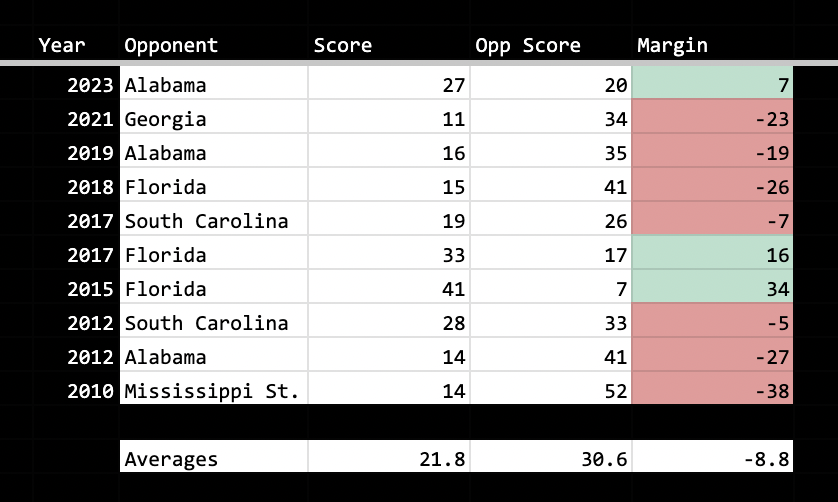
Prior to New Years Day 2024, anytime Michigan squared off against a top-tier SEC team, it was a bloodbath. They clearly were not on that level as a program–they simply didn’t have the talent. And I thought we’d see that once again in the Rose Bowl semifinal against Alabama. After all, the composite talent rankings showed us that Alabama was on a different level than Michigan was.
But now, Michigan, the 14th ranked team in the talent composite, beat Alabama, the #1 team in the talent composite. Along the way, they also beat Ohio State, the #3 team in the talent composite.
Washington, the 26th ranked team in the talent composite, just beat Texas, the 6th ranked team in the talent composite. To get to the National Championship, Washington also beat USC (8th in talent) and Oregon twice (10th in talent).
I mean, clearly we have to wonder whether the talent composite rankings are destiny anymore, don’t we?
This National Championship matchup we have is completely unprecedented in the CFP era. 247 has composite talent rankings dating back to the 2015 season, meaning over the previous 8 seasons.
Only twice has a team outside the top 10 in composite talent even made the National Championship game: TCU last year (32) and Clemson in 2015 (13). The least talented team (per the composite rankings) to actually win a National Championship was Clemson in 2016: they ranked 9th.
Only 5 of the 16 National Championship game participants since 2015 have been ranked outside of the top 5 in composite talent: TCU last year (32), Clemson in 2019 (9), Clemson in 2018 (6), Clemson in 2016 (9), and Clemson in 2015 (13).
The #1 or #2 most talented team has won the National Championship 5 of 8 years since 2015.
This year, it will either be the 14th ranked team winning it, or the 26th.
There’s never been a team ranked 14th or lower even make the National Championship game before last year.
Prior to TCU making it last year, we’d never seen a team outside of the top 15 in the talent composite come anywhere close to even making it to the National Championship game.
This year we’ve got by far the two “least talented” teams to ever compete for a CFP National Championship.
Now, this does not necessarily mean that talent is no longer important and that anybody can win the National Championship. If that were the case, then wouldn’t we have seen Liberty be more competitive with Oregon?
And if you look at the teams that just missed the playoff, like Georgia and Ohio State, they’re 2 and 3 in the talent composite. They were very close. Ohio State was about 35 yards away from beating Michigan in the Big House 6 weeks ago. The most talented teams in the country are still very good, they just didn’t have quite enough to make the playoff.
There’s no reason to think that getting elite talent is no longer important.
But there is reason to believe that perhaps the talent composite is no longer the be-all, end-all when it comes to ascertaining and ranking teams by talent level.
I think there are now very viable ways for teams that don’t pull in top-5 recruiting classes to level the playing field with the programs that do.
The composite talent rankings take high school recruiting ranks into account, and that’s it.
But now that there is a transfer portal, and player mobility has increased exponentially over the past few seasons, we can no longer just rely on high school recruiting rankings to tell us how talented these teams are.
High school recruiting rankings are imperfect. We know that. We’ve always known that. There are 5 star busts, there are 2 stars that go on to be incredible players. JJ Watt was a 2-star recruit who initially played at Central Michigan before he transferred to Wisconsin. Now he’s a surefire NFL Hall of Famer. And in the past I’ve done deep-dives into the recruiting rankings to see just how off-base they’ve been in the past. It’s an imperfect science, and it always will be. You can never project with utmost confidence how good a 17 or 18 year old high schooler is going to be 2, 3, 4 or 5 years down the road.
Still, though–even in light of the inherent flaws in the recruit ranking process, the composite talent rankings were generally accurate and reliable predictors of success in the aggregate during the pre-portal/pre-Covid era. Which is to say, yes, there will be some misses on individual players going both ways (over-ranked players and under-ranked players, and those kind of cancel each other out), but in the aggregate, when you consider each team’s 85-man roster top to bottom, the composite talent rankings are going to be roughly accurate. If you have 12 players on your roster who were 5-star recruits coming out of high school, a good chunk of them are going to actually live up to that billing, and so on and so forth.

Composite talent rankings go by a single number, like Alabama’s overall composite talent score is 1015.43, Georgia’s is 977.80, Ohio State’s is 974.79, and so on. But the rankings are better viewed as a range, you know, like: “1015.43 give or take 10 points in either direction, 977.80 give or take 10 points in either direction, 974.79 give or take 10 points in either direction,” etc. etc. Overall, they give you a roughly accurate–but not precise–idea of where all the teams stack up in terms of aggregate roster talent.
But clearly, we can no longer just look at the composite talent rankings before the season and know with near-certainty that the National Champion is going to be one of the teams in the top 5 or 6.
And it’s not even just Michigan and Washington who bucked the trend, either. Florida State, who was just 20th in the talent composite, went 13-0 in the regular season, and if Jordan Travis hadn’t gotten hurt, they almost certainly would’ve been in the playoff. According to the talent composite, FSU’s talent level is about on par with Nebraska, yet FSU was in the national title hunt til the last week of the season. If they’d been selected to the playoff, they would’ve had a real chance of winning it.
How does that happen? If Jordan Travis hadn’t gotten hurt we would’ve had a playoff field consisting of Texas (6th in talent), Michigan (14th), FSU (20th) and Washington (26th). That would’ve been unprecedented.
It’s not uncommon for one lesser-talented team to make the playoff (Cincinnati in 2021, TCU last year), but to have three teams outside of the top 10 is just crazy. And it’s extremely rare for there to not be at least one or two teams with elite talent in the playoff field. Last year we had Georgia and Ohio State (2 and 3), in 2021 there was Alabama and Georgia (1 and 2), in 2020 there was Alabama, Ohio State and Clemson (2, 3 and 4).
This year, the only top-5 talent composite team was Alabama, and they only made it because of Travis’ injury.
So why are we now seeing these “less-talented” teams have so much success?
Because the talent composite rankings themselves are increasingly flawed, and arguably outdated. They can’t fully account for the value of transfer portal players, and the transfer portal has had a massive, massive impact on the fundamental nature of the sport which is impossible to overstate.
Florida State built their team heavily through the portal. So many of their top guys are transfers: Jordan Travis transferred from Louisville. He was originally a three-star recruit. 247 doesn’t even list a transfer recruit star rating for him. Keon Coleman, originally a 4 star prospect, was at Michigan State for two years before transferring to FSU. He was considered a 4 star transfer prospect, but he’s clearly better than that. There was a while earlier in the season where people thought he was even better than Marvin Harrison Jr.
Johnny Wilson originally went to Arizona State as a 4 star receiver coming out of high school, but then was considered a 3 star in the portal. Jared Verse transferred to FSU from an FCS program called Albany, now he’s a projected first round pick. Jaheim Bell and Trey Benson–FSU’s starting tight end and RB respectively–were both transfers as well. Basically Florida State’s entire offense is transfer portal guys. Overall, I count 17 key contributors for FSU from this season that were portal guys.
Officially, Florida State is the 20th-most talented program in the country, but does anybody actually believe that? That FSU roster is loaded to the gills with NFL talent, regardless of what the composite rankings say.
So here’s the summary of my argument:
- Super Duper Seniors: Michael Penix is a 6th year player. He was in the same recruiting class as Justin Fields and Trevor Lawrence, and both of those guys are in year 3 of their NFL careers. Isn’t that wild? Michigan’s roster is full of older players who have been around a while. Having this level of experience–as well as just the body development that makes a 22 year old so much different from an 18 year old–is a massive deal in college football.
- And it’s a product of Covid: the 2020 season is treated by the NCAA as if it never happened, it didn’t count. You didn’t lose a year of eligibility even if you played the whole season in 2020, and that has had some major effects on the sport.
- It’s almost a cheat code for these teams to have 23, 24 and even in some cases 25 year old grown men (like Stetson Bennett and Hendon Hooker last season) competing against 18-21 year old kids. Michael Penix is 23, turning 24 in May. And the advantage he and other players like him have in terms of experience, maturity and development is impossible to quantify.
- Covid-era flubbed recruiting evals: There’s reason to believe the composite talent rankings aren’t quite as accurate as they were pre-Covid, and for a simple reason: it was extremely difficult to evaluate high school seniors in 2020 with all the restrictions on travel and game attendance. As such, there were a lot of botched evaluations that year. Kyle McCord was considered a 5-star quarterback prospect. And again, it’s not like the rankings were never wrong before Covid, but during Covid, there were even more botched evaluations than normal because, simply, teams and scouts and reporters couldn’t get out to see these players as frequently. They were operating off of incomplete data.
- The end result was that in 2020–technically the 2021 recruiting classes–there was an abnormally large number of high school recruits that were ranked incorrectly. 5 stars that should’ve been 4 stars, 3 stars that should’ve been 5 stars, etc.
- The recruiting rankings from that cycle still factor into the composite talent rankings, which has the effect of widening the margin of error. Remember how I said earlier the composite talent rankings should actually be viewed as ranges, or ballpark estimates? Well, when you factor in the increased miss rate on the 2021 recruiting class, that margin of error is even greater now. Instead of an error margin of, say, +/- 10, maybe it’s now +/- 15 when you factor in the 2021 class. We can’t trust the composite rankings as much due to the 2021 class.
- The portal: Players develop significantly in college. There are late bloomers. The top schools passed on them coming out of high school, but they developed into big time players at lesser colleges. And then when the transfer rules were changed, and these players were allowed to test their values on the open market, a lot of them transferred to schools that better matched their current talent level. The reverse also occurs: players who were over-ranked coming out of high school but wind up never cracking the starting lineup at Ohio State or Alabama or Georgia, they’re able to hit the portal and go to a school where they are good enough to start. You see Ohio State’s 3rd and 4th stringers transferring to places like Cincinnati, etc.
- The end result here is that a guy who was thought to be a 3-star talent coming out of high school that becomes one of the better players in the nation by his sophomore or junior year, he’ll transfer to a bigger school, but on the talent composite he’ll still be valued as a 3-star. Now, the composite rankings do factor in re-evaluations players after they hit the portal, but those evaluations are often imperfect as well.
- Overall, a main issue with the composite rankings is that they have no way of taking into account players who overperform or underperform their high school recruiting grade.
The bottom line here is that Michael Penix Jr. was considered a 3-star prospect coming out of high school. He was also considered a 3-star transfer QB when he left Indiana. And so on Washington’s roster, he counts as just a 3-star player even though he’s arguably the best quarterback in America.
Jayden Daniels was a 4 star prospect coming out of high school in 2019, and remained a 4 star prospect when he hit the portal in 2022. As a transfer, he was considered the 11th-best quarterback in the class. On LSU’s roster right now, the reigning Heisman winner is considered just a 4-star player as far as the composite rankings are concerned. If he hit the portal right now he’d easily be considered a 5-star plus player, and if they had a 6-star rating, he’d deserve that.
Again, you’re only graded as a senior in high school, and that’s it. The only time you can ever be re-evaluated is if you hit the portal. But even the portal rankings are often wildly wrong.
So the reason the composite talent rankings might be off is if Alabama has some 5-star busts on their roster (and they do), the composite rankings don’t take any of that into account. They only take into account where the players were ranked coming out of high school. They don’t go back in and revise a guy’s talent rating if he turns out to be a bust. So those 5-star bust guys are going to boost Alabama’s composite talent score way more than a guy like Michael Penix boosts Washington’s composite talent ranking, which is obviously ass-backwards. But there’s also no way to really fix the problem unless 247 wants to re-grade every player in the country every single year, which is a near-impossible task.
So now, a confluence of factors have brought us to a place where we simply cannot rely on the composite talent rankings to predict champions as much as we once could. With a litany of players now still in college after 5 or even 6 years, with unprecedented player mobility, an abnormal Covid year in which it was much more difficult to accurately rank high school recruits–when you add that stuff on top of the fact that high school recruiting rankings are imperfect to begin with, it puts us in a place where recruiting rankings simply are not the be-all, end-all.
The talent composite used to reliably tell us why things shook out the way they did. It made it clear and obvious why Alabama and Georgia win so many National Championships. But now that’s not the case.
Another factor that increased the parity in the sport and made this one of the most wide-open seasons ever was simply that Ohio State, Alabama and Georgia were all breaking in new quarterbacks this year, and all three programs have lost a ton of great players to the NFL–Georgia in particular after reeling off two straight national championships. When programs have a lot of high-profile success, guys naturally try to cash in on that by declaring for the draft. It seems like just a normal part of life in college football to have guys in and out of the program so quickly, but at most programs, it’s not normal.
Shit, Georgia has had 25 players drafted to the NFL in the past two seasons alone. That, more than anything else, was their biggest obstacle in their failed quest to three-peat: how do you continue to play at a National Championship level when you’ve basically lost all the guys who led you to those two National Championships? There’s a reason nobody has three-peated in the modern era of college football, and why it’s exceedingly rare to even repeat as National Champions.
Stetson Bennett often didn’t get the respect he deserved, but in my view he’s the best quarterback Georgia has ever had. You could say Matthew Stafford was a better football talent, and nobody would ever dispute that, but in terms of their impact on the program, intangibles? It’s Stetson Bennett. His impact on that team was enormous. Georgia has always had elite talent, but they hadn’t won a National Championship in over 40 years until Stetson Bennett came around. Then he led them to two straight. So while he wasn’t some elite NFL arm talent, he was a massively important piece for that team and that Georgia program–he was irreplaceable. There’s just no way to avoid regressing after losing a guy like that.
Alabama’s and Ohio State’s quarterbacks went 1 and 2 in the 2023 NFL draft respectively, and neither program was able to replace them with comparable talents. Had Bryce Young somehow decided to stay at Alabama another year, or had CJ Stroud decided to come back to Ohio State for another year, both programs’ offenses would’ve been markedly better. Bama and Ohio State would’ve been clear-cut National Championship favorites had Young and Stroud returned respectively. Like Stetson Bennett, both Bryce Young and CJ Stroud were irreplaceable players for their respective programs. Georgia’s offense didn’t regress too much this year, and in some ways it was actually even better than it was in 2021 and 2022–Georgia’s regression was more on the defensive side of the ball just due to attrition. But Alabama and Ohio State? They regressed significantly on offense after losing Bryce Young and CJ Stroud respectively.
And not only did those three programs lose all-time great quarterbacks, Alabama had to replace both their offensive and defensive coordinators this year. Georgia and Ohio State both lost their offensive coordinators.
I always say this, and I’ll keep repeating it like a broken record: coordinator turnover is the most underrated and under-discussed cause of decline at major college football programs. It’s arguably the hardest challenge that coaches at top-10 programs have to deal with: constantly losing great coordinators.
For example, Alabama’s defense under Kirby Smart was ferocious until he left after the 2015 season. It’s been very good since, but not quite on that super elite level it was from 2008-2015. 2017 was the last time Alabama had a truly dominant, Kirby Smart-level defense. Since then they’ve been a notch below that.
When Urban Meyer was at Ohio State, they failed to repeat as National Champions primarily because they lost offensive coordinator Tom Herman and replaced him with the incompetent Ed Warriner. After Herman left Ohio State, the offense went into a tailspin for a few years, bottoming out in spectacular fashion with the humiliating 31-0 playoff loss to Clemson in 2016. Ohio State’s defense was excellent in 2019, then fell off dramatically for a couple of years after defensive coordinator Jeff Hafley left. Ohio State is only now starting to get back to being a top-10 defense in year two of Jim Knowles.
This next bit is specific just to Alabama, but it helps explain the regression we’ve seen in recent years: recruiting is simply harder for them now. The south is always going to be the most competitive recruiting area in the country, but over the past decade, it’s only gotten more and more competitive. When Saban started at Alabama in 2007, he had to worry about Urban Meyer’s Florida, LSU, Texas and Georgia to an extent, but now he’s also got to deal with Texas A&M, a program determined to basically buy its way into blue blood status and pay any price to land top recruits. Texas is also resurgent, Georgia can now look Bama square in the eye, and Clemson thanks to their great run several years back is now a much stronger recruiting power.
The net result is that each of these programs–in addition to longstanding Bama SEC rivals like Florida, LSU and Auburn–are all taking bites out of Alabama’s recruiting pie, and it’s starting to add up. Shit, even Ole Miss is now super active on the recruiting scene, specifically in the portal (don’t be surprised if they’re the next program to level up to national power status–they’re absolutely cleaning up in the portal right now). With this increased competition on the recruiting trail, all these other southern programs are taking bites out of Bama’s pie, and that means it’s getting harder and harder for Bama to reload.
It just kind of worked out that Bama, Georgia and Ohio State all had down years (for their standards) in the same season. A big part of it was that all three were trying to replace generational quarterbacks, but it was also because of what we discussed above: the landscape of the sport has changed and not to the Big Three’s advantage. They’re high-turnover programs, pro factories that rely predominantly on young “three and done” phenom talents to carry them.
But we’re now in an era of 5th year and even 6th year players sticking around at other programs, and that continuity, maturity and experiences gives a program like Michigan an advantage over programs like Bama and Ohio State. It narrows the talent gap that was, previously, wide and insurmountable.
There’s also a compelling argument that the transfer portal doesn’t really benefit The Big Three as much as it benefits the programs in the tier below them.
Why do players transfer, in general?
Well, there are two big reasons and one minor reason:
- They’re not good enough to play at their current program.
- They’re too good for their current program.
- They’re just chasing a bag.
The Big Three do not lose players for the second reason. They just don’t. If you’re a starter at Alabama, Ohio State or Georgia, you’re staying put. You’re exactly where you want to be–there’s no better place for you to be to get exposure, get developed and make it to the NFL. Last year there was a bunch of noise about USC trying to lure Marvin Harrison Jr. away from Ohio State, but he turned them down because, well, why would he leave Ohio State? He was the most famous wide receiver in the sport, he was on pace to be a top-5 draft pick, he was on a team in contention for the CFP, plus I’m sure the NIL collective at Ohio State made it worth his while. Solidified starters and star players at Big Three programs have no real reason to transfer.
(Now, I know Kyle McCord transferred from Ohio State but that was because it was basically made clear to him that he was not good enough to be guaranteed the starting job at Ohio State. And you see that he wound up at Syracuse, the proof was in the pudding.)
Georgia has lost some starting-caliber players to the portal, namely AD Mitchell to Texas last year and then this year they lost starting linebacker Jamon Dumas-Johnson, but he went to Kentucky.
But for the most part, players transfer from Bama/Georgia/Ohio State because they’re not good enough to push for a starting role or at the very least major playing time.
So the Big Three programs are, for the most part, losing a lot of their depth now in the portal era.
On the flip side, they’re not really pulling in the best transfer portal recruits because what are recruits looking for in transfer portal, besides money?
They’re looking to be starters.
And it’s hard to crack the starting lineup at Bama, Georgia and Ohio State. These are by far the most competitive programs in the country in terms of how difficult it is to earn a starting role, so if you’re a player transferring from a mid-level school (just picking a name at random: Cal), and you want to increase your profile, make more NIL money, get better development, and play for a contender, you’re absolutely going to have your agent place phone calls to Bama, Georgia and Ohio State, because who wouldn’t want to play at one of those three schools?
But they’re also going to tell your agent that you’re not guaranteed a starting spot. And you’re going to look at what players they have at your position and know pretty quickly whether you’re going to have a realistic chance to earn a starting spot. Like, if you’re a receiver transferring from Cal, you’re not even going to consider Ohio State because that’s the best receiver room in the country, full of elite talents, and there’s no way you’re going to beat all of those guys out. If you’re a safety in the portal, you’re not going to Bama. That’s the best secondary in the country. You’re not going to beat out Caleb Downs.
So you’re going to look at lower-level schools–schools which are an upgrade over Cal, but not quite on that Bama, Georgia or Ohio State level. You’re going to look at a school like Oregon or Ole Miss, where you might realistically expect to win a starting spot. You’ll go somewhere the competition for a starting gig is less intense. It’s no surprise that these are the programs benefiting the most from the transfer portal right now.
When Michael Penix was in the portal, going to Ohio State or Alabama wasn’t an option for him. Ohio State had Stroud and Bama had Bryce. Is Penix good enough to start at Bama or Ohio State? Without question he is. But he wanted to start, and Bama and Ohio State already had starting QB spots locked down. So he went to Washington, a school that’s a tier below the Big Three, but where Penix could improve his national profile, develop, get a nice NIL bag, and compete for a playoff spot. It worked out beautifully.
So in my view, for the most part, it’s these B-tier programs like Washington that benefit the most from the transfer portal. (Washington also pulled Ja’Lynn Polk out of the portal from Texas Tech. He’s been huge for them.) Obviously there are some exceptions to the rule, but I think because the starting spots are so competitive at the Big Three programs, it turns a lot of these portal guys off from transferring there.
(There are a couple notable examples of top-flight programs landing elite transfer players, and both of them were at Alabama: Jahmyr Gibbs and Jameson Williams. Gibbs was originally at Georgia Tech and transferred to Bama, but that’s because, like I’ve been saying for a while, skill position recruiting at Bama has fallen off quite a bit and they needed a running back. After nearly a decade and a half of having elite running backs–from Mark Ingram to Trent Richardson to Derrick Henry to Josh Jacobs, etc.–they didn’t really have anybody on deck in the backfield. So there was an opening for Gibbs at Bama. And with Jameson Williams, he was a great receiver, it just so happened that Ohio State had a ridiculously deep receiver room going into the 2021 season with Garrett Wilson, Chris Olave and JSN. And Williams was the 4th receiver there, but because, again, skill position recruiting at Bama has fallen off in recent years, there was a starting role for him.)
Basically, the reason the Big Three don’t typically land the top portal prospects is because most of the time, they’ve got better players on their roster already. But then you see a program like Florida State, which is a notch below the Big Three, and they built a great team predominantly through the transfer portal. They just had spots available. A guy like Keon Coleman would rather transfer there than Ohio State. Jaheim Bell, even though he’s from Georgia, wasn’t going to transfer to Georgia because there’s no way he was beating out Brock Bowers for the starting tight end spot.
So what ends up happening, for the most part, is Bama, Georgia and Ohio State lose a lot of their depth players to the portal, and the guys they bring in from the portal are mostly to replace that depth. There will be a few guys here and there that compete for and maybe even win starting spots–I know Ohio State’s starting left tackle this year was a portal guy, as was one of their starting cornerbacks–but for the most part, the Big Three are in the portal primarily to replenish their depth and fill specific positions of need. They’re not casting wide nets like, for example, Ole Miss is right now. Lane Kiffin basically decided he was going to overhaul his entire defense through the portal, and so they’ve been extremely aggressive over the past month. It’s not really like that at Bama, Georgia and Ohio State.
I’d say overall, the portal is a net-negative for Bama, Georgia and Ohio State. They’ve all had success stories in the portal here and there, but overall, the portal probably hurts them more than it helps them. They’re not super attractive destinations for top portal prospects because they can’t guarantee starting spots, meanwhile all the mid-tier programs are trying to lure their depth players away with promises of starting roles. You’re a third-stringer at Alabama and aren’t seeing the field? There are 80+ programs out there that you can go to and be a starter at from day one.
The portal is more beneficial to the programs in the next tier down, like Oregon, Washington, Ole Miss, Florida State and Texas. Texas got Quinn Ewers and AD Mitchell out of the portal from Ohio State and Georgia respectively. Texas is not a playoff team this year without those guys. Michigan has benefited a good bit from the portal, although not quite as much as those other programs. They’ve got three offensive starters who are transfers, two of them on the line, but only one on defense.
The fact that the portal is a net-positive for the programs in the tier below the Big Three makes it an even greater net-negative for the Big Three, since they’re all losing ground relative to the teams below them. It’s like if Ohio State was a 98 overall team rating in NCAA, and they go down to a 95, that’s one thing. But if Michigan is also improving from an 86 to a 92 overall at the same time? Double whammy. You were +12 over Michigan, now you’re only +5 because not only did you get slightly worse, they got a lot better, too.
Ultimately, though, the portal is just one of the factors that is, in my opinion, eroding the stranglehold the Big Three have had over the sport in the CFP era.
There are other forces working against them as well, although unlike the transfer portal, which is here to stay (although maybe not in its current unrestricted form), this next one we’ll discuss is a temporary thing.
In an era where due to the Covid season players are staying in college for longer than ever before, this serves to put the best programs at a disadvantage. When you’re a pro factory like the Big Three, you typically have to rely on a lot of younger players: you bring in uber-talented high school players who push for playing time immediately, but then a lot of these guys go three-and-done straight to the NFL. Oftentimes you only get a year or two out of your best players. Like Marvin Harrison Jr., for example: Ohio State only got him for basically two seasons, because he didn’t play much as a true freshman in 2021.
When they say programs like Bama, Georgia and Ohio State don’t rebuild, they reload, that’s not just a luxury for them–it’s a necessity. They lose so many players to the NFL every year, and they don’t get to keep guys around to develop them over 4 or 5 years. They typically only get 1, 2 or maybe in the best case scenario, 3 years tops from their best guys. They’re used to only having their best guys around for 1-2 seasons. They just have to deal with so much more roster turnover than everyone else.
Meanwhile, a program like Michigan, which recruits at a good-not-great level, but is senior-laden and has been able to keep their core group of guys around for a while, has come to gain an edge over the Big Three.
Michigan had a major advantage over Alabama in terms of experience. 13 of Alabama’s 22 starters listed on Our Lads are upper-classmen. 7 of their 22 starters are seniors.
Michigan, on the other hand, has 9 seniors on offense alone–4 of which are on the offensive line. They’ve got a further 7 seniors on defense.
So 16 of Michigan’s 22 starters are seniors compared to just 7 for Alabama.
That’s a major advantage for Michigan, and it helped them close the talent gap.
Washington, too: they’ve got 9 of their 22 starters as seniors right now, plus a further 7 guys who are redshirt juniors, meaning academically they’re seniors but they’re only on year three of football eligibility. Washington, like Michigan, has a ton of veteran experience. They’re a roster of predominantly upper-classmen players. Texas has 9 of their 22 starters as seniors, but four of those 9 are concentrated in the secondary. Texas only has 2 seniors plus one redshirt junior on offense. They’re simply a younger and less-experienced team than Washington, and that’s a big deal.
If you’ve got a senior-heavy roster, that levels the playing field a lot even when you’re going up against a team with elite talent. A 22 or 23 year old senior who has been starting for multiple years has an edge over an uber-talented freshman or sophomore, not only in terms of experience but also in mental maturity and body development. It’s like the proverbial “old man strength”, or how a dad is somehow going to find a way to beat his younger and more athletic son in a game of driveway basketball.
Obviously we’re only talking about 22 year olds here, not 50 or 60 year old dads, but you get the point. A 5th-year senior college football player who was, say, a 3-star coming out of high school, should be able to hold his own against a freshman or sophomore that was a 5-star highly touted prospect, just because the 5th-year senior has so much more experience and development.
He’s been around the block, he’s been in a Power Five strength and conditioning program for much longer, and on top of that he’s got that older guy mentality where he’s simply not going to allow some hotshot kid to beat him, even if that kid has more natural talent.
So that’s my theory on why we’re seeing these “lesser-talented” teams like Michigan and Washington prevail over teams like Bama, Texas, Ohio State and Oregon, whose rosters are filled with blue-chip talent.
There’s just a lot more 5th-year and even 6th-year seniors than ever before in college football because of the Covid year, plus now they’re allowed to transfer wherever they want–Michael Penix Jr. was able to transfer to Washington instead of being forced to stay at Indiana.
It turns out that, at least right now, it’s not the rich getting richer via the transfer portal (meaning the Bama/Georgia/Ohio States). It’s actually the “upper-middle class” programs like Washington, who are able to supplement their already-good rosters with transfer guys like Michael Penix Jr.
If Penix were 5 years older, meaning he started playing college football in 2013 instead of 2018, he would not have been able to have the career he’s had. He probably would not have been able to transfer from Indiana to Washington, and even if he were, he wouldn’t have had the extra year granted through Covid. He’d have exhausted his eligibility after 5 years even with the medical redshirt he was granted (he’s torn both ACLs, and has had 4 season-ending injuries in total during his college career).
Anyway, we’re about to have a National Championship that is fully a product of the new era in college football. Both these teams will be in the Big Ten next year–in fact Michigan will travel to Seattle to play Washington on October 5.
I feel like I’m hovering dangerously close to putting this game in “fluke” territory, but I really don’t think that’s the case. This season isn’t more fluky than 2020, a season that feels faker and faker the further we get from it.
There has just been a lot of change in college football over a very short amount of time, and Michigan and Washington are the two teams that have capitalized.
It’s also simply a fact that this was arguably the worst Alabama team of the Saban era (obviously excluding the 2007 team). I shared the table above, but this is the first season in the Saban era where Alabama didn’t rank in the top-10 nationally in either offensive or defensive yards per play. They were 31st in YPP on offense and 16th in YPP allowed on defense. It simply wasn’t a very good Alabama team, compared to Alabama standards.
Michigan got Alabama at the right time. Shit, that could explain everything, and maybe the whole transfer portal and Covid super duper seniors thing was trivial.
Alabama isn’t Alabama anymore, Ohio State had their worst quarterback arguably of the 21st century, and that’s what enabled Michigan to get this far. They beat both teams by one score in games that went down to the wire.
I don’t know. That might explain it all, but I think it also took a legitimately good Michigan team to capitalize. You don’t just stumble into this, at least I don’t think you do.
Truth be told, Michigan feels like a team of destiny. I fucking hate it, because there is no program and fanbase I despise more than Michigan.
But honestly, it almost feels like God wants them to win. Which is crazy because of the cheating scandal, but how do you explain their offense working almost exclusively by trick plays?
How do you explain McCarthy catching that ball on the double pass?
How do you explain them recovering that muffed punt and avoiding a safety at the end of the game?
Huh? I’m all ears here.
Maybe those Michigan fans are right and this is all just a big witch hunt against Jim Harbaugh because he spoke out in favor of players getting paid. If they get some more miracles and they beat Washington on Monday, I’ll probably believe that shit.
It still won’t explain how Michigan went from being a solid B-tier program to a National Championship contender basically overnight, though.
Maybe the Michigan fans are right and it was all about culture and hiring new coaches and shit. Idk.
But I’m done picking against Michigan. I’ve been predicting them to lose since the Penn State game. And they fucking should’ve lost to Maryland.
It’s their year. It’s Michigan’s year. I hate to say it because nobody deserves a National Championship less. Their fans will be absolutely insufferable. They’re already the most delusional and arrogant assholes on the internet, but when they win the Natty, they won’t be delusional anymore. Technically.
Like, they think they’re the gold standard of college football–the envy of the nation. They think their program is Alabama and has been for 100+ years.
And now they’ll actually be right about that, technically speaking. They’ll have beaten Alabama and won the National Championship. Nobody will be able to say shit to them.
It’s going to fucking suck when they win it. But I have no real doubt that they’re going to win it. It feels like it’s already pre-ordained. It feels like it’s written in the stars and there’s nothing Washington can do to change it. Penix could throw for 500 yards but somehow Michigan will still find a way to win.
It feels like we’re in a movie and it’s simply part of the script that Michigan wins the National Championship, and there’s nothing that’ll change it.
I would love to be wrong. I would love nothing more for those arrogant assholes to get this close to winning a Natty only to lose, and then their program gets nuked by the NCAA for all the cheating and corner-cutting and blatant disregard of the rules.
Because this is it for Michigan. They’re not going to be competing for a Natty anytime soon after this. Harbaugh is going to leave for the NFL before the sanctions come down–he’s going to take a golden parachute out of there and escape relatively unscathed. That program is going to be a smoking crater for years to come. It’s all going to catch up to them eventually.
But I really do think they’re going to get away with it, and be rewarded for cheating.
I don’t give a shit if it gets vacated. They’ll still have won it. You can’t un-play a football game. Get real.
Look, I think Washington has a real chance to win this game. Penix and those receivers give you a chance to beat anybody. It is extremely difficult to beat a team with a quarterback who can put the ball anywhere on the field and a platoon of receivers who can get open.
It’s borderline OP to have great receivers and a QB who can fit the ball into the tiniest windows. There’s basically no defense for it, because no matter how good your DBs are in coverage, the quarterback can just put the ball in the perfect place so that covered receivers are actually open.
And Washington has a really solid offensive line, too. They’re not going to crumble like Bama’s line did.
And for all the people saying, “Well Michigan is just going to pound the ball on the ground and Washington won’t be able to stop them,” I don’t know about that. Washington is 4-0 in games where they allow more than 5.0 yards per carry on the ground. Oregon ran for 204 yards on 5.1 YPC in their first meeting, Washington still won the game. Oregon ran for 6.2 YPC in the Pac 12 Championship game, Washington still won. Texas ran for 6.4 YPC and Washington still won. USC racked up 203 yards on a whopping 7.5 yards a carry, and Washington still won the game.
Washington can win even when they can’t stop the run, and it’s because when you have a passing attack that is quite literally unstoppable when it’s at its best, you can basically outscore anybody.
It might be a little different because Michigan is the slowest offense in the country–it is literally part of their game plan to bleed out the clock. They want to limit Washington’s possessions, and keep Penix on the sidelines. That’s going to be Michigan’s strategy here.
But then again, it’s not like Michigan is some dominant run game. They only average 4.3 yards a carry on the ground. Texas and Oregon were both, statistically, way better on the ground than Michigan was this year.
And here’s another thing: Michigan can only play one way, it’s just that they’ve not faced any team that could force them out of their element.
If Washington gets a lead on Michigan, it completely changes everything. Michigan is not built for a shootout, and they’re not built to erase multiple scores, but that’s the way Washington wants to play. Washington wants a track meet, Michigan wants the game to be played in quicksand.
And Michigan hasn’t faced a quarterback or passing attack even remotely close to Washington’s. The best passing attack they faced this year was Ohio State, and that passing attack was so good their quarterback had to transfer to Syracuse. The best passing QBs Michigan has faced this year are Taulia and Kyle McCord. Penix is 10x better than both of those guys.
So there is a way for Washington to win this game.
I’m actually trying to talk myself into it happening.
But I just have this terrible feeling that it’s already somehow pre-ordained for Michigan to win. It just feels like it’s their year, and that’s that.
I don’t even have a score prediction. I guess it’s just whatever Washington scores, Michigan will score one more than that. Washington could score 50, Michigan will score 51. It’s written into the script, I fear.
 Fade the Public