
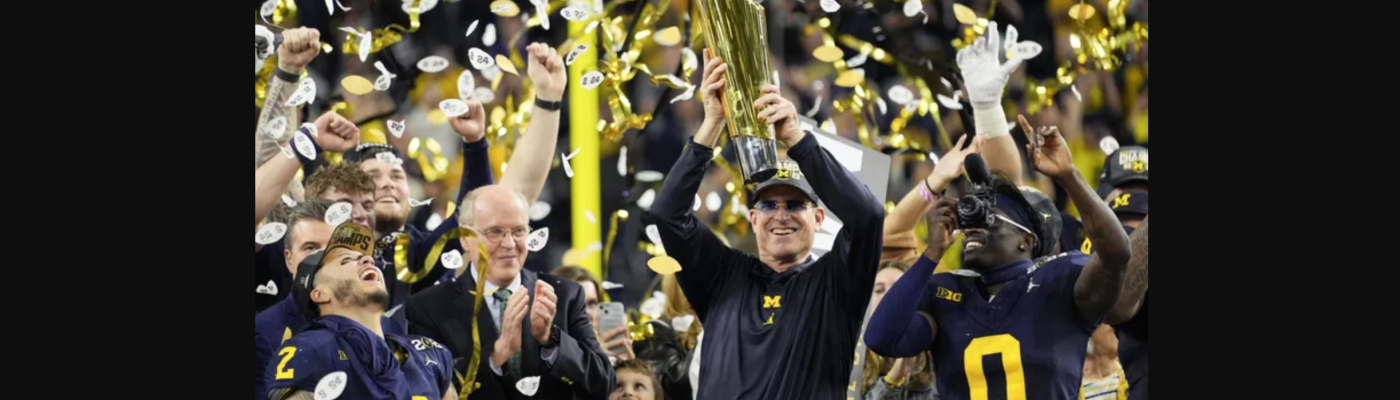
This is going to be basically part two to my post from earlier in the month previewing the National Championship game. In that post I went over the unprecedented nature of this year’s national championship game, in that it featured two teams who don’t recruit at an elite level. I went in depth on why I thought Michigan and Washington were able to buck the trend of basically the past 20 years or so, and what it means for the future of the sport. I predicted Michigan would win the Championship in that post, and this is the follow up.
I never thought we’d see the day. I thought until now that there existed a sort of glass ceiling in college football and that it was extremely difficult if not impossible for any program below it to blast through barring extraordinary circumstance (eg. Auburn getting Cam Newton in 2010).
Basically my operating assumption here has been that other than Ohio State, and in theory USC, if you’re not an SEC team (or a historical southern ACC power like FSU, Miami or Clemson) you essentially have no real chance of winning a national championship. And by SEC I’m also including Texas and Oklahoma.
Ohio State is the only non-SEC team that recruits at an elite level and that’s why they’re the exception. USC in my view at least has the potential to become a dominant power again because we’ve seen it before and because the state of California is a goldmine of football talent. If USC could ever regain the stranglehold on elite California high school talent it had during the Pete Carroll years, USC could absolutely return to super elite status. They’d be borderline unstoppable.
The reason I am so biased towards southern teams is simple: it’s by far the best region of the country when it comes to recruiting, which means that while there are and have been traditional SEC powerhouse schools that far surpass the rest, like Alabama and lately Georgia, history shows us that there are simply way more schools in the SEC that have a National Championship ceiling, which is why since the advent of the BCS in 1998, six different legacy SEC schools have won National Championships (and that’s not including Texas and Oklahoma), by far the most of any conference. The ACC has had three different schools win National Championships since 1998 (FSU, Miami, Clemson), but this to me says more about the fact that those three particular programs have simply transcended the ACC, and they have close proximity to the best high school football talent in the nation.
The Big 12 has had two schools win National Championships: Oklahoma in 2000 and Texas in 2005. The Big 10 now has two schools that have won National Championships in the BCS/CFP era. The Pac 12 has only had one school win a National Championship since 1998: USC.
So this means that, prior Michigan winning it, the SEC had six different programs win National Championships since 1998, while the other four power conferences had a grand total of 7 combined. Three of those seven (FSU, Miami, Clemson) are in the south so I don’t think they really count, the next three (Oklahoma, Texas and USC) won all their National Titles between 2000-2005 and collectively haven’t even been close to winning a Natty since 2009.
(Miami in my opinion is cursed; I subscribe to the belief that Miami football has been cursed ever since they left the Orange Bowl and allowed it to be demolished, and that Miami can never be back until they get their own stadium again.)
Which then left just Ohio State as the only non-Southern team to win a National Championship not only in the CFP era, but since USC in 2004.
I know Ohio State’s 2014 National Championship is getting to be further and further in the rearview mirror, but I still do consider them a National Championship-caliber program because while they don’t always win in the playoff, they have shown a consistent ability to be extremely competitive with elite southern and SEC programs–they were a missed field goal away from beating Georgia in the 2022 CFP and winning the National Championship. Even though they didn’t do it, it’s pretty obvious to anyone that watched that game that Ohio State was every bit as good as Georgia was.
We’d never really seen any other non-Southern program be as competitive as Ohio State was against the cream of the SEC crop. Michigan played Georgia in the 2021 CFP and got absolutely obliterated. It was clear in that game that Georgia was just on a completely different level than Michigan was–that Michigan’s players were no match for the elite southern athletes featured at Georgia.
I simply thought that Michigan’s recruiting was not good enough to put them over the top. At best they could max out by beating Ohio State, because it’s a rivalry and sometimes Ohio State has down years, and then getting exposed in the playoff by an SEC team.
Until very recently I thought that was Michigan’s ultimate ceiling as a program. Harbaugh was supposed to be the savior at Michigan, and if even he couldn’t turn them into a National Championship program, it simply wasn’t possible at all.
In sum I thought there was a very short list of non-SEC/Southern programs that could win national championships: Ohio State, and then theoretically USC.
I also think you can include Oregon with how they’ve been pretty consistently good, sometimes bordering on great, for at least the past 15 years now, plus the fact that they have Phil Knight’s checkbook on their side and he desperately wants to turn them into a national championship program.
I just didn’t think Michigan was a part of that tiny group, and it was proven by their consistent failures against elite SEC teams, and their inability to recruit at an elite level. Plus, outside of their half a national championship that they got in 1997 (because the BCS didn’t yet exist and they didn’t have to play Nebraska) Michigan has never been a national championship contender. Their last outright national championship was in 1948, and to me as a general rule of thumb I don’t really count stuff that happened before segregation was abolished. I mean come on. If it’s in the poll era (1936) I will count it officially, but really anything before the 1960s is kind of suspect to me. Shit, Alabama, Georgia and the SEC didn’t desegregate until 1971. Truth be told anything prior to the BCS in 1998, or at the bare minimum the bowl coalition system in 1992, is questionable to me since prior to 1992 there was no real mechanism in place to ensure 1 and 2 played each other.
Michigan has never until 2024 even played for a game that was considered the National Championship. This was the first time they’ve ever even won a College Football Playoff game, and during the BCS era before that from 1998-2013, they never once made it to the BCS National Championship game. So I think I was on pretty damn solid ground in assuming Michigan was incapable of winning a Natty.
But Michigan proved all that wrong. In my previous post I went in depth as to my theories on why I was proven wrong, but right now a lot of the longstanding assumptions I’ve had about college football need to be reevaluated.
For example, I now believe it’s entirely possible for Penn State to win a Natty. Why not? They recruit at a slightly higher level than Michigan. They’ve got a lot of money, or at least the potential to access a lot of money given that they’re relatively close to New York City and have plenty of alumni from the NYC area. They’re in the Big Ten. They’re in a high population state with good high school talent. If Penn State ever found the right coach, why couldn’t they win a National Championship? And in fact Penn state has won National Championships in the 80s and should have won another in 1994.
If anything this year just underscored the fact that James Franklin isn’t the guy, and that Penn State fans have every reason to demand more. There’s no reason they shouldn’t be able to win a national championship if Michigan can do it.
But it also makes me wonder about programs like Wisconsin, too. Wisconsin is a bit more of a stretch than Penn State, but not by much. Wisconsin in its heyday, yes they consistently ran into the Ohio State wall, but they were a top-10 program. If they just leveled up a notch from where they were in the 2010s, they could conceivably win a Natty. If it all broke their way and they had a bunch of senior leadership and a rock solid coach (which Fickell has the potential to be), they could absolutely do it.
I never believed that until today.
And I think Notre Dame could do it as well. Obviously Notre Dame has the brand and the reach and the history, but they’re kind of limited in recruiting due to academics and the fact that they’re a catholic school.
But why couldn’t Notre Dame do what Michigan did? They recruit at a slightly higher level than Michigan does, and if Michigan can do it with players of that caliber, then certainly Notre Dame could as well. It’s just a matter of finding a coach who understands the assignment.
I think a prevailing assumption was that Brian Kelly left Notre Dame for LSU because he had hit his ceiling at Notre Dame and the program simply wasn’t capable of winning a national championship. But I’m not sure that’s the case; I’m actually not sure that Brian Kelly is this top tier elite head coach like he’s made out to be.
Again, if Harbaugh could do it at Michigan, there’s no reason to think someone couldn’t do it at Notre Dame.
Maybe it’s not that Notre Dame is fundamentally incapable of blasting through the ceiling, rather it’s just that Brian Kelly is just not quite on that elite level.
I mean if Brian Kelly didn’t have that home overtime win over Bama in his first year at LSU (a Bama program that I think we can now all agree is clearly not the same Alabama that terrorized the country in the 2010s), what would we think of Brian Kelly at LSU through two seasons? He’s been good but not great. Maybe that’s just what Brian Kelly is. Obviously you have to give a guy at least three years before you can really cast judgment, but LSU was better in his first year than his second, I thought.
(But shit, honestly, maybe three years isn’t even enough anymore. We’re reevaluating everything we thought we knew about college football–why not that as well? Harbaugh started out 0-5 against Ohio State. It took him 9 years to get Michigan to the top. Dabo was kind of mid for a while before he really got Clemson leveled up. Dabo was in year 8 when he made his first national championship game, and year 9 when he finally busted through and won it. Kirby Smart was in year 6 at Georgia before he won his first Natty, although he did get there in year 2 only to lose narrowly in overtime to Alabama.)
Anyway, I think now I’m going to have to start taking some of these teams that I previously thought were hard-capped in the B-tier a bit more seriously. Michigan has shown that there is a path to a National Championship. It’s not as reliable or consistent of a path as that of a southern school, and you need a lot to go in your favor along the way, but it’s possible.
I really did think it was a matter of, you can only win a Natty if you are Bama/Georgia/Ohio State, or you are a Tier 2 program that somehow stumbles into a generational quarterback:
- 2022: Georgia
- 2021: Georgia
- 2020: Bama
- 2019: Tier 2 program with a generational QB (LSU)
- 2018: Tier 2 program with a generational QB (Clemson)
- 2017: Bama
- 2016: Tier 2 program with a generational QB (Clemson)
- 2015: Bama
- 2014: Ohio State
- 2013: Tier 2 program with a generational QB (Florida State)
- 2012: Bama
- 2011: Bama
- 2010: Tier 2 program with a generational QB (Auburn)
- 2009: Bama
Michigan just upended all of that. They broke the mold. They’re neither Bama, Georgia or Ohio State, nor did they acquire a generational QB talent.
Now certainly Michigan fans think JJ McCarthy is generational, but they’re the only people who think that. The rest of us think they just have fan glasses on considering they won a National Championship game where McCarthy completed 10 passes. That isn’t exactly on the same level as DeShaun Watson throwing for 420 yards against Alabama and leading them down the field for a dramatic game-winning drive late in the 4th quarter in the 2016 National Championship. If Clemson didn’t have Watson in that game, they don’t come anywhere close to winning. If Michigan didn’t have McCarthy against Washington, they still could’ve won. For goodness sakes, they ran for 303 yards on 8 yards a carry.
What remains to be seen about this Michigan championship is whether it proves to be an anomaly–a perfect storm of events enabled by the super-duper seniors from the Covid year, an eminently beatable Alabama team led by a Nick Saban no longer at the peak of his powers, and an Ohio State program led by a coach incapable of winning at the highest level. It also helped that Georgia was out of the picture by the time the playoffs rolled around–after two straight National Championships, the Bulldogs were just not quite on the same level they were the previous two years.
Overall, the “Big Three” of college football–Bama, Georgia and Ohio State–were collectively as beatable as they’ve been in a while, and I think that’s a big part of the reason Michigan was able to get through two of the Big Three rather than smash into the glass ceiling that those programs previously represented for them.
Then there’s also the cheating aspect of it, which has to be addressed.
But I’m really trying to figure out how to wrap my head around that.
On the one hand, Michigan cheated. They obviously cheated. If you read the letter the Big Ten president sent to them, it lays it all out. The NCAA has proof. It’s not an alleged thing. It’s proven. They cheated and it went way beyond the line.
And yet they did all this winning, in fact the toughest part of their schedule, seemingly without the help of cheating. I mean why did they even cheat in the first place then?
I just don’t know how to wrap my head around this. There’s a very obvious difference in Michigan pre and post Stalions. Yet they did this without him.
Was it truly without him? Was he secretly in contact with the team? Did he leave behind all his info?
Yet at the same time once the cheating became known you’d think everyone would’ve changed their signs. I’ve heard it’s much easier said than done to change offensive signs in a season, which might explain why Michigan’s defense has been pretty consistently great while their offense regressed noticeably. But also that offensive regression could have just been the fact that they played good defenses post-Stalions.
And really, even if Stalions left all his info with them after leaving, is that enough? Wasn’t the big thing having him in the coordinators ears and deciphering signals on the sideline in real time? Not having him around kind of moots the whole thing no? Even if he left behind his decoder sheet of signals as a key so someone else could take up the mantle, how reliable would that stuff really be now that everyone knew Michigan had their signs? Is Michigan really going to have the confidence to call plays in response to likely outdated signals, and without their chief spy? Very risky.
I really don’t know what to think. I do know that it’s indisputable that Michigan cheated and they cheated this year. That has to taint this to some degree. I just don’t know to what degree.
Michigan fans will say this proves they didn’t need to cheat, but then that just begs the question, “WELL THEN WHY DID THEY DO IT?”
Because we know they did it! It’s proven. It’s not alleged, or a witch hunt. Nobody framed them for this.
They cheated. Consciously, willingly, deliberately, rampantly, unapologetically, brazenly.
And yet it turned out, they didn’t need to. Or at least they won their most important games this season without cheating (presumably).
Could the cheating have helped them in 2021 and 2022, and they wouldn’t be where they are now without it? Like they used it to take some steps as a program, elevate their profile, retain players who otherwise would’ve left for the league early and build up their depth and experience.
Part of me, the old me that still clings to the idea that only a handful of programs can actually win Nattys and Michigan isn’t one of them, still suspects something fishy has been going on somehow even after the cheating was exposed and Stalions left the program. I don’t know exactly what, but I’m still wary of Michigan. This could just be that I’m still adjusting to the new reality after my old one was shattered. I’m not sure. After living for the past, I don’t know, 10, 15 years under the assumption that Michigan is by nature incapable of winning a national championship, it’s going to take some time to adjust and recalibrate my worldview.
But the cheating thing, I really don’t understand it anymore. I guess we’ll just have to wait until the NCAA releases its findings and hands down its punishment, but even then, the cheating was uncovered before Michigan hit the toughest stretch of their schedule. I really don’t know.
Maybe the reason they “didn’t need the cheating” this year is because of what I talked about above and earlier this month: Michigan really benefited from having a lot of veteran experience and continuity, and that’s what it took for them to beat teams like Ohio State and Alabama who were in uniquely vulnerable states.
I mean, Ohio State had a Syracuse quarterback this season. Kyle McCord was a massive downgrade from guys like CJ Stroud and Justin Fields. And Alabama? By nearly every statistical measure this was the weakest Alabama team since 2008. And I’ve been saying for over a year that Bama wasn’t Bama anymore.
What about Washington in the National Championship game? Well, that game, despite the 34-13 final score, was hanging in the balance well into the 4th quarter. Washington just couldn’t get out of their own way. Penix played terribly, missing throws left and right. But overall, Michigan was just a more talented and complete football team than Washington. In that regard, the composite talent rankings and all the various power ratings had the National Championship game nailed: Michigan was the better team. My own power rating had Michigan as 16 point favorites over Washington on a neutral site. Michigan may have only ranked 14th in composite talent, but Washington was 26th.
I just think it was a wide open year. We now know that Nick Saban was running on fumes, Georgia as a program was kind of running on fumes after consecutive National Titles and losing 25 players to the NFL. Ohio State, again, had a Syracuse quarterback. In a year like that, where the traditional juggernauts aren’t juggernauts, and where Michigan is bringing back an experienced, veteran core with tons of continuity and admittedly pretty great coaching (they rarely made mistakes, rarely turned the ball over, and simply out-executed just about everybody they played), it’s possible for Michigan to go all the way.
The one thing I will say about Michigan winning is that, as an Ohio State fan, it’s oddly comforting.
Not that I wanted this to happen; not that I was rooting for the conference, or that I see this as anything other than a terribly dark day for Ohio State and the sport as a whole.
But the silver lining here is that we don’t have to feel so damn ASHAMED about losing to Michigan anymore. I think that’s been the worst part of it the past three years. I go the whole year and I convince myself, MICHIGAN ISNT EVEN GOOD.
But then they beat us and it’s like, well what do you have to say now? I guess I have to say that either Ohio State wasn’t actually that good, or that Michigan actually is good.
Then they’d go on and get embarrassed in the postseason and I’d be like, “SEE? I TOLD YOU THEY WERE FRAUDULENT!!”
The worst part was not the jeers from the Michigan fans, it was the pointing and laughing by the SEC fans. “Ohio State thinks they’re elite and they can’t even beat fucking MICHIGAN? Hahahahahah!”
Well now what?
What now, SEC folks?
Ohio State couldn’t beat them.
But neither could Bama. And Georgia couldn’t even beat the team that couldn’t beat Michigan.
So if there is one positive takeaway here, it’s that SEC folks had to shut the fuck up real quickly.
And now we Ohio State fans don’t have to be so damn ASHAMED about losing to a program we perceived to be inferior in all facets.
I used to think of it like, if we can’t beat Michigan, and we know for damn sure Michigan can’t beat an SEC team, then we must be nowhere close to winning a national championship. That was the depressing part.
On the flip side, if you lose narrowly to the best team in the country, yeah it sucks and it hurts, and it hurts even more that it’s your bitter rival. But you can live with that knowing you’re not that far off, you’re close, you’re knocking on the door.
I mean shit, I already have a very different perspective on the Ohio State-Michigan game from this year. During the game I thought it was the biggest embarrassment ever. Oh my gosh, Ryan Day lost three in a row, he even lost to Sherrone Moore–it wasn’t even Harbaugh on the sidelines. He lost after everyone in Buckeye nation said Michigan only won the last two because they were cheating. It was a disaster.
Now it’s like, well Ohio State was 35 yards away from beating the national champions on the road, and we had a fucking Syracuse quarterback.
If Kyle McCord doesn’t throw that early pick and basically give Michigan a touchdown, we probably win that game. I really think any of McCord’s predecessors would’ve won that game—Stroud, Fields, Haskins, Barrett, Cardale, Braxton, Terrelle Pryor.
If that Ohio State-Michigan game goes differently, does Ohio State win the Natty this year? Bama was clearly not some juggernaut typical Bama squad. Washington was clearly not capable of getting the job done. I really think there’s a plausible argument to be made that the Ohio State-Michigan game this year might have been the Real National Championship Game. I don’t fully believe it, but it’s not such a crazy idea is it?
I mean shit, I thought Ohio State played Michigan as tough if not tougher than Alabama did. We didn’t get pushed around. I thought Bama kinda did for large stretches of that game, although there definitely stretches of that game where Bama was in firm control of the line of scrimmage, to be fair.
But when we played Michigan there was no part of me that thought, “Wow we just got bullied.” My thought was just that McCord sucks and he was the weak link of the team all season long.
So it’s good to finally be able to view the Ohio State-Michigan rivalry as truly consequential in the national landscape. Up to this year, it was only really consequential for Ohio State–do you beat Michigan and then see how good you truly are in the playoffs, or do you lose to Michigan and have it confirmed that you ain’t shit?
Now Ohio State fans can view the Michigan game as a true national test against a worthy foe capable of winning the whole thing.
Previously, I only used to view games against Alabama, Georgia and Clemson that way. I thought you could not find any sort of true, measuring-stick test for Ohio State in the Big Ten.
Of course the turd in the punchbowl to all of this daydreaming is how bad the Ohio State offensive line looked in the Cotton Bowl against Missouri. And yeah it was horrible, and I was pissed as fuck in the moment (and still kind of am), but I’m more willing to dismiss that as an anomaly. Our offensive line looked significantly better against Michigan, and I know Missouri doesn’t have a better defensive front than Michigan.
So I’m willing to chalk that game up as a fluke due to the fact that we reshuffled the offensive line before the game. For whatever reason Day decided to stealth bench starting center Carson Hinzman, and center is arguably the most important position on the line. It wasn’t that Ohio State’s offensive line was getting out-muscled and physically beaten by Missouri as it was they simply had no idea what the fuck was going on, they were missing assignments left and right, the communication was completely off, and they were clearly not on the same page for basically the entire game.
So while I’m not willing to forgive Ryan Day for how he handled that Missouri game, I am willing to just kind of forget the game ever happened, if that makes any sense. I know the phrase is “Forgive but don’t forget,” but in this case I’m turning that on its head. I’m not going to forgive Ryan day simply because he hasn’t earned it, he hasn’t proven himself yet. However I will forget the game because I don’t believe it was truly representative of how good that offensive line was throughout the course of the season.
I’ll put it another way: I don’t think the offensive line just got suddenly worse in a month. Nor do I think that the offensive line is going to be horrible going into next season. I don’t think the offensive line became this massive liability (well, more of a liability than it already was). I think it was a one-off in that game only, and that Ryan Day is a cowardly moron for suspending Hinzman the whole game (and then lying about it to the media claiming it was just a simple benching because Hinzman had the yips in practice. Honestly of all the things Ryan Day has done that one might be the thing that pisses me off the most. What a bitch move.)
But overall, I mean how can you feel worse about Ohio State football after watching what Michigan just did? If you just try to separate your hatred of Michigan and how much it kills you to see them and their fans happy, just think about this rationally. Think about this from the perspective of an unbiased observer—say the CFP committee. That’s a high quality loss, and it proved that you very well may have been the second best team in the country. Or even the best if a few breaks had gone your way.
There are such a thing as moral victories. As an outside observer, you can admit that. I don’t want any teams I root for actually saying that or having that mentality, which is why coaches always say there’s no such thing as a moral victory.
But from a fan perspective, they’re absolutely a thing. They let us know our team isn’t far off.
I mean think of Missouri this year. In my opinion, their biggest moment of the season was losing somewhat closely at Georgia. At least for me, that was the moment I thought Missouri might actually be legit. Even though they lost the game! But still, Missouri goes down to Georgia and plays 4 tough quarters with a team that’s won 2 straight Nattys and hasn’t lost a game in 2 years? That’s quite a feat. That’s a textbook moral victory in my opinion. It showed us what Missouri was made of even though they lost. We were able to benchmark them against a team we knew was great.
This is the hard part about college football: there’s so few real data points it’s hard to actually benchmark these teams. You only get 12 games in a season and at least half are going to be against hopelessly outmatched cupcakes. There’s only a handful of games that actually show us what a team is truly made of. Even if you lose one of those games, if you lose close and fight valiantly against a team you know is great, it’s hard to be too broken up about it. That’s a moral victory, I’m sorry to say it.
So again I’d be lying if I said I’m still super down on Ohio State like I was immediately after the Michigan game. Michigan won the whole thing. We played them super close. We’re not very far off.
And Michigan fans will never admit it but I think they actually gained respect for us when they realized how good their team was, which made them realize how good we were. Was there any game they had to sweat out more than their game against us? Maybe the Bama game. Probably the Bama game. But they also made mistakes in the Bama game. They made none against us. And we made several. It’s harder to sweat a game when you feel like your team is giving the game away—you’re more mad than anything else. But against us they had no turnovers and they still could’ve lost.
I don’t know. I could be wrong. All I know is I don’t hear Michigan fans call Ohio State soft anymore. And that’s a recent thing.
So overall, after going back and forth, I don’t think I’m on the Fire Ryan Day team. This is where I landed last year as well—after the Michigan game I wanted him run out of town. Then I came around after the Georgia game. This year I wanted him not only fired but deported out of Ohio and sent straight to Guantanamo Bay. Lock him up.
While I’ve cooled down on that position, though, that doesn’t mean I don’t still have major issues with the way he runs the program and major concerns about whether he’s actually cut out to be the guy. While I don’t want the guy fired, I’m not an enthusiastic supporter of him and I don’t think I ever will be until he proves he can not only beat Michigan, but beat them consistently, and honestly, he’s got to win a National Championship. There’s just too much talent in Columbus to accept not winning at Natty.
My reasons for not wanting him fired are more of a practical thing: I just don’t think there’s any clearly superior alternatives out there and I think the team is a lot closer to being elite than I did 6 weeks ago. We’re not far off, no need to blow the whole thing up if you’re only 5% away. You don’t demolish a house if you don’t like the color of the walls, do you?
And as we’ve seen since Saban’s retirement, Bama has been pillaged and picked apart–a lot of it by Ohio State, in fact. The bottom line: it is very bad in the age of the transfer portal and NIL to lose your head coach. You will have a mass exodus of players, and if your coach leaves after the portal window closes, God help you. It’s a one-way street out of there. Bama is sitting there powerless and helpless as they experience one of the biggest college football “brain drains” we’ve ever seen.
So I’ve changed my tune quite a bit on Ryan Day. Firing your head coach at a program like Ohio State is a massively consequential decision that could set your program back considerably. Bama is now basically in a full program rebuild.
What does need to happen, though, is Ryan Day needs to give up playcalling and assume the CEO role. Has to happen.
I went over this last year, and the topic kind of died down after how well he acquitted himself in the Georgia game, and now it’s a hot topic again, but I really think it’s time for him to give up play calling duties. Most of the fanbase probably agrees, it seems like the beat reporters are all kind of in alignment on it, and there’s been some reports that Day indeed does plan to do this.
I’m not saying he isn’t a good play-caller. In fact I think he’s a really good play caller, he was just limited by the fact that his quarterback was, well, limited.
But it’s not about whether he’s a good play-caller or not—it’s about the fact that it’s nearly impossible to fulfill all your duties and obligations as a head coach while also being the primary play caller and offensive coordinator. You get too bogged down in the play-by-play to also keep track of the overall, big picture stuff like managing the game and overseeing all three phases of the team.
The head coach has to make sure everyone is on their Ps and Qs, and if a unit isn’t playing well, he’s got to get that figured out. He’s got to be working with all of his assistants making in-game adjustments—you can’t just leave all the non-offensive areas of the game completely in the hands of your assistants. You have to be there as that sort of backstop for everyone to provide input, hold them accountable, and make sure everything is working the way it should.
The head coach is Napoleon—he’s the general there on that sideline: he oversees all aspects of the team, and in my opinion, when the head coach is the play caller, you almost get the worst of both worlds because he’s trying to juggle play calling and being Napoleon, and it’s just inevitable that when you try to do two things at once, you’ll usually just end up doing a mediocre job at both. Like texting and driving.
Somebody has to be running the whole show on the sideline, and if the head coach is really just a glorified offensive coordinator, that means nobody is really actually running the whole show.
Even things like just making sure younger guys are getting enough tick, and that the positional rotations are what they should be–there has to be another backstop behind the position coaches. You can’t just entrust that all your assistant coaches are doing a perfect job at all times—there has to be oversight in the form of a head coach who oversees every unit on the team.
I feel like Ohio State fans and reporters have been complaining for years that younger guys aren’t seeing the field enough and that the rotations aren’t good. Maybe the head coach, being the main play-caller, loses track of that stuff.
If Ryan Day doesn’t want to give up play calling because nobody is as good as he is at it, that’s on him. He’s either got to find somebody he trusts and has confidence in to call plays, or he’s got to turn Brian Hartline into an elite play caller. He’s got to download his football mind onto an SD card and put it into Brian Hartline’s head. I don’t know how you actually do that in real life but he’s got to figure it out because there’s just too many deficient areas on that football team for him to continue being primarily focused on offense.
The head chef in the kitchen of a busy restaurant might be the best chef on staff, but the head chef’s main job isn’t just to cook food—it’s to oversee everything. He has to be able to delegate. He’s got to make sure the prep kitchen is on top of things, he’s got to make sure the kitchen is stocked and supplied and that they have enough 16oz ribeyes for the Friday night dinner rush, he’s got to make sure perishables don’t spoil, that things stay clean and sanitary; he’s got to occasionally venture out of the kitchen to shake hands and make sure the customers are all taken care of and happy with their food and their service. Somebody’s got to oversee the whole operation.
If Ryan Day wants to just cook up the best bone-in ribeye in town, then he’s an offensive coordinator. The head coach’s job is to make sure the whole kitchen is running smoothly and that everyone that’s part of the operation is doing what they’re supposed to be doing—and at a high level.
I just don’t believe that Ryan has enough bandwidth to get involved with the special teams unit during the game to figure out why his punter isn’t getting the job done, or why the linebackers are getting cooked by tight ends constantly, or why the defense isn’t being aggressive enough when the moment calls for it. He’s got to notice when stuff isn’t going according to plan, and get it fixed. There’s got to be somebody cracking the whip.
You know in military movies when they show scenes in the command center, with that one big-ass screen in the front that shows the status of the mission or a map of the world or something, and there’s one guy running the show and then there’s a bunch of subordinates all furiously typing away on their computers in front of him, or talking on headsets, and he’s just pacing back and forth behind them? The head coach is the guy pacing back and forth and making sure everyone is on their shit.


This is what I mean by “managing the game” and overseeing the entire operation. You cannot just allow all of your assistants to be the masters of their own little domains and hope they’re going to get it figured out on their own, and hold themselves accountable. You have to be that backstop; the one who holds them all accountable when things don’t go according to plan. These little fires that pop up throughout the course of a game don’t just put themselves out.
This is a difficult concept to grasp, being the leader of an organization. It was kind of hard for me to grasp when I found myself in a leadership role for the first time—it’s like, all of your top officials have clearly defined roles and responsibilities and duties, but you really don’t. In a business, the chief financial officer is responsible for the finances; the chief revenue officer is responsible for bringing in revenue; the head of HR is responsible for HR, etc.
But what exactly is the CEO’s responsibility? It’s not clearly defined, but he’s the chief decision maker; the boss of the bosses; the ultimate overseer; the visionary; the big-picture thinker; the general who determines the overall strategy and vision of the organization, and then tasks his subordinates with carrying that vision out.
I think for a lot of people, it’s tough to truly understand what a head football coach actually does. The most casual observers probably think he calls all the plays. Those who know a bit more, however, know that typically the offensive and defensive coordinators call the plays.
But then it’s like, okay, well what does the head coach actually do, then, besides just decide if we’re going for it on 4th down or punting?
Well, it’s what we just went over above. He has to oversee the entire operation and make sure it’s a well-oiled machine.
Trust me, if the head coach was unnecessary, and all you needed was an offensive coordinator to call plays for the offense and a defensive coordinator to call plays for the defense, nobody would have a head coach. Do you see how much money head coaches make? It would save a heck of a lot of money to cut the head coach out of the equation.
But obviously we know the head coach makes the most money and is thus the most important person on the team.
On every ship, there is a captain. Sometimes the first mate mans the wheel, but there’s always a captain that is in charge at all times. When the Titanic struck the iceberg at night, they went and woke up the captain and awaited his orders.
Imagine a ship without a captain—it just doesn’t work.
There’s a reason why the vast majority of head coaches don’t call plays. It’s because calling plays makes it very difficult to keep track of the big picture and oversee the whole sideline. For example, making sure your kick returners fair catch the ball late in the game when time is precious—that was a blunder by Ohio State against Michigan, and it’s on Ryan Day to double check and make sure the returners know the drill. It’s that attention to detail I feel like Ohio State is missing.
It’s the little stuff.
They’ve got the big stuff figured out—recruiting, mainly. They have better players than just about everybody. But if the coaching is not where it needs to be, you will lose to teams that are within spitting distance of you talent-wise, but are better coached. It’s just a fact. When talent is equal or relatively equal, then what makes the difference is coaching.
Most big time coaches in college football at one time called the plays for whatever unit they were in charge of. Kirby used to call the plays when he was the defensive coordinator at Alabama. But he doesn’t call the plays now that he’s the head coach. Most of these guys willingly gave up calling the plays once they became head coaches because they came to the conclusion that it’s virtually impossible to do both at a high level. You have to make sure that every unit on your team is doing what it’s supposed to be doing, and if not, diagnose the problem and fix it ASAP. You just can’t really do that if your main priority is calling plays.
You have to be the head coach of the entire team.
Some major developments since the National Championship game:
- Ryan Day needed to give up play-calling and hire a real offensive coordinator, which he did. Bill O’Brien is a great hire for Ohio State. He’s been a successful head coach at both the NFL and college levels, Ryan Day can have confidence in his ability to run that offensive room, and that staff. Ryan Day does not need to constantly be micromanaging the offense–he can oversee the whole operation now.
- Saban leaving Bama has created a power vacuum at the top of the sport. Georgia and Ohio State are rushing to fill that void, and it looks like Ohio State kind of has the upper hand. The analogy I think of is the ‘08 Financial Crisis where Lehman Brothers went belly up and all the other big banks were feasting on its remaining assets. Only Alabama isn’t Lehman Brothers; this is like if JP Morgan/Chase or Goldman Sachs went belly up.
- I theorized before the National Championship that perhaps the transfer portal was a net negative for the Big Three programs at the top of the sport, and was much more of a boon for the Tier 2 schools just below them (Oregon, Texas, FSU, Washington, Michigan, etc). That is now looking to be completely untrue–Ohio State is proving that. However, this could just be a one-off situation and Ohio State realizes the unique opportunity and is seizing the moment. I mean, it’s not every day the best coach in CFB history retires without a succession plan, after the transfer portal window closes, meaning that since Bama players are still allowed to transfer (when a head coach leaves the portal opens up for that school for 30 days, but it’s a one-way street: out).
- Ohio State may have created the first Superteam of the Portal Era. It will not be the last. I’m sure a lot of other schools are going to try and replicate what Ohio State is doing, but it won’t be easy. Again, it’s not every year that Nick Saban retires and leaves his entire star-studded roster up for grabs. And I also don’t think we can overlook just how big a factor Ohio State’s much-improved NIL apparatus was. You need a lot of money to do what Ohio State just did, and not many programs out there have this kind of money. They out-bid Georgia for Caleb Downs, pure and simple.
- The reason Ohio State is the #1 program in the country: they’re an elite program even though nobody thinks they have an elite head coach. Ryan Day is considered top-10, but not top-3. Georgia is a program that can be elite, but only with an elite head coach. Same with Bama. Ohio State is the exception: they can be elite without having one of the 2-3 best coaches in the sport.
- Ohio State NIL is finally flexing its muscles: the sleeping giant has finally awoken. Ohio State has the largest fanbase in America. It has, I believe, the largest alumni base in America. On top of that, Columbus, unlike most other college towns, is a big-ass city, which means there’s more money floating around there than in places like, say, Tuscaloosa, or Athens. You’ve got bigger businesses and generally wealthier people in Columbus, and it translates to more money at Ohio State’s disposal for NIL. They’ve finally gotten their NIL act together, and they’re eating everyone’s lunch.
2024 is National Championship or bust for Ohio State. I think a big part of the reason you’re seeing such a massive and unprecedented NIL push from Ohio State is that the boosters are fed up with losing to Michigan after three straight years. But also, seeing Michigan win a National Championship must’ve been the thing that pushed the over the edge.
Michigan winning a Natty is like the Sum of All Fears for Buckeye nation. Until earlier this month, that was what separated us from them. It’s what gave us that sense of confidence and reassurance that even if they beat us on the field, they’re still not on our level as a program in the big picture. Ohio State has National Championships, Michigan doesn’t. They just have the half of one they were lucky to get in ’97.
Well, now Michigan has one, too. They have the same number of CFP National Championships as Ohio State does. So what now, Buckeye Nation?
What are you going to say to them now?
Ohio State still has 2 in the BCS/CFP era to Michigan’s 1, but Michigan going from zero to one is a very big deal.
No longer can we just dismiss them and everything they say by pointing out that they’ve never won a real National Championship.
Now they have.
This, above all else, is why you’re now seeing the Ohio State NIL sleeping giant wake up.
Little brother ain’t little brother anymore.
 Fade the Public