
I am going to set the tone early in this article: we want as many compelling, high-quality football games as possible, and everything the college football big wigs do should be in pursuit of that.
Currently, college football is not delivering.
At least not anywhere near its potential.
College Football Week 0 2023 is coming soon: Saturday, August 26 is when it all starts.
Week 1 starts Thursday, August 31 and wraps up Monday, September 4.
Altogether, between Week 0 and Week 1, there are 93 FBS-level college football games scheduled, per the ESPN slate.
How many of those games are actually compelling? Let’s take a look.
Kicking things off as the first game of the year is Navy vs. Notre Dame in Dublin Ireland. Interesting, sure, but it probably won’t be a good football game. Notre Dame will probably win by 3-4 touchdowns. It’s not a compelling matchup. In other words, if this game wasn’t being played in Ireland, would you have any interest in it? Me neither.
We get Florida at Utah on Thursday night, August 31. That should be a good game, and it’s on the right track in terms of what I want to see out of the sport: big time programs with playoff aspirations squaring off. But this isn’t like an elite matchup. Florida turned out to be pretty shitty last year, and they’re a question mark going into this year. We know Utah is good, so this game is kind of question mark, but it should be a good matchup. Okay, so we’re now through 18 games of the 2023 season and one of them is nationally relevant.
Let’s look at Friday night, September 1st. Best game is probably Louisville at Georgia Tech. Not nationally relevant but two decent programs.
Alright, now for Saturday: the big day. This is when college football truly kicks off. What have we got? Let’s get this thing started in style. Well, Michigan is playing East Carolina… nope. TCU is playing at Colorado, so that should be fun. You’ve got a great team in TCU, then you have Deion Sanders at Colorado. However, doesn’t Colorado have like 45 guys on scholarship? Deion has been in and out of the hospital. Game’s probably going to be a beatdown. So this game is intriguing, but it’s not nationally relevant.
Oregon’s playing Portland State. Lol. Ohio State is at Indiana, so that’s a conference game, but we all know Ohio State will win by 5 touchdowns.
Boise State plays at Washington. Could that be interesting? Well, Washington will come into the season ranked top-10, and Boise State as we know has always been scrappy, but not quite as much lately. Boise State isn’t as relevant anymore.
Texas hosts Rice, Georgia hosts UT-Martin, Notre Dame hosts Tennessee State, USC hosts Nevada, Alabama hosts Middle Tennessee… there’s a lot of cupcake games.
And that’s the way college football is, and has been for a while. We only get 12 precious games a year in the regular season, and most of the time, 8-9 of the games (if not more!) are pure filler. We sit through them to get to the good stuff.
One game that could be decent in Week 1 is Penn State vs. West Virginia. They are close in proximity, so there is that regional element in play even though it’s not technically a rivalry. The two teams have played 59 times historically, but the last time they played was all the way back in 1992, so this is a long-dormant rivalry. Which is interesting because all the Chicken Littles freaking out about how the soul is being sucked out of the sport make it seem like all these wonderful rivalries have been perfectly preserved and intact up until now. Anyway, Penn State should have their best team in years this season, ranked 7th already, but West Virginia has been mediocre for the past half-decade. So this game will have some buzz, but it probably won’t be very competitive.
Come on, we’ve got to have one good game to start the season, right? Yes, thankfully there is one game on opening weekend that has playoff implications, and is the exact kind of matchup we like to see. On Sunday night, we get Florida State vs. LSU in Orlando. LSU is ranked 5 in the preseason poll, while FSU is ranked 8. So this is the game to circle for opening weekend. But that’s it.
Clemson wraps the opening weekend up on Monday at Duke, which is a dud matchup.
So out of 93 games to kick off the season, only one of them is truly compelling in terms of playoff implications and national relevance. I’m talking about a game that people all over the country are going to go out of their way to tune into, and not just watch it because it happens to be on national TV.
One out of 93.
That’s what the current college football status quo has produced.
Why are people trying to save this?
What is so sacred about Georgia vs. UT-Martin?
I’m sorry, nothing against UT-Martin, we don’t want to see Georgia beat you by 60. UT-Martin fans probably don’t even want to watch that. Most Georgia fans will turn that game off after halftime, other than the real diehards who have to watch every second of their favorite team’s games because they care so much and they want to get a look at some of the younger guys on the second unit in garbage time.
The biggest problem with college football is that the great games are few and far between, and the season often feels like a lot of filler. It’s just sitting through the dreck and waiting for the marquee matchups, like Alabama vs. Tennessee last year, or Michigan vs. Ohio State.
Those games are what college football is all about. Period.
But we’ve got people wailing and gnashing their teeth because we’ll no longer get to see Oregon beat up on Arizona at midnight on a Saturday? How many people even watch those games outside of the Oregon and Arizona fanbases? Matchups like that have no juice nationally. National audiences would rather see USC vs. Ohio State than USC vs. Cal.
That’s just the truth.
Pac 12 football has been irrelevant for almost a decade now.
When’s the last time a Pac 12 team made the playoff? Any guesses?
The answer is 2016. Well, technically the playoff game took place in 2017. Washington made it as the 4th seed and lost in the semifinal to Bama, 24-7.
The only other time a Pac 12 team made the playoff was 2014, when Oregon had Heisman Winner Marcus Mariota and got to the Championship game, losing 42-20 to Ohio State.
That’s it. Two years out of nine in the CFP era has a Pac 12 team made the playoff field.
That means of the 36 playoff spots that have been available since the start of the CFP in 2014, only 2 of them have been earned by Pac 12 teams.
The SEC has represented 11 of those 36 teams, the Big 10 has had 8, the ACC 7, the Big 12 has had 5, and the Pac 12 lagged behind all the Power Five conferences with just 2.
It had gotten to the point where the Pac 12 is essentially irrelevant nationally. No school west of Oklahoma is a national player. College football has become an eastern half of the country sport, at least when we’re talking about competitiveness.
But the thing is, programs like USC, Oregon, Washington and to a lesser extent UCLA, they could be major players. They have been major players in the past. Oregon was an excellent program from about 2009-2015, got very close to winning a National Championship on two separate occasions. USC was the premier program in the sport in the mid 2000s. Washington hasn’t been great in a few decades, but nowadays, with the proper resources, they could be on par with like a Wisconsin, or even a Michigan State (back when Michigan State was good).
One criticism I’m seeing thrown around a lot is that college football is turning into the NFL.
Now, in fairness, there is a lot I don’t like about the NFL. I don’t like how skewed the rules are towards offenses and passing games in particular, which allows the Chiefs to dink and bubble screen their way to a dynasty. I don’t like the officiating most of the time, especially when the Super Bowl gets decided by a weak-ass holding call.
But the NFL is the #1 sports league in America. Every week there are compelling matchups. It’s insanely competitive and compelling. The NFL doesn’t have down weeks, or even weeks where there’s only 1-2 good games on. The NFL pretty much has 3-5 great, compelling matchups every single week.
College football, on the other hand, has weeks where there are no great matchups at all. How is that even possible? During football season, I’ll look at the upcoming schedule for the weekend, and some weeks I’ll see no games that I’m truly excited for. None. It happened a few times last season, and it will happen at least 2-3 times this year.
And this is a sport that we only get to enjoy for about 13 weeks, including conference title weekend, and excluding bowl season.
How can you have the shortest regular season and still have wasted weeks?
It’s unacceptable.
The recent realignment moves are all going to result in more high quality college football matchups. Period. We’ve now got a conference with Michigan, Ohio State, USC, Penn State, Oregon, Washington, Wisconsin, Iowa, UCLA, Michigan State—this is great! We’re going to see these teams play on a much more regular basis. How can that be a bad thing?
We’re now going to see Georgia play Oklahoma regularly. Alabama and Texas will play regularly. LSU and Texas, regularly. This is excellent for the sport.
I do feel bad for Stanford, Cal, Washington State and Oregon State. Those are the four teams remaining in the Pac 12 conference, basically left out in the cold. But I’m sure they’ll land on their feet somewhere. Perhaps in the bizarre, bicoastal mosaic that the Big 12 has become.
And the rivalry games that people are so concerned about preserving? As far as I can tell, Oregon fully intends to continue playing Oregon State in their annual rivalry game every year. Washington fully intends to keep playing Washington State every year. The rivalry games aren’t going away.
What it looks like is, they’re going to be able to preserve a lot of these great rivalries even amidst all the conference reshuffling.
It does appear that the Oklahoma vs. Oklahoma State Bedlam rivalry is ending. At least for the foreseeable future. But it seems that’s because Oklahoma State took their ball and went home, pissed off that Oklahoma left for the SEC.
“We don’t have any openings to play them,” Oklahoma State athletic director Chad Weiberg said. “We’re full. Unless there are significant undertakings to make the game happen, it can’t happen.”
Weiberg’s counterpart at Oklahoma, Joe Castiglione, said that the Cowboys had opted not to continue with the series.
“Oklahoma State has shown no interest to schedule any future games in football, so we’re moving on,” he said.
In other words, Oklahoma left the Big 12 fully intending to continue the Bedlam rivalry, but it was Oklahoma State—the perceived “victims” of realignment, who were supposedly left high and dry by their money-hungry counterparts in Norman—that killed the rivalry.
Just because you’re not in the same conference doesn’t mean you can’t still continue your rivalry. I mean, come on. Florida and Florida State are in different conferences and they still play every year.
You have 8 or 9 conference games, that still leaves 3-4 non-conference games. Who you choose to schedule in those games is up to you. Looks like Oklahoma State prefers to schedule cupcakes rather than Oklahoma. That is their decision. They could’ve taken steps to make this work, but they chose not to out of bitterness and spite.
These rivalries can continue. It’s just a matter of want-to. The SEC didn’t tell Oklahoma they weren’t allowed to play Oklahoma State anymore.
These schools, and the TV networks, have every incentive to keep these great rivalry games going, because they are compelling and get good ratings. That’s what people are missing here: there is a strong positive incentive to find a way to keep these rivalries going because they generate big money.
At the end of the day, the idea here is to have the best teams in college football play each other more often. More compelling matchups. That’s what we want.
That’s what realignment’s goals are: getting all the best teams in one place and ensuring they play each other more often.
It is about improving the product.
The 12 team playoff enables all of this, by the way. Because now there’s more margin for error in the regular season, so the big teams are not as incentivized to schedule cupcakes. Right now, the incentive is for the Ohio States and Georgias and Alabamas to play easy schedules to ensure they get into the playoff. They have nothing to prove, and nothing to gain by playing tough regular season schedules, so they don’t schedule tough opponents.
Now that there are automatic berths for winning your conference, and several at large bids for teams that don’t, you can play a grinder of a schedule and still make it to the playoff. That’s good for the sport. Because right now we’re in a place where essentially we have to wait until December and January to see the true heavyweight matchups, outside of a few great games sprinkled few and far between throughout the regular season.
So all of this is good for the sport. The 12 team playoff, realignment—it’s all positive. We are going to get more great games, period.
And as for the Pac 12, like I said above: it was an irrelevant conference. So the teams in the Pac 12 that were actually relevant decided to leave.
They basically had no choice. People just think USC, UCLA, Oregon and Washington left “because they were greedy,” but it’s not that simple.
They left because they had simply outgrown the conference. They did.
Let’s get into that a little bit.
As we all know, big time sports in America is heavily dependent on the TV contracts. ESPN and the SEC are going to start a contract in 2024, while the Big Ten has a multi-faceted contract with several different networks—CBS, Fox and NBC. Sadly we will no longer be seeing the SEC on CBS, but instead we’ll have the Big Ten there.
The Big Ten’s contract, signed last year, is for 7 years, $7 billion. A billion dollars a year, essentially. The contract technically began on July 1, 2023, but it doesn’t fully kick in until next season, because CBS will still be airing predominantly SEC games this upcoming season, while the Big Ten will only have 7 games on CBS in 2023. In 2024, when the SEC moves to ESPN, then that’s when the real shakeup happens.
But anyway, according to ESPN, in the 2020 season, the Big Ten’s previous TV contract distributed about $54 million to each of its member programs annually. The new contract is projected to eventually distribute $80-100 million per school, annually. That’s a massive contract—and that was before Oregon and Washington joined. The SEC’s contract with ESPN is probably similar, maybe slightly smaller.
Want to know what the Pac 12’s proposed new TV contract was going to pay out to each program? $23 million.
And guess who that contract was with?
It wasn’t even a TV network. It was Apple TV.
So what Oregon and Washington were looking at is a future in which their games were not broadcast on national television, but instead on Apple TV. And they would each be making $23 million a year, while teams in the Big Ten (including USC and UCLA) rake in $80 to $100 million a year playing on national television in front of much bigger audiences.
Now, Oregon and Washington won’t be making $80-100 million, since they were not members of the Big Ten when the contract was inked (USC and UCLA, however, were). Oregon and Washington be pulling in between $30-35 million a year in the Big Ten, I believe until the current deal expires in 2030 (although details are murky). But even being “second-class” members of the Big Ten for the remainder of the decade was more appealing to them than the Pac 12 deal. That should tell you a lot.
The Pac 12’s goal was to raise that annual payout number to $50 million a year, but that was based on the hope that they could attract 5 million subscribers to them on Apple TV. Compare that to ESPN, which has 75 million subscribers. Obviously you have much, much greater exposure being on a national TV network than you do on a streaming platform.
And the cable networks like Fox, NBC and CBS are even bigger than ESPN because they’re not subscription channels like ESPN is. Every TV in America can get Fox/NBC/CBS, essentially. Even if you don’t have cable or even internet, all you need to do is buy a $30 antenna and pick up the signal for free.
The Apple TV rights deal that the Pac 12 was presenting to its member schools was so underwhelming that Oregon and Washington opted to become, essentially, indentured servants in the Big Ten. They will not be realizing their full earnings potential in the Big Ten for years to come. Maybe they’ll be able to become “full” members before 2030, but it’s possible they don’t. They did not think that the high-end Pac 12 earnings projections of $50 million a year were attainable, so they took the $30-35 million offer with the Big Ten.
That’s how desperate they were to leave the Pac 12.
The conference was a sinking ship. It has been for a while. There weren’t even any guarantees that Pac 12 football would be simulcast on both Apple TV and Fox, the way Major League Soccer is now. It might have been an Apple TV exclusive.
What really broke the camel’s back was once Oregon and Washington saw the details of what the new Pac 12 media rights deal was going to look like. It was only unveiled on August 1st, last Tuesday. By Friday morning, Oregon and Washington had announced their intent to leave for the Big Ten.
When you are talking about a situation in which one of the supposed “Power Five” conferences is only available to watch on Apple TV, that is not tenable.
Personally, I can’t hold it against Oregon and Washington for leaving. When you realize you’re on a sinking ship, you have to get off.
It sucks that the Pac 12, which has been around since 1915, is defunct. But the conference had fallen off precipitously since its heyday in the 2000s. Just like any other business, it failed and its most valuable remaining assets were snapped up by more powerful competitors.
The next move on the horizon? It’s possible the Big Ten goes to 20, but what’s more likely is the SEC joins the Big Ten at 18 teams. The Pac 12 has been raided and left for the vultures. The Big 12 has basically feasted on the scraps of other conferences and should remain viable as a large, second-tier hodgepodge conference.
What would seem to me the next logical move is the SEC raids the ACC. Florida State is openly unhappy with the ACC, and the obvious destination is the SEC. FSU would have to notify the ACC by August 15 if it intends to leave, so keep an eye out for that.
Why is Florida State unhappy? Like with the Pac 12, the ACC is lagging behind the Big Ten and SEC. ESPN’s article reports a $30 million annual gap, per school, between the ACC’s revenue distribution and that enjoyed by Big Ten and SEC programs. Florida State clearly knows they’re worth more than that, while the ACC doesn’t really have room to grow. Who could they poach? Notre Dame? It seems they’d need Notre Dame a lot more than Notre Dame would need them, especially if Notre Dame catches a whiff of all the big time ACC programs heading for the exits. The ACC is firmly entrenched in third place in the pecking order of conferences, and now there’s only 4 major conferences. The Big Ten and SEC are getting bigger and getting richer while the ACC stagnates.
I could see either FSU and Clemson or FSU and Miami bolting the ACC for the SEC. That’s what I think will happen. The SEC publicly says it’s not looking to expand and that it is content at 16, but that was before the Big Ten went to 18 with Oregon and Washington. FSU is a natural geographic fit for the SEC. Somehow, Vegas seems to think the Big Ten is the more likely destination for the Seminoles, and has them at a startling +1000 to stay in the ACC, essentially declaring that it’s a done deal that Florida State is moving on. I do ultimately think it’ll be the SEC that gets them, though.
Because again, I think FSU might end up as a package deal with either Miami or Clemson. You look at USC and UCLA joining the Big Ten together, and now Oregon and Washington. Texas and Oklahoma both joined the SEC at the same time. A decade ago it was Texas A&M and Mizzou joining the SEC, and Maryland and Rutgers joining the Big Ten. It seems like these things generally happen in twos.
What’s interesting is that either Clemson or Miami will be left behind in the ACC. I’m not sure how that will shake out. Miami is richer, definitely the bigger brand and has the stronger historical prestige, but Clemson is in much better shape as a football program as of right now. But honestly, I think all three will eventually end up in the SEC plus one additional ACC school to bring the SEC to an even 20 schools. My best guess? North Carolina. They are obviously a storied basketball school, and their football program is respectable now. It could also be either Virginia Tech or Georgia Tech.
The domino effect of this, of course, is that the ACC is a rump conference. That would probably force Notre Dame, which has a strong affiliation with the ACC, to join the Big Ten. At that point there would be no real benefit to remaining independent. Notre Dame brings the Big Ten to 19, then one of the following schools would make 20: Kansas, Virginia, Virginia Tech or Stanford. Kansas is a great basketball school but lacking in football. UVA has great academics and are more than qualified to join the Big Ten. VT is a good football program but I see them as a better fit in the SEC. And then Stanford has the academics, plus the Big Ten now has four West Coast teams so what’s stopping them from adding a fifth?
We’re going to have the Big Ten and SEC at 20 schools apiece. I think it’s a matter of when, not if. And then I could see the Big 12 going to 20 as well.
This is how I see things shaking out. Teams highlighted in blue are my guesses:

For the next four Big 12 teams, it’s anybody’s guess. But I have seen some rumors that the Big 12 wants to add UConn and SDSU. I’ll throw Wazzu and Oregon State in there as well to give them more of a west coast presence. I’d hope they figure out a way to add Cal because Cal looks like the odd man out here. Maybe Cal gets the nod over UConn, but then again if the Big 12 is trying to become a powerhouse basketball conference, UConn is much more valuable in that regard. After all, they are the reigning national champions.
So that would give us three 20-team conferences with 11 schools homeless. I would assume that those 11 schools plus a one other (maybe Memphis?) could be equally distributed among the three remaining conferences to put them all at 24 schools.
I could see, down the road, the Big Ten adding UVA, Syracuse, Boston College and Pitt. Then the SEC would ideally add UNC, NC State, Duke and Louisville. This then leaves Wake Forest, Georgia Tech and Cal for the Big 12, and then they’d need one more to get to 24, and let’s just say that 24th team is Memphis. I’m looking at Group of Five teams that could possibly make the jump up to Power “Five” status by joining the Big 12, and I’m looking specifically at the AAC which is probably the strongest of the G5 conferences. That’s where I got the idea of Memphis from, but it could also be perhaps Tulane (who just beat USC in a New Years Six Bowl game), or maybe SMU. But I think it would probably be Memphis because they are a stronger basketball school, and again, the Big 12 is basically staking its claim here as basketball powerhouse of a conference.
So then this is my best guess for the final product:
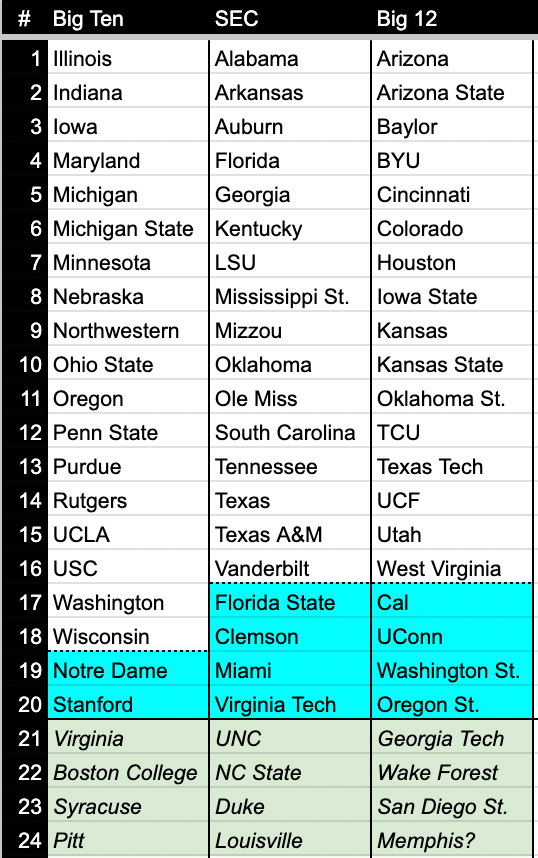
Honestly, I think this happens sooner than later. Within the next 5 years, I think this is what College Football will look like.
College football is changing significantly, and in a very short time at that. It’s normal and natural that a lot of people are reflexively against that change. But the sport is improving. Obviously there are going to be lots of ripple effects that may not be apparent for years to come, but between the 12-team expanded playoff and conference realignment trending towards “Super Conferences”, it’s going to result in a much better product overall.
Additional thoughts a day later:
Additional CFB/Realignment Thoughts
- Seven ACC teams known as the “Magnificent Seven” (FSU, Clemson, Miami, UNC, NC State, UVA, Virginia Tech) are all exploring their options to leave the conference. In other words, if it’s possible they’ll do it. Florida State has just been the most vocal of the bunch.
- The issue with the ACC is that their media rights contract with ESPN, ridiculously, runs until 2036. I don’t think there’s any chance that the conference stays together for another 13 years, and I’d be surprised if they stay together another 3 years quite honestly. The only issue is that the exit fee is extremely steep: $120 million. So what Florida State (and the other six) are doing is having their legal teams review the contract to see if there are any loopholes that would enable them to jump ship early. The “Magnificent Seven” will exhaust all possible options—they want out.
- And where there’s a will, there’s a way. I remember it wasn’t too long ago that the conventional wisdom was that there was no way Texas and Oklahoma could join the SEC before 2026. Well, they found a way and now they will be playing in the SEC one year from now. They each had to pay about $50 million to leave early, which is way less than the $120 million it would cost each ACC team to leave the conference. But still, it goes to show you that you can buy your way out of just about any problem you may be facing.
- Let’s say Florida State can’t find a way out of the contract yet still does leave the ACC, opting to pay the $120 million to do so. If they were somehow able to become full members of the SEC or the Big Ten (which is unlikely), then given that by FSU’s own calculations they are getting $30 million less per year than schools in the SEC and Big Ten, they’d recoup that $120 million in just 4 years. Now, I don’t think it’s likely that they’d be able to become full-fledged members of the SEC or Big Ten right off the bat. I don’t think there’s any chance it happens in the Big Ten, because Oregon and Washington would be outraged given that they will not become full members of the conference until 2030. They would be irate if Florida State got to cut them in line. As for the SEC, I don’t know as much about how it would work there but I’d assume FSU could not just come in and be getting full revenue distribution from day one.
- What I expect to happen, ultimately, is that the Magnificent Seven will come together and put forth an offer to the ACC contract that basically amounts to paying off conference officials to rip up the contract. It won’t be $120 million, but they will make sure that ACC Commissioner Jim Phillips and co. are taken care of in some way. It’ll be a backroom style deal and the details won’t become public for a long time, I’m sure, but it will essentially amount to a massive bribe. Again, money can solve just about any problem you have, and everyone has a price.
- I think Notre Dame is just waiting for the ACC to implode. Notre Dame has a contractual agreement that ties it to the ACC, and they’re a full conference member in basketball already. If Notre Dame decides to join a conference for football, it has to be the ACC, even though the Big Ten is the much better fit. So what I think Notre Dame is waiting on is for Florida State to begin the chain reaction that leads to the dissolution of the ACC, which would then obviously make any contracts Notre Dame has with the ACC totally null and void.
- Having three 24 team super conferences just feels…. wrong. Doesn’t it? I mean come on. The larger you get, the less these conferences actually make sense geographically and culturally. And you’re having to sacrifice more and more of your identity with each new school you add. Of the three 24 team conferences that I’ve outlined here, the only one that still makes sense geographically and culturally is the SEC. If the SEC were to add FSU, Clemson, Miami, VT, UNC, NC State, Duke and Louisville, they’re still not really expanding into new territory other than North Carolina and Virginia, and both states are still considered part of the Southeast. So the Southeastern Conference name would still apply.
- But for the Big 10 and the Big 12, which would each have 24 teams? I mean come on. What is that? That’s just silly. Besides the fact that the names don’t work, there’s just no real regional or geographic cohesiveness to the conferences. The Big Ten would essentially be rooted in the upper midwest, but with “satellites” all the way out on the West Coast and into New England. It would be contiguous essentially from Massachusetts to Nebraska, and you’d have schools as far away as Boston College and USC. How can that really work over the long term? The Big 12 would have both UConn and San Diego State; Georgia Tech and Washington State and everything in between.
- This is why I think the three megaconference model isn’t built to last. Well, at least with the Big Ten and Big 12. The SEC seems way more viable long-term. The only way to operate a bicoastal sports league, which is what both the Big Ten and Big 12 look poised to turn into, is by having division. Think the NFL and the pro sports leagues. Everyone’s part of the same league, but they are all organized by geographical divisions. Every pro sports league is like this. The NFL does not have the Seahawks and the Washington Commanders in the same division, do they? No, of course they don’t. Well, that’s essentially what the Big Ten is doing here: it’s got a school in Seattle (Washington) and a school in the DC Beltway area (Maryland).
- I think the long-term solution for college football, and this is something I see as being 10-15 years down the road, is that the three conferences will eventually merge into one gigantic college football league of 72 teams. Then, from there, they could organize things into geographic divisions, which would all be coherent and logical, designed to preserve regional rivalries and minimize taxing travel. You could have 8 divisions of 9 teams apiece, organized regionally, which would leave you with an 8 game division schedule (because you can’t play yourself) and then 4 out of division games per year. We’d scrap the conference championship games, because now there are not conferences, and then just go straight into what I’d imagine will be a 16-team playoff. You win your division, you get an automatic berth. We maintain the poll ranking system in order to determine seeding for the playoff.
- The remaining 60 or so teams in college football would be part of their own “league” of sorts. It would basically be the Group of Five turning into one megaconference, and they’d still have the opportunity to make it into the playoff somehow, whether through at-large bids or some sort of automatic bid that one or two of those teams could earn.
- Then, I would propose they add in some form of relegation/promotion, which allows for upward mobility for the most successful “G5” teams, and which allows the lowest performing “P5” teams to be dropped if they are not keeping pace. I mean, we can’t have Rutgers going 2-10 every year and staying in the big boy league, can we?
- So the FBS would be split into an upper division (formerly known as Power Five) and a lower division (formerly known as Group of Five). These two divisions would be sub-divided into regional divisions.
- I think this is how it has to be done, ultimately. People hate the idea of turning college football into an “NFL style” league but if you think about it, this is the best way to preserve traditional rivalries.
- What would the incentive be for the schools and conferences in this sort of arrangement? Far greater negotiation leverage, which would equal more money. Imagine, instead of the SEC negotiating with ESPN over a TV contract, and saying, “If you want to be able to air Alabama and Georgia games on your network, this is the price.” Instead of that, with one giant megaconference/league, it’s the SEC, the Big Ten and the Big 12 having the combined power to say to ESPN, “If you want to have big time college football on your network at all, you have to pay us what we want. If you want Alabama, Georgia, Ohio State, Michigan, Texas, USC, Oklahoma, Clemson, Notre Dame, etc., then you pay us what we want.” And if ESPN doesn’t pay up, then they can have fun airing SMU vs. Coastal Carolina on Saturday night primetime.
- Instead of three major TV contracts (one for the Big Ten, one for the SEC, one for the Big 12), there is just one. The scarcity will create a bidding war between all the major players (Disney/ESPN/ABC, NBC, CBS, Fox, Apple TV, Amazon Prime, etc.) Right now, it’s in a place where if you miss out on one of the conferences, you can still get another. Like, for example, CBS lost the SEC, but they picked up the Big Ten, so they’re still fine. Not the case with the mega-league. If CBS isn’t willing to pay the asking price, then they’re out of luck—they’ve got no college football now. I’d imagine the mega league would reach an NFL-style contract with all the different networks—you know how the NFL airs its games on NBC, Fox, CBS, ESPN, Amazon Prime as well as its own NFL Network.
- How would the revenue distribution work? It could not be equal. You could not have Rutgers getting the same annual payout as Alabama. That just wouldn’t fly. The pie would have to be divided up based on how many viewers each individual program actually brings to the table in order to keep the big boys happy. In other words, the Alabamas and Georgias and Ohio States are going to get the largest slices of the pie, while the Rutgers and Vanderbilts will get the smallest slices. This is something that would have to be worked out, and it’s probably the single greatest obstacle toward an arrangement like this because if you have a large number of schools that will be pulling in less money per year under the mega-league arrangement than they did under the 3 super conference arrangement, they will never go for it. The vast majority of programs would have to see a financial incentive in moving to this type of system. I think that would be possible, if not likely, when you factor in the greater leverage in negotiating these TV contracts but of course I have no way of knowing that for sure.
- Right now it appears the total value of the Big Ten, SEC and Big 12’s TV contracts total around $16 billion. The Big Ten is on a 7 year, $7 billion deal, the SEC is on a 10 year, $3 billion deal, and the Big 12 is on a 6 year, $2.3 billion deal. Annually, it comes out to about $1.68 billion combined ($1 billion for the Big Ten, $300 million for the SEC, $380 million for the Big 12). But these figures are not yet complete as the word now is that the Big 10 is talks with ESPN on a late night package to accommodate their four new west coast teams. So the Big Ten is now poised to have its teams playing on ESPN in addition to Fox, CBS and NBC. That will add even more money to the Big Ten’s pie, most of which will probably go towards the West Coast schools to bring them closer to the “full Big Ten member” annual distribution payout.
- Anyway, if the current value of big time college football’s annual TV contracts is in the ballpark of $1.7 billion, and probably a bit more than that, then a “mega-league” TV contract would have to be more than that. If they could get the number over $2 billion a year, which I think is very likely, or even in the $2.5 billion range, then it would seem to be advantageous for everyone.
- And that’s what I think the bottom line is: if the conferences banded together, I think they could make more money than they make on their own. There is strength in numbers, and there is strength in collective action. What a merger of the Big Ten, SEC and Big 12 would represent is, essentially, a college football monopoly that has vastly greater pricing power. They’d be able to name their price, and the TV networks would have no choice but to pay it. This is in part why the NFL, NBA, MLB and NHL make so much money: there is no alternative to them. The NBA enters into negotiations as the one and only source for professional basketball, which means that they have a great deal of leverage over the networks. The NFL tells the television networks, “If you want to air professional football, then this is what it costs.” And the networks say, “Alrighty then. Sounds like a plan.” This is what college football needs to aim for in the long run: solidarity.
- Will this happen anytime soon? That’s the tough part. I don’t think we see anything like this happen for at least a decade, even though it does make the most sense. It is a radical and watershed change for the sport, and one of the biggest and thorniest issues will be, simply: who gets to be in charge of the whole thing? Who’s going to be the commissioner? Will it be Greg Sankey from the SEC? Tony Petitti from the Big Ten? Brett Yormark from the Big 12? Will it be a rotating commissionership?
- There are simply way too many stakeholders and decisionmakers here for this to be something that could come together in the near future. You’ve got 72 schools, meaning 72 presidents, plus 72 more athletic directors, plus each school has its own board of regents, then there’s the conferences themselves that will be seeking to preserve their own existence, plus you’re talking about multiple, multi-billion dollar TV contracts that would have to be ripped up–it would be a monumental undertaking to bring everyone under one umbrella. However, I think it’s the only real long term option for the sport.
 Fade the Public