

Several undefeated teams went down: Oregon, Louisville and USC.
The following undefeated teams remain: Georgia, Michigan, Ohio State, Florida State, Washington, Oklahoma, Penn State, North Carolina, Air Force, Liberty and James Madison. That’s 11 teams, and the number will be down to at least 10 after Saturday as Ohio State and Penn State square off and somebody has to lose.
Florida State also plays Duke, and while I think FSU wins, I think it’ll be an interesting game. My power ratings have Florida State favored by about 10 at home.
Quick hits:
- Stanford #13 is a monster. I stayed up on Friday and watched that whole Colorado-Stanford game, and oh man was that dude cooking Travis Hunter. Elic Ayomanor is his name–he’s a sophomore from Canada. Dude definitely put himself on the map with that game. 100% chance USC comes after him hard in the transfer portal after the season.
- Speaking of USC, I thought USC was going to get exposed against Notre Dame, but I didn’t think their offense would get exposed. I thought it would be their defense getting exposed, but it was the opposite. Their defense actually held up pretty well when you consider how many times their offense turned the ball over in their own territory giving Notre Dame a short field. You can’t really hold those scoring drives against the USC defense. The USC defense played better than the USC offense, honestly.
- In the first half of the Bama game, I thought we were seeing Jalen Milroe become a legit passer before our eyes. He was 5/7 for like 200 yards and 2 TDs. He was unreal. But then the rest of the game happened. Bama is still deeply flawed on offense.
- Arkansas is the best 5-loss team in the country. Seriously.
- Just going to throw this potential unpopular opinion in here because I don’t really have enough new unpopular opinions to warrant a whole section for them: Lincoln Riley should be an offensive coordinator. Could you imagine him at Bama?
Updated Power Ratings & Gambling Picks
Oregon moves up to #1 in the country, leapfrogging Oklahoma. But Oregon lost! Yes, but they were statistically dominant and the ratings don’t care about record.
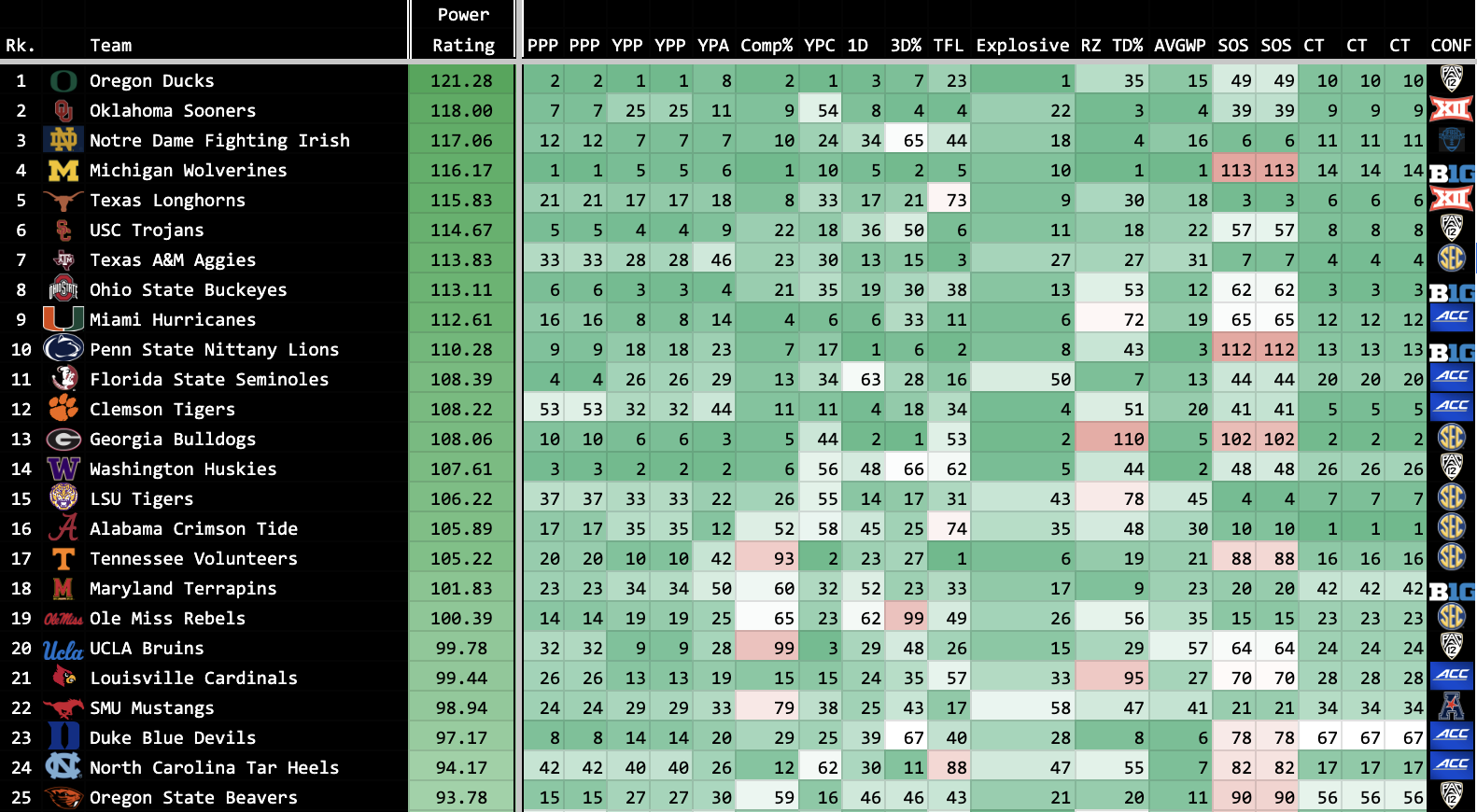
There you have it.
Now for the gambling picks for this week, which are based off the power ratings:
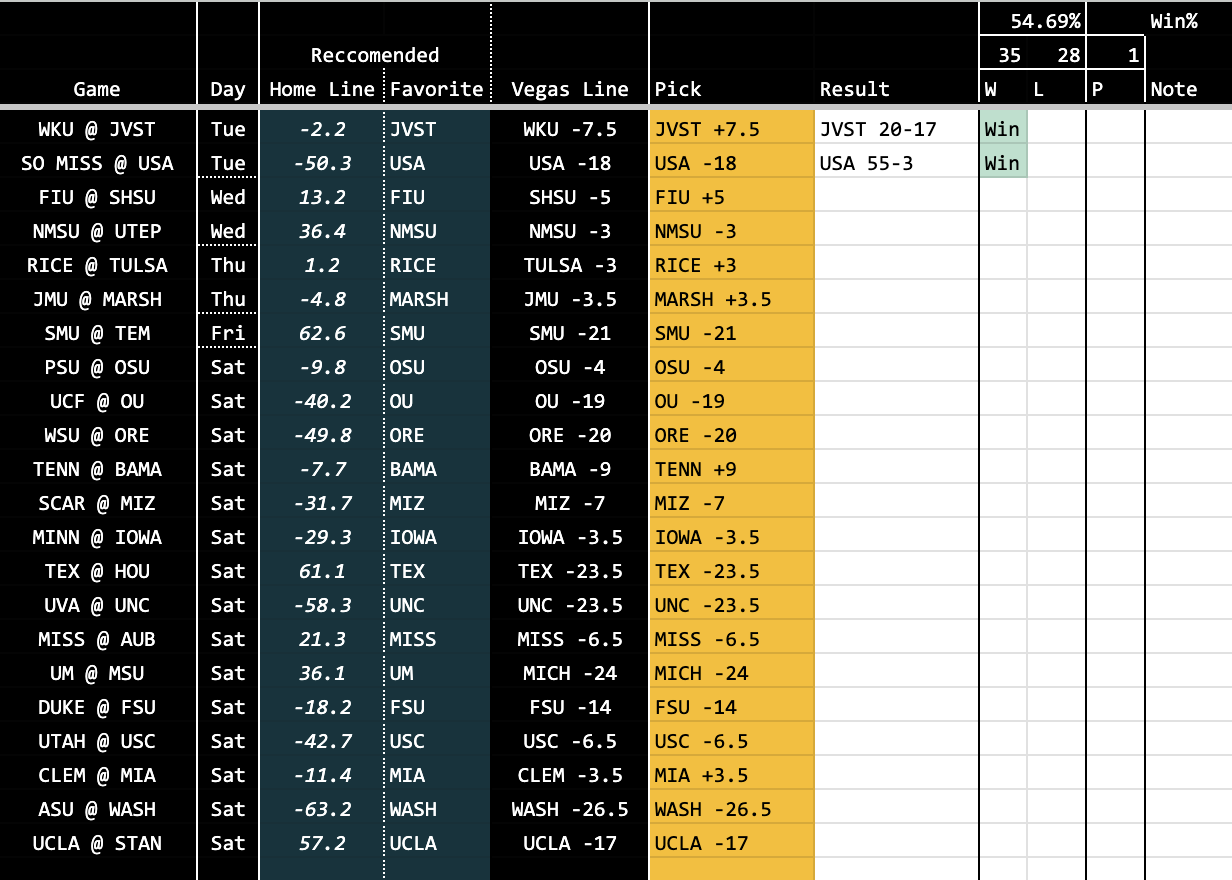
I’ve picked 64 games thus far and have a record of 35-28, about a 54.7% win clip. That’s pretty close to what you’re looking for to be profitable in sports betting, although I’d like to get that number closer to 56% to really feel good about it. You need to win 52% of your bets to break even, assuming you bet the same on every game and get -110 odds every time.
If you exclude the Miami-UNC game, which in view was a “stay away” game because I was unsure how mentally screwed up Miami would be after that Georgia Tech game, I’m sitting at about 55.6% on the season. And if FIU holds on and covers this +5 against Sam Houston (it’s 10-7 FIU right now), that would put me over 56%.
My pick of Colorado -11.5 was looking GREAT until they choked away a 29-0 lead. But that’s college football–and gambling–for you.
Honestly, what’s holding me back the most is these screwy weeknight games on Tuesday, Wednesday, Thursday and Friday. If you exclude all of those over the past few weeks, my win rate goes up to 62%. So maybe I should only make picks for Saturday games…
All Eyes on Brock Bowers
Georgia beat Vanderbilt on the road 37-20 this weekend, but the main story to come out of this game is that superstar tight end Brock Bowers suffered a high ankle sprain and will be out 4-6 weeks.
I was not concerned about Georgia’s sluggish performance against Vandy. Last week I went over how I think Georgia’s flat performances this year are mainly a function of them simply not being a “Tryhard” team because we saw them at their best against Kentucky.
But once I heard Brock Bowers would be out 4-6 weeks, with lots of people speculating that he will probably just shut it down and prepare for the draft, that’s when I became concerned about Georgia. That’s a real issue for them because he’s their best offensive player–and maybe the best player on the whole team. He’s the best tight end in the country, a surefire first round pick, was probably going to win the Mackey Award for the second straight year–he’s a stud, we all know that.
I’m not convinced he’ll shut it down for the year. Some people who follow Georgia closely think he will, and I would tend to defer to them, but I think if they have a chance to three-peat, he will want to be there for that. His draft stock is secure no matter what, but if he’s a true competitor–which I think he is–then he will not pass up the chance to three-peat.
But more to the point, the surgery he’s undergoing–dubbed “tightrope surgery”–leads me to believe he is aiming to come back. Because that’s the whole purpose of tightrope surgery–to accelerate the recovery process and get you back on the playing field quicker. Tua had it in 2019 when he was at Bama and returned in 3 weeks. Now of course Tua played quarterback and Bowers plays tight end, a position that obviously puts way more strain and torque on the ankle, but the reason Tua got the surgery is so he could return quicker than usual. I think Bowers took this option as the only way he could possibly return by the SEC Championship.
And that’s really the only realistic scenario here. December 2, 2023: that’s the target date for return if my speculation is correct. He actually had the surgery done today, Monday October 16 (it takes me a few days to write these posts), and so a 4-6 week return timetable would put us right around early December. You’re looking at 47 days which is just under 7 weeks.
I believe a typical high ankle sprain without this surgery carries a 4-8 week recovery period, but from what I’ve seen in the NFL, 4 weeks is usually overly optimistic in most cases. I know ankle sprains can vary in severity, but from what I’ve seen in the NFL, when a guy gets a high ankle sprain, expect 6-8 weeks. 4 weeks ain’t happening.
So that’s where tightrope surgery comes in. Apparently it makes 4-6 weeks a very real possibility. I still seriously doubt 4 weeks will happen for Bowers as an offensive skill player who plants and cuts and has to put extra strain on it through his work as a blocker. To me, 6 weeks is probably the best case scenario which would mean the SEC Championship game is a possibility.
However, the schedule between now and then gets pretty dicey. It didn’t seem that way coming into the season, but after this upcoming bye week things really start to heat up for Georgia. They’ve got the annual rivalry game with Florida in Jacksonville on the 28th. And Florida is probably not good enough to beat Georgia but they’re not as horrible as they looked to start the season. They’re not a bad team. They’re definitely flawed, but they’re not bad.
Then Georgia hosts ranked Mizzou. I’m not sure if they’ll be ranked three weeks from now when they go to Athens, but they are ranked 20th right now.
A week after that Ole Miss pays a visit. They’re currently ranked 13. I don’t think Ole Miss can beat Georgia but it’s not going to be some walk in the park. Ole Miss has a good offense.
The toughest test of the season comes November 18 when Georgia has to travel to Tennessee. That’s the one game they’re really going to miss Bowers because Tennessee actually, surprisingly, plays defense now. They’re suddenly a defense and running team (although if you actually look at their numbers from last year they were pretty stout against the run and they ran it more than they threw it even with Hooker and Hyatt). I won’t confuse Tennessee with a top-10 team, they’re probably more like a top-20 team, which is exactly what Ole Miss is as well. But it’s no guarantee that Georgia just rolls them. Georgia will be favored but it’s going to be a game.
It’s nice that Georgia will get 2 of those 4 upcoming games either at home or at a neutral site, and only the Tennessee game is on the road. So that certainly helps.
But after Tennessee it’s Georgia Tech. Just kneel the ball when you have a late lead and you should be fine against them—that’s the secret to beating Georgia Tech, you know.
So essentially Georgia has to face the toughest part of their schedule without Bowers. Couldn’t have been worse timing but no one plans these things. They just happen.
Look, a program like Georgia is going to have studs followed up by more studs on the depth chart. That’s what separates the super elite programs from the others—the super elite programs have that depth that helps them withstand injuries better.
You can’t replace a guy like Bowers because he’s a special, borderline generational player. Like sure, Georgia has highly-rated tight ends on the depth chart behind him (Oscar Delp, etc.) that will step in to try to fill the void of his absence, but there’s really no replacing a player like that. He’s 1 of 1 in college football. Like there’s great 5-star players who turn into studs, and then there’s guys even above them who are better than studs—they’re special, irreplaceable 1 of 1 guys. Brock Bowers and Marvin Harrison Jr. come to mind. Guys who can take over a game by themselves and single-handedly shift the outcome.
You know what I mean? There’s good, there’s great, and then there’s special. Georgia has a lot of good and great players on their roster. But special players are incredibly rare. Obviously the teams like Bama, Georgia and Ohio State that recruit the best give themselves the best chance of landing the special players, but it’s often unpredictable. Most 5-star guys don’t even turn into special players. Marvin Harrison Jr. was actually a 4-star recruit, believe it or not. Bowers was not a 5-star recruit either, he was a 4-star and rated as the second best tight end in the 2021 recruiting class behind a guy named Thomas Fidone who went to Nebraska (he’s still there I just had never heard of him really.)
You just can’t know for sure which guy is going to become a special player. You can only give yourself the best chance of finding one by recruiting as many 4 and 5 star guys as you possibly can.
Anyway, I tend to get off track but the takeaway here is that it’s impossible to fully replace Brock Bowers. Georgia is going to notice his absence, for sure. It just means everybody else on the team has to step up now. You don’t replace Brock Bowers by hoping and praying Oscar Delp is as good as Brock Bowers. You have to make up the difference everywhere else–the quarterback has to play better, the running backs have to play better, the offensive line has to play better, the wide receivers have to play better, the defense has to play better, the special teams has to play better. It’s the only way you can replace an irreplaceable player.
The schedule isn’t favorable for Georgia–Bowers got hurt as they were heading into the most difficult stretch of games. But you can’t control it; it is what it is. You have to keep moving regardless.
I’ll get into this more later in another section, but if any program in the country is uniquely equipped to handle the loss of a player like Brock Bowers, it’s Georgia. The biggest difference between Bama, Georgia and Ohio State–the top three rosters in the country by a wide margin–and everyone else, including even programs like Texas, Oklahoma, Oregon, Michigan and Penn State, is the depth that such elite recruiting affords.
Georgia still was able to repeat as National Champions despite a slew of injuries last year–AD Mitchell missed 9 games, their best pass rusher Nolan Smith tore his pec in like October and missed the rest of the season, Jalen Carter missed four games. They still went 15-0. And in 2021, Georgia basically was without George Pickens for the whole season–still won the Natty.
Injuries are going to happen to everybody. But only a select few teams have the depth to overcome those injuries and not allow those injuries to ruin the season.
We’ll see what Georgia is really made of. I definitely think they’re done with the whole sleepwalking through most of their games thing they’ve been doing to this point in the season–Kirby is not going to allow that now.
And again–I think Bowers will try to come back. I know the consensus seems to be that he’s going to shut it down and just focus on the draft, but I think his goal is to come back.
He wouldn’t have gotten that tightrope surgery–which expedites your recovery time–if his goal was not to make it back for the SEC Championship.
What’s interesting is that all the sudden, Bama is now in prime position to win the SEC. I left them for dead after the Texas game, but things are looking up for them more and more with each passing week. Georgia is still listed as the favorite to win the SEC even after the Bowers injury (maybe Vegas thinks he returns in time for Atlanta?), but if Bama beats Tennessee this weekend, watch out…
Washington 36, Oregon 33
Michael Penix Jr. is your Heisman front-runner, folks. And with the way Caleb Williams and USC went down in flame in South Bend a few hours after that Oregon-Washington game concluded, it is definitely MPJ’s Heisman to lose. Plus, they just passed the toughest test of their season, too. I’m not going to say it’s smooth sailing from here on out–in the month of November they have at USC, Utah, at Oregon State and Washington State. Going 12-0 is no guarantee, but Washington controls their own destiny.
That scene though, after the game–crowd storming the field, Purple Rain playing in the background, Penix with tears in his eyes after such an emotional win. What a moment. Herbstreit was calling the game and surveying the scene, and he said something to the effect of, “Look, I call Thursday night games for the NFL and the NFL is great, but only college football gives you this.” And it’s true. There’s just nothing like college football. I don’t want to say the NFL is soulless, but it definitely doesn’t have anywhere near the soul college football does.
In fact, after the game, Kirk Herbstreit, maybe he was a little caught up in the moment, but he said that this year’s Washington squad reminds him a little of the 2019 LSU squad. That was a head-turning comment in my book, because Herbstreit doesn’t normally say stuff like that. He’s not a guy who is prone to hyperbole and grandiose, sweeping statements. For him to compare a team to 2019 LSU is very interesting to me, especially because I consider 2019 LSU to be the best college football team ever–at least the best I’ve ever seen–and right there with the 2001 Miami Hurricanes. And Herbie called a lot of their games–he knows better than just about anybody who wasn’t actually on the field that year how good 2019 LSU was.
When you dig a little deeper into the comparisons between Washington and LSU, it gets kind of freaky. Both teams have second-year transfer quarterbacks that came from the Big Ten, somewhat late bloomers, although if you watched Michael Penix at Indiana in 2020 you know he’s always been a dude. Both Penix and Burrow emerged as Heisman front runners without really that much preseason hype. Both of those quarterbacks wear #9. They both have elite wide receivers that were #1 as their go-to targets–Ja’Marr Chase at LSU, Rome Odunze at Washington. Joe Burrow really captured the hearts of Americans when he gave that wonderful speech during the Heisman ceremony. Penix I’m sure has become a fan favorite for his postgame interview following the Oregon game.
Another big similarity: 2019 LSU really put themselves on the map nationally when they went to Bama and won that 2 vs. 3 matchup in early November. Washington similarly made themselves a household name in this game against Oregon.
The overarching comparison that I think Herbie was making, though, is that this Washington squad has the potential to be one of those generational offenses that we talk about for years to come, and that we measure every other team up against. Like, “Yeah, they’re good, but they’re no 2019 LSU.”
Washington does feel like a special team, almost a team of destiny feel to them like 2019 LSU had, and their passing attack is so good that at times it feels like defenses are simply powerless to stop it. Penix is such a precision passer (as was Burrow), and Odunze is such a good receiver that even if you play perfect defense, they can still beat you. 2019 LSU was making even really good SEC defenses look silly, and similarly, Oregon has a really good defense this year, they just couldn’t do anything about that Penix-Odunze connection. And they won’t be the last team to find themselves in that situation.
It’s an interesting comparison, for sure, but I don’t think I’m willing to go there. 2019 LSU played in the SEC, and while the Pac 12 is the best it’s been in years this season, it ain’t the SEC. Additionally, Joe Burrow not only had Ja’Marr Chase, he had Justin Jefferson as well. Washington doesn’t have a Justin Jefferson opposite Rome Odunze. I also think that while 2019 LSU wasn’t elite on defense, they definitely had more NFL dudes on their defense than this Washington team does. LSU in general recruits at a higher level than Washington does, and that’s the real reason 2019 LSU won a Natty: they sent 15 guys to the NFL draft the following spring. That was an absolutely loaded-up roster, and Washington’s roster is not on that level.
So I don’t really buy this year’s Washington team as the next 2019 LSU, although they have been a great story and more importantly a great team. I think they can make the playoff, for sure, and in a wide-open year like this I’m not going to rule them out as a National Championship contender–but I’m definitely not putting any money down on them to win it.
The main thing people are talking about from this game, though, is Dan Lanning’s decision to go for it on fourth down three times, and all three times his team turned the ball over on downs.
Statistically, Oregon dominated this game. 31 first downs to 24, 541 yards to 415 for Washington, zero INTs thrown to Washington’s 1, 204 rushing yards to 99 for Washington (5.1ypc to 4.3), over 34 minutes time of possession in the game–they played more than well enough to win.
Except for those three failed fourth down attempts.
And this is what I want to focus on. I cannot stand how all these coaches are going crazy with the 4th down attempts. Look, I get it– “Analytics”. “The chart said to go for it.” “Be aggressive.”
How about “Score more points than the other team”?
Going for it on 4th down late is not the decision I have an issue with. You’re winning 33-29, and if you get a first down you essentially win the game–it’s only three yards, so go for it and don’t let Penix step foot on the field again. Lanning knew that if they punted away the ball, Michael Penix was going to go down the field and score, whether it’s a 55 yard drive or an 85 yard drive. In that situation, I didn’t think punting would’ve made much of a difference. Three yards to win the game, I have no issue with going for it there. Lanning ultimately made that decision out of respect for Michael Penix (or fear, some would say). No coach wants to be standing there powerless on the sideline as a Heisman-level quarterback just carves up his defense.
So I’m fine with Lanning going for the win on that 4th down late in the game. I think that even if Oregon had punted it away and pinned Washington deep, Penix was still marching his team down the field for a TD.
What I do have an issue with is coaches who are seemingly allergic to kicking field goals. Going for it on 4th down instead of taking points almost cost Ohio State the game against Notre Dame, and now it did cost Oregon this game and possibly a chance to make the playoff.
The first time Lanning went for it on 4th was at the end of the first quarter, they had the ball on the Washington 2 yard line with one final play left. It was either kick the field goal and go to half or run a 4th down play and go to half. Oregon went for it and didn’t get it. They were down 22-18, would’ve made it 22-21.
To me, there’s value in being down 1 at halftime vs. being down 4. You’d be at a place where another field goal gets you the lead.
Instead they came away with zero points on that drive and probably lost some morale and momentum going into halftime.
You have to come away with points on your red zone trips. I know coaches want touchdowns, but to me this is just greediness rather than aggression. Pigs get slaughtered.
Think about it: you’re at the end of the first half and the score is 22-18. You know it’s probably going to be a close game where every point counts. The Vegas line was 3 points. You have to take that stuff into account: take points when you can get them, for goodness sake.
The only reason you pass up a field goal and go for a touchdown is if you are afraid your team won’t be able to keep pace, but I know Dan Lanning didn’t feel that way about his team. They were the #1 team in the nation in net yards per play. The other reason is that you are so confident in your team that you feel like you will win even if you don’t get any points on that possession. If that was Lanning’s mindset, I don’t know where he got that idea as the game was close for the whole first half.
I feel like coaches are blinded by the idea of “It would be awesome if we got a touchdown here” and don’t think enough about, “What if we come away from this drive with zero points?”
Again, I think it’s greediness. It’s like someone buying a risky stock–they will always think, “Could you imagine if this thing goes up 1000%?” rather than “What if this thing goes down 60%?”
You have to think of the downside risk. You can’t just only think of the upside.
Coaches think of it as “I’d rather have 7 points than 3 points,” but they should really be thinking of it as, “I’d rather have 3 points than 0 points.”
The next time Oregon went for it on 4th down was a bit more forgivable. It was late in the third quarter, they were on the Washington 8 yard line, but this time they were down 29-18. So I understand going for it here, because Lanning may have felt like Washington was starting to pull away, but this is one of those situations where your previous decision not to take the points started to snowball on you. You were down 29-18 instead of 29-21 specifically because you didn’t take the points at the end of the first half.
So if you’re down 29-21 instead of 29-18, it’s more palatable to kick the field goal and cut it to 29-24. It’s only the third quarter at that point–you are not in desperate need of points. You have plenty of time.
But even still, 29-21 is much better than 29-18. It’s a one possession game as opposed to two. If it’s a two possession game and you can cut it to a one possession game, you have to do it. Maybe Lanning wasn’t trusting his defense at that moment, I’m not sure. I can’t really say because I was not on that sideline. But clearly his defense was able to clamp down and keep the game close, giving the Oregon offense the chance to retake the lead, which they eventually did later in the 4th quarter.
The bottom line is that if you feel like it’s going to be a close game, you have to take all the points you can get whenever you can get them.
If you are afraid of getting left in the dust, and you think kicking a field goal is useless, then I get it. If you feel it’s one of those games where you need to score 45-50 points in order to have a chance to win, then by all means be ultra aggressive. But I feel like that’s only really the case in games where the talent difference is lopsided. Like if Ole Miss is playing Georgia and they know they’re probably not going to be able to get many stops on Georgia’s offense, Ole Miss has to be ultra aggressive because taking 3 points is essentially like taking 0 points if the other team is going to be getting 7 consistently.
But this was not the case in the Oregon-Washington game. That doesn’t even really apply here. Oregon actually had the more talented roster, and in my opinion the more complete team. They were not at risk of getting left in the dust. They were not going to need 50 points to win that game.
And if they did, nobody would be criticizing Lanning for kicking field goals earlier in the game when it was close. They’d be ripping him for how bad his defense was. People wouldn’t be saying, “If only we hadn’t kicked those field goals!” They’d be saying, “How did this supposed defensive genius coach let up 50 points?”
When you believe you need 45-50 points to win a game, it’s not being greedy to go for it on 4th down in the red zone–that’s just sticking to your game plan.
When you don’t feel like you’ll need 45-50 points to win a game and you’re still going for it on 4th down in the red zone, then, to me, that’s just being greedy.
I just wish more coaches would ask themselves, “Would I rather have 3 points or 0 points?” instead of asking themselves “Would I rather have 7 points or 3 points?”
Oregon passed up 2 easy field goals in a game they ultimately lost by 3 points. Obviously those decisions by Lanning are going to be second-guessed in hindsight, but the point I’m making here is that I was second-guessing them in the moment. I was first guessing them because I feel very strongly about this subject. I’m the kind of guy that starts yelling “What are you doing?!?!” at the TV in moments like that. It’s like I’m watching a horror movie and I’m yelling, “No, don’t go down into the dark basement, that’s where the killer is!!” as the character walks down into the dark basement and gets killed. That’s what it felt like watching Oregon pass up those field goals. I could see them walking into disaster.
Scoring points is a good thing.
3 points is better than 0 points.
Pigs get slaughtered.
More coaches need to take that to heart.
We can’t say for certain whether Oregon would’ve won this game had they kicked those two field goals, because you don’t know how having 6 additional points would’ve changed their play calling and decision making going forward, and Washington’s as well. A football game is like 50 different forks in the road that all lead to other forks in the road, which in turn all lead to other forks in the road, so you can’t just assume the game would play out exactly the way it did just with Oregon having 6 more points.
But it sure would have been nice to have those 6 points in a game you lost by 3. The bottom line is that it was a very close game, and you need all the points you can get.
Alright, I think I’ve made my point here.
My overall view on this game, though, is that I still think Oregon was probably the better team, they just made some poor coaching and game-management decisions. And even then, it still came down to a missed field goal that would’ve forced overtime.
My latest power ratings have Oregon actually up one spot, and they are now my top team in the nation. I don’t take wins and losses into account in the ratings, only the stats you put up. The ratings are not intended to predict a specific game, because the games themselves are often fluky and unpredictable, but rather to quantify how much better one team is than another. It’s basically a way to determine who would win the majority of the time if the teams played 10 games in a row at a neutral site.
The reason Oregon improved in the rankings even after losing is because, like we went over above, Oregon kind of dominated the game statistically–they just weren’t able to convert their yards advantage into points. They outgained Washington by 126 yards, had 7 more first downs, converted third downs at a higher clip, ran the ball better and even won the turnover battle. The difference is that they were 0/3 on 4th down while Washington was 2/3. If you’re statistically dominant in a loss, you’re going to move up in the ratings.
I don’t view Oregon as a significantly better team than Washington, though. The power ratings do, but I personally don’t. I think they’re slightly better, and if the game was played in Eugene, they probably would’ve won. I’d also take Oregon at a neutral site.
Fortunately, we might get to see that game in the Pac-12 Championship in early December.
Michigan 52, Indiana 7
Indiana had their fun early in the game with that trick play that went for a touchdown. The Big House may have been quieted a little bit, and maybe even for most of the first half. But we all knew Indiana was not going to be able to win that game.
Joel Klatt refers to Michigan as a “boa constrictor” meaning they’re a team that doesn’t avalanche you and destroy you quickly, rather they slowly choke the life out of you–like a boa constrictor gradually coiling itself around you. It’s kind of close at first, and you might think you’re in the game going into halftime but they just keep chipping away and by the end of the game, you look up and you’ve lost by 3-4 touchdowns (in this case Indiana lost by 45).
It never really looks like a blowout until the end, even though you’re being dominated.
Michigan is not really a quick-strike offense. They’re not a “shock and awe” type of team where you’re like, “Whoa, we’re down 21-0 at the end of the first quarter. What just happened?” You might even be tied with them at the end of the first quarter. But this is because Michigan operates on long, methodical drives. Most of their scoring drives were 10+ play drives, although once they started to wear Indiana down, they were putting together some quicker drives. This is why they don’t “avalanche” opponents, though. They’re not a quick-scoring team. They hit you with 4 yards, then 6 yards, then 3 yards, then 7 yards, etc. all the way down the field and eventually they’re knocking on the door and they punch it in.
Here’s the thing: this doesn’t move me. I still don’t take them seriously as a National Championship contender, and I’ll tell you why: because Michigan can’t do that to great teams. And the boa constrictor analogy is fitting here because boa constrictors prey on smaller, weaker animals. They don’t bother panthers and tigers and other apex predators of the jungle.
Michigan can “boa constrict” teams like Indiana and Minnesota and Rutgers (although Rutgers isn’t half bad this year, in fairness). They can do it to teams that they have a massive talent advantage over. They can bully those teams. But what happens when they run into a team that they can’t push around at the line? What happens when they run into Georgia, or some other team that is as talented or more talented than they are? They can’t do shit.
Michigan is not going to be able to get 5-7 drives of 10+ plays against Georgia. It’s just not happening. They’re not going to dominate Georgia up front–nor are they going to dominate the line of scrimmage against a team like Texas, Oklahoma or even Florida State, whose defense I don’t trust but who has equal talent to Michigan and won’t just get pushed around.
And another reason Michigan’s style of play doesn’t translate against great teams: Michigan is built to win in the Big Ten, where very few teams are actually capable of throwing the ball. If you can stop the run in the Big Ten, most teams have no other way of beating you. They’re cooked. The Big Ten is a running-oriented conference. Michigan knows if they just shut down the run, the teams they play don’t have a plan B.
You look at all the teams Michigan has played this year and where they rank in pass yards per game:
- East Carolina: 173.2 pass YPG (116th in the country)
- UNLV: 193.2 pass YPG (107th)
- Bowling Green: 163.6 pass YPG (120th)
- Rutgers: 164.0 pass YPG (119th)
- Nebraska: 141.8 pass YPG (128th)
- Minnesota: 132.8 pass YPG (130th)
- Indiana: 210.0 pass YPG (93rd)
Indiana was the best passing team Michigan has played this season, and they rank 93rd in pass yards per game. That is just pitiful.
Not one team Michigan has played this year is built in a way that makes it conducive to beating them.
You know what Michigan is?
They’re the ultimate Big Ten team. They themselves are only 70th in the nation in pass yards per game with 231.7. They are simply a very good version of the teams they beat down on a weekly basis. Like, if Rutgers had better talent, they’d be Michigan. If Michigan had less talent, they’d be Rutgers. They have the same type of philosophy: play strong defense up front, run the ball, control the clock.
Most of the Big Ten is like this. It’s a very old school conference–it’s reminiscent of how football was played up until about the mid-2000s. The only teams that aren’t like this are basically just Maryland and Ohio State. Other than them, pretty much everyone in the Big Ten has a run-first philosophy.
But more to the point, they’re not competent at passing the ball. In other words, most teams in the Big Ten don’t run the ball by choice, they run out of necessity–they just don’t have the quarterbacks and skill players to be able to throw consistently. Michigan is at least somewhat competent at throwing, I will give them that.
But they’re not competent enough to beat a team that is capable of taking away the run game, and whose run game Michigan cannot just stonewall.
When they meet a team that can stop the run and with an offensive line that can push Michigan’s defensive line off the ball, they get destroyed. See the playoff game against Georgia in 2021: Michigan’s vaunted run game that ran all over Ohio State was held to 91 rush yards on 27 carries. And Georgia was able to run for 190 yards on 35 carries, 5.4 yards per. What happens is Michigan’s offense completely stalls out–it’s a bunch of three and outs as they fall further and further behind.
“But they didn’t have JJ McCarthy back in 2021! They didn’t have a Generational Quarterback™! JJ McCarthy changes everything! He makes Michigan unstoppable!”
I know JJ McCarthy is the greatest quarterback in the history of football. He’s a combination of Tom Brady, Patrick Mahomes and Peyton Manning but 100x better. I get it.
Except, he isn’t. He puts up all his numbers against stacked boxes when the defenses are already fully committed to the run. It’s like 3-4 straight runs, then play action pass and McCarthy will complete it to his first read. They do not ask him to drop back in the pocket and pick defenses apart. Almost all of his passing plays are first-read throws to guys who are wide open either off of play action or just because the defense has the box stacked. This is why I think it’s utter insanity that some NFL mock drafts have him going in the first round. The only real traits he shows that would make NFL teams interested are escapability and the occasional off-platform throw on the move, but doing that stuff in the NFL is a much different beast and I don’t think he’s athletic enough for it.
He is not capable of throwing them to victory against a great team. He’s never done it. The one game in his career where he actually had to–the playoff game against TCU–he failed miserably, throwing two pick-sixes. And that was against a complete swiss cheese Big 12 defense that lost 65-7 to Georgia. But that’s what happens when you ask JJ McCarthy to be a real quarterback: he can’t do it. If it’s not served up to him on a silver platter, he can’t make the throws. The first pick six he had was because he just can’t throw a sideline out route. He underthrew the receiver and the DB easily jumped the route and took it to the house.
If JJ McCarthy was as great as Michigan fans say he is, then why is Michigan still such a heavily run-oriented team? They throw it 23 times a game on average, 126th in the country and about even with Iowa. Why don’t they let him just air it out and show how amazing he is? It’s not just because they’re great at running the ball. Oregon runs the ball even better than Michigan does and they still let Bo Nix air it out and show his arm talent.
If you have a great quarterback, you will let him go wild even against bad teams. You’ll let him put up numbers and make his case for the Heisman. When Washington plays cupcake teams, they still let Penix go out there and throw 350 yards and 3 TDs and then pull him out in the third quarter. They don’t just limit him to 17 pass attempts and stick to the run game. They let him be great.
Michigan fans insist that McCarthy is on that level, but their offensive game plan and play calling suggest otherwise. Michigan fans always tout McCarthy’s completion percentage, because that’s the only stat he’s actually elite in. In terms of yards and touchdowns, he does not come close to the best guys.
Michigan can only win one way, and their coaching staff knows it. They can’t just go out there and ask JJ to throw it for 350 yards and 3 TDs through three quarters and then pull the starters. They have to run, run, run, run, run for three quarters straight until the other team’s dam breaks. That’s it.
Actually, Michigan did try to showcase JJ in one game this season. It was against Bowling Green. And he threw three interceptions. It should’ve been four but the DB bobbled the ball and it went right to the Michigan receiver who ran it in for a touchdown. After the INTs, Michigan stopped throwing. They finished the game with 13 total pass attempts. Whenever Michigan actually takes the training wheels off of JJ, he makes bad decisions and bad throws and gets picked off. Frequently. I’m telling you, he is nowhere near as good as people say he is. He is totally propped up by the run game and needs play action to function.
What about the Ohio State game last year? Okay, fine. Let’s talk about that game. I cannot emphasize enough how wrong most people are about that game. You look at the box score and it looks like Michigan dominated, but really, outside of 5 plays, they were getting dominated. It sounds crazy to say about a game they won 45-23, but quite literally it was 5 plays that made the difference between Michigan winning 45-23 and losing by 2-3 touchdowns. Outside of those 5 plays, Michigan had nothing going on offense. Nothing.
Michigan had 349 yards on their 5 long touchdown plays. They had 515 yards of offense in the game, so on their 55 other plays, they produced a total of 166 yards, or 3.02 yards per play.
JJ McCarthy–the GREAT JJ McCarthy–had 263 passing yards, 12/24. 189 yards of those 263 came on 3 plays, all of which went for touchdowns. And those three long touchdowns were terrible coverage busts by the Ohio State secondary. It was more about Ohio State’s secondary just screwing up.
Now, in fairness, Ohio State was running a lot of cover zero because they were going ultra aggressive against the run. So there’s a good reason those three long pass plays happened.
But in no way, shape or form was JJ McCarthy dicing up that Ohio State secondary. He was only 12/24 passing. It was still a JJ Training Wheels game. And not to get too much into this year’s Ohio State/Michigan game, but Ohio State’s defense this year is specifically designed to prevent big plays–they’ve not let up one play of 40 yards or more all season.
It feels like Michigan has everyone fooled, which is crazy to me because we have seen them get embarrassed in the playoffs the last two seasons. Nobody remembers the 2021 Georgia game or the TCU game? They had this supposedly incredible defense last year and they got absolutely shredded by TCU. Even taking away the two McCarthy pick-sixes, the Michigan defense still let up 37 points. TCU still was able to run the ball for 263 yards on 6.4 yards a carry. That wasn’t JJ McCarthy’s fault. Even Ohio State averaged 4.9 a carry against Michigan’s run defense last year.
And we haven’t even gotten to Michigan’s defense but this is a nice segue point: the Michigan defense is also not built to beat great teams, either. They absolutely suffocate low-level Big Ten teams that can’t throw, but when they go up against a team with legit athletes, they get exposed. Most Big Ten teams don’t have perimeter speed and don’t have competent passing attacks that can really go after the Michigan secondary.
TCU had Quentin Johnston at wide receiver, they had Emari Demercado (who is now playing for the Cardinals) at running back, plus Kendre Miller who is playing for the Saints. They had Max Duggan who was dynamic. TCU had NFL players at the skill positions, and they were able to have tremendous success against Michigan.
Michigan’s defense looks a lot different when they play high-level teams but that usually doesn’t happen until the Ohio State game and then the postseason. And since they play a pathetic non-conference schedule, it takes a while for them to get exposed.
But they always do eventually. They just don’t have the speed and athleticism to deal with high-level athletes. Like, for instance, I think they would be able to move the ball on Florida State because Florida State is not good against the run (4.1 YPC allowed, 70th in the nation). But Michigan would not be able to handle the Florida State offense. They just don’t have the athletes and the speed.
Again: Michigan is tailor-made to dominate the Big Ten. Their team is tailor-made to dominate teams like Indiana, Nebraska, Iowa, Minnesota and Rutgers.
It’s surprising to me that they’ve been able to beat Ohio State the past two years because on paper, Ohio State is the exact kind of team that Michigan should have a ton of trouble with. Ohio State has elite athletes all over the place, they’re one of the few Big Ten teams that can throw–they should be Michigan’s kryptonite.
And if you actually look at the past two Ohio State-Michigan games, Ohio State has had a ton of success moving the ball on offense. They had 492 yards of offense on Michigan’s defense last year, which was the most yards Michigan allowed all season (TCU had 488). In 2021, Ohio State had 458 yards of offense, which was the second-most yards Michigan allowed that season (Georgia had 521).
But Ohio State from 2020-2022 really fell off on defense, especially in 2021. Michigan was able to take advantage of the fact that Ohio State couldn’t stop the run in 2021, and last year they were able to take advantage of the fact that Ohio State’s secondary was suspect. It wasn’t just against Michigan where the Ohio State defense busted a bunch of coverages and let up huge scoring plays–it happened against Maryland, and it happened against Georgia, too. It’s the main reason Ohio State didn’t win the National Championship last year. They had Georgia beat and then they let them back in the game with huge passing plays.
Ohio State looks to have a highly competent defense this year, which should bode very well for them when they head up to Ann Arbor in the last game of the regular season.
The issue is Ohio State doesn’t have the same offense this year that they had last year and in 2021–when CJ Stroud was at Ohio State, they were the best offense in the nation. Now they’re not quite as good. So it will make the Michigan game interesting–Ohio State’s defense shouldn’t let them down like it did the past two years, but they also can’t count on putting up 450+ yards of offense.
I know I said I wouldn’t get into the Ohio State-Michigan game because it’s like 6 weeks away, but really, I mean, come on: that’s Michigan’s entire season. It’s the only game on Michigan’s schedule that’s really worth talking about.
Michigan plays Michigan State this weekend, and I know it’s a rivalry but Michigan State is probably the biggest dumpster fire in the FBS. The way they lost to Rutgers–Michigan State is simply horrendous. Then they’ve got a bye, then Purdue, and Purdue is not good at all.
But then on November 11, they will travel to Penn State, and Penn State is a lot like Michigan this year. They’re not particularly explosive on offense, only averaging 5.5 yards per play which is 78th in the country, but they still do score the ball–averaging 44.3 points per game, tied for 5th-best in the country with Washington.
Defensively, Penn State has been dominant this year, allowing a nation’s-best 3.4 yards per play, which is just absurd, and 2.4 yards per carry, which is almost equally absurd. But then again, Penn State really hasn’t played anybody with a good offense (and I think their defensive stats are a bit skewed by the Iowa game). They’ve played a tougher schedule than Michigan has, but not by much.
Michigan was able to run the ball for 418 yards on Penn State last year–it was an utter embarrassment. But Penn State looks much improved so I doubt they let that happen again, especially because Michigan isn’t as good at running the ball this year, averaging 4.9 yards a carry (33rd in the nation) vs. 5.6 yards per carry last season (3rd best in the nation).
And that’s really the one area where Michigan has kind of regressed a bit from last year: they’re not quite as good on the offensive line as they were last season, specifically in the run game. You can see it in the stats, but it really hasn’t been talked about, or noticed all that much. I mean, come on, let’s be honest: nobody but die-hard Michigan fans is actually watching their games. They’re complete snooze-fests. But if you watch their film breakdowns, they’re pretty clearly not as good on the offensive line as they were last season.
It’s most evident in the difference between Donovan Edwards at running back and when Blake Corum is in. I said all year last year that while everyone was worshiping Blake Corum, Donovan Edwards was actually the better running back–more explosive, home run speed, pass-catching ability. Corum is kind of a plodder, or I guess a grinder. He wears you down over the course of a game. (That’s part of the reason he didn’t make it through the season last year, by the way–his body can’t take the wear and tear of a full season. I wouldn’t be shocked if it happens again this year; it’s a cumulative effect, although they have done a good job in limiting his carries to about 13 a game with an eye on keeping him fresh later in the season. Last year he averaged over 20 carries a game and it proved unsustainable.)
But if you look at his numbers’ vs. Edwards’ numbers this season, it’s night and day:

Corum is averaging 5.7 yards per carry, Edwards only 3.3. That’s really bad for Edwards, because last year he averaged 7.1 yards a carry over the full season, while Corum averaged 5.9. So both guys are down this year, (and they haven’t even gotten to the hard games yet) but Edwards is down significantly, and I don’t know exactly why that is. His longest rush this year is 14 yards. This is the same dude that had 75 yard and 85 yard touchdown runs against Ohio State last year!
Edwards is still really productive as a pass-catcher, but running the ball he’s much, much worse this year than he was last year, and I think it has to do with the offensive line. I would guess it’s because Corum is the kind of guy who can fight and claw forward for yards even when there’s really not great creases being opened up, whereas Edwards is the kind of guy who hits the crease and he’s gone. If Michigan’s offensive line isn’t knocking the defense back off the ball consistently, Edwards isn’t going to have much room to get going. Corum is smaller and can squeeze through smaller creases, hit a linebacker and fall forward for a few yards. Plus Corum is stronger so he can push the pile better than Edwards can.
That’s my explanation for why Edwards has fallen off so significantly while Corum has regressed just slightly but really not all that much (5.7 YPC this year vs. 5.9 last year). I just think the yards are harder-fought for Michigan running backs this year than last year, and Corum is the running back who is better suited to a situation like that. Corum is much more of a yards after contact running back than Edwards is.
Alright, so anyways, it’s not until they go to Penn State on November 11 that Michigan will actually be challenged this season. They can definitely lose that game, but after what I saw last year with Michigan running for 418 (418!) on that Penn State defense, I just can’t say I favor Penn State in that game. It was such a thorough domination and embarrassment that I can’t look past it.
The week after that, Michigan goes to Maryland, and Maryland is a team that gave Michigan some trouble last year, but I don’t think Maryland will be able to actually beat Michigan. I just don’t see it. Maryland hung with Ohio State for about two-and-a-half quarters, but then the floodgates opened. This past weekend, Maryland lost at home to an Illinois team that is not very good. Could’ve been an emotional letdown game, and I do think Maryland is better than they were against Illinois, but I can’t see them beating Michigan. They’re one of the few Big Ten teams that could make things interesting, but winning is a different story.
And then after those two road games, Michigan will welcome their great friends to the south to Ann Arbor. I’ve already kind of given you my thoughts on that game, but obviously I will get a lot more in-depth once we get to that weekend.
So it’s really a three-game season for Michigan. They will take care of Michigan State and Purdue to get to 9-0, but the season really begins on November 11 in Happy Valley.
Now, I will say, even though I’ve gone on at length about how Michigan has no chance of winning a National Championship built the way they are, if there ever was a season in which they might have a chance, it would be this season. When I look at the other contenders out there, there aren’t many of them that I think would just easily dominate Michigan. And it says more about the quality of competition than it does about Michigan.
Like last year, I had no doubt in my mind that Georgia would destroy Michigan. They never got the chance because Michigan couldn’t even get past TCU, but even if Michigan did get the opportunity to play Georgia in the Natty, they would’ve gotten boat-raced like TCU did. Georgia was elite against the run and they were highly competent in the pass game. It would have been a disaster for Michigan. It wouldn’t have been 65-7, but probably something like 41-14.
This year Georgia feels a bit shakier. I went over last week how I don’t really worry about Georgia because the shakiness they’ve shown this year is, to me, more about them just not taking their opponents seriously than anything else. But at the same time, there is no Jalen Carter anchoring the Georgia defensive line. They don’t have that generational freak on the defensive line like they’ve had the past couple years.
Nevertheless, Michigan still would not be able to run the ball reliably against Georgia. And Carson Beck has actually been pretty damn good as a first-year starting QB–he’s 4th in the nation in pass yards, averages a healthy 9.1 yards per attempt, and they do actually ask him to throw the ball unlike McCarthy.
I still think Georgia would handle Michigan pretty easily. If you give Kirby Smart a month to prepare to stop the Michigan run game, he’s shutting it down.
Then you look at teams like Texas and Oklahoma, I would take either of them over Michigan without much hesitation. They’re both pretty good against the run, not dominant, but then again they’ve actually played against legit offenses (particularly each other) thus far so their stats are going to reflect that. Both of them are dynamic and explosive on offense, and both of them have better talent than Michigan does.
Ohio State should beat Michigan, and I pick them to do it every year because it’s what the numbers indicate, but I just don’t trust Ohio State against Michigan until they actually prove they can play against Michigan without having a complete and total mental implosion. But really, if Ohio State plays their best game and Michigan plays their best game, Ohio State wins. They just have way more dynamic players on offense and their defense is much-improved. But again, Ohio State pisses down their leg the moment they see those maize and blue helmets, so I can’t just go off the stats and the matchups. There’s a mental and emotional element there that is too unpredictable.
Oregon vs. Michigan I think would be a good game, but like with the other teams, Oregon has dynamic playmakers on offense and I don’t think Michigan would be able to handle that.
Washington vs. Michigan would probably be a high-scoring game, but I’d expect that game to go a lot like the TCU game last year: Michigan just has no answer for Penix and that passing attack, Washington will put up a lot of points because they just have the playmakers and weapons. I think Michigan would score on them because I don’t really know how great the Washington defense is, but then again they held up decently well against Oregon. It’s impressive anytime someone can hold Oregon under 35.
Florida State would be a lot like Washington. Florida State doesn’t really play much defense, but they are extremely explosive and dynamic on offense.
And this is the thing: if you get up on Michigan and force them to pass, their game plan is wrecked. Like I said before, they can only win one way. So even if a team like Washington or Florida State can’t really stop the Michigan run game, if they are scoring points quickly on offense and they get out to a 14-0 or 17-3 lead, it changes the whole game because then Michigan has to throw to keep pace and that’s when JJ McCarthy starts throwing it to the other team. You don’t have to stonewall a team’s run game 25 times to stop the run–if you jump out ahead of them and force them to abandon the run, that does the trick as well.
All these teams in the top-10 that I’ve gone over here–Georgia, Ohio State, Texas, Oklahoma, Florida State, Oregon, Washington–they’ve all got dynamic and explosive playmakers on offense. Michigan really doesn’t. Their best offensive player is Corum, and he is not really a game-breaker. He’s a wear-you-down type of running back. He’s a guy that goes for 30 carries and then really starts to hit his stride late in the third quarter. Michigan needs to be either ahead or in a close, low-scoring game for that to happen. If they go down 17-3 to Florida State or Washington, they will not have the chance to give Corum the heavy volume he needs to be at max effectiveness.
Every one of these teams is going to try to get Michigan into a track meet because they all know Michigan is not built to win like that.
The best matchup would be Michigan vs. Alabama, honestly. They’re very similar: stout on defense, primarily running teams, and don’t like to throw the ball. Michigan is definitely more competent in the run game than Bama is, and Bama’s offensive line is a massive question mark. Bama has more dynamic offensive weapons, I think their defense is better, and they would have a major overall talent edge. But this would likely be a low-scoring, slow-paced game and that’s where Michigan might have the chance to win.
Michigan is definitely built to dominate inferior Big Ten teams. There’s no doubt about that. But they simply do not have the talent to do that to elite teams. They try to be like the AJ McCarron Alabama teams, but the difference was that A. back then teams didn’t really throw the ball that much, and B. they don’t have the talent edge over everybody else like Bama did. Michigan ranks 14th in the nation in talent, and they are built to dominate teams that rank in the 40s, 50s, 60s. It’s a completely different animal playing against teams that are ranked in the top-10 in talent.
Michigan is the kid on the playground that bullies all the smaller kids, but then gets the crap kicked out of them when they try to “pick on somebody their own size.”
They’ve been this way not just the past two years that they’ve been “good” but basically Harbaugh’s entire tenure there. They’re the same team they’ve always been under Harbaugh.
The reason they look so much more dominant nowadays is because they play nobody in their non-conference schedule (they used to play Notre Dame sometimes and that would occasionally be an early loss), and because the few Big Ten teams that used to give them trouble (primarily Michigan State and Wisconsin) are no longer good anymore. The Big Ten right now is just them, Ohio State and Penn State. Nobody else is even close to their level. Maryland is a distant 4th best team in the Big Ten but still deeply flawed, and then past Maryland it’s like 10 teams that are all the same.
Michigan has always dominated those inferior Big Ten teams. It’s not like they were regularly losing to the Illinois and Purdues of the world prior to 2021. They were always beating up on those teams.
If we look at Harbaugh’s tenure from 2015-2019, and all the times they lost to non-Ohio State teams, it’s pretty obvious what’s happened:
- 2015: Lost the first game of the year to Utah; lost that crazy “trouble with the snap” game to Michigan State when Michigan State was ranked #7.
- 2016: Started 9-0 then lost 14-13 on the road at unranked Iowa. That’s just what Iowa does sometimes, though. Once every 5-7 years, Iowa will beat the big boys of the Big Ten–they destroyed Ohio State in 2017, they beat Penn State in 2021. It just happens sometimes with Iowa.
- 2017: Lost 14-10 to a then-unranked Michigan State team that would eventually finish 10-3. So Michigan State was still good at this point. Also lost 42-13 at Penn State when Penn State was ranked #2 and had Saquon Barkley. Also lost to #5 Wisconsin late in the season back when Wisconsin was really good under Paul Chryst.
- 2018: Lost in week 1 to Notre Dame, but then reeled off 10 straight wins before getting boat-raced by Ohio State in Urban Meyer’s famous final game.
- 2019: Lost big to #13 Wisconsin early, lost to #7 Penn State later.
People think Michigan has undergone this massive level-up the past few years, but what’s really happened is simple: they don’t play anybody with a pulse in their non-conference slate, and then Michigan State and Wisconsin fell off. When Michigan State and Wisconsin were perennial top-10 programs, they would regularly beat Michigan. Michigan State beat Michigan in 2015 and 2017. Wisconsin beat them in 2017 and 2019. It was a back-and-forth kind of rivalry with each of them.
Not the case anymore. Wisconsin and Michigan State have leveled down considerably over the past few years to the point where they are no longer capable of beating Michigan, and there are no other Big Ten programs that have risen to take their place as kind of those second-tier programs. Penn State kind of straddles back and forth between being on that top-tier level with Ohio State and Michigan, and some years they’re in that second tier of teams. Michigan State and Wisconsin used to be like that too–at the very least they’re in that second tier, but some years–like 2015 and 2013 for Michigan State, and 2017 and 2019 for Wisconsin–they can actually elevate to that top tier with Ohio State and Michigan.
(And in my honest opinion, Michigan is also a “straddler” program where they’re not always on that elite level. Only Ohio State is consistently elite. But Michigan is in that top tier now, so whatever.)
Right now it looks like the second tier is actually empty, because we’re assuming Penn State is good enough this year that we can consider them on the same level as Ohio State and Michigan.
Below that second tier is the third tier, which in my opinion today is occupied only by Maryland, Iowa, as well as Wisconsin, who prior to this past weekend looked to be improving under Luke Fickell, however starting QB Tanner Mordecai broke his hand in the loss to Iowa and is probably out for the season.
It’s also possible that Rutgers is in this third tier as well because they are a 5-2 football program right now. I know, the Rutgers name is more synonymous with 2-10 than anything else, but actually, now that they have Greg Schiano back, Rutgers might actually be on the come-up.
For those who don’t know, Greg Schiano is basically the only coach who can win at Rutgers. He coached there from 2001-2011, and it took him about 4 years to get that program built up, but from 2005-2011, they had 6 out of 7 winning seasons. They were 5-1 in bowl games under Schiano, and he even led them to an 11-2 record in 2006, which is just incomprehensible. Winning 11 games at RUTGERS?! HOW?!
Prior to 2005, Schiano’s first winning year at Rutgers, the last time they had a winning season was 1992. Rutgers prior to Schiano had only made one bowl game EVER in their entire program history–they went 9-3 and got an invite to the Garden State Bowl back in 1978 (they lost 34-18 to Arizona State). So don’t discount Rutgers under Schiano–he’s quite literally the only coach who knows how to win there.
Anyway, Michigan State was a “straddler” team in the Big Ten–most years in the second year but occasionally they could play at a top-tier level. Now, Michigan State is a shell of the program they once were under Mark Dantonio. They’ve only got two seasons since 2016 where they won double-digit games: 2017 and 2021. And actually those are the only two years in the past 8 where they’ve won more than 7 games. From 2010-2015, Michigan State won 11+ games in 5 of 6 years. They’ve fallen far.
Okay, you may accept that part of the reason Michigan appears to be so dominant nowadays is that there’s simply fewer teams out there in the Big Ten capable of competing with them. But how do I explain all these dominant wins Michigan is racking up?!
Michigan was still destroying inferior Big Ten teams regularly prior to 2021. In 2016, they beat Rutgers 78-0, Maryland 59-3, Illinois 41-8. 2018: they beat Nebraska 56-10, they beat Rutgers 42-7.
The biggest thing that has changed is not that Michigan suddenly became this ultra elite program; it’s that the Big Ten got way more top-heavy–it’s really a three-team conference now–so Michigan looks better by comparison now. There’s just way more mid teams in the Big Ten nowadays than there were 5-7 years ago. It’s not as strong top-to-bottom. The number of teams in the Big Ten that could reasonably expect to beat Michigan in a given year has shrunk from like 4 down to 2.
And as for Michigan suddenly having success against Ohio State, what happened there is, like we went over, Ohio State’s defense fell off. In Ryan Day’s first year, Ohio State ranked #1 in the nation in yards per play allowed. They were the best defense in America (and they were elite on offense, too) and blew out Michigan 56-27 in Ann Arbor. The 2020 game got canceled but Michigian was a 30 point underdog and would’ve certainly lost, and then in 2021, Michigan had that big win over Ohio State. The difference? Ohio State ranked 36th in yards per play allowed in 2021, and 34th last year.
Michigan is the same team they’ve always been under Harbaugh–a solid B+ to A- level program–but the landscape of the Big Ten around them has changed in their favor, so now people think, “Whoa, Michigan is really leveled-up!”
How do I know they’re the same Michigan they were pre-Covid? Two reasons: there hasn’t been a recruiting level-up at Michigan that would explain any on-field level-up, and they’re still the same old Michigan when it comes to the postseason.
First, Michigan’s recruiting class ranks going back to the start of Harbaugh’s tenure, per 247 Sports:
- 2023: 17
- 2022: 9
- 2021: 13
- 2020: 10
- 2019: 8
- 2018: 22
- 2017: 5
- 2016: 8
We’re not going to count the 2015 recruiting class since Harbaugh was the head coach of the 49ers until December 28, 2014, was named the Michigan head coach 2 days later, and then National Signing Day 2015 was in early February–he didn’t have much to do with the 2015 recruiting class. So we’ll start with 2016.
Where is the level-up in recruiting? Shit, they had more top-10 recruiting classes pre Covid than they’ve had since! If the idea is that Michigan has undergone this major level-up since 2020, logic dictates that we’d see the evidence of that in recruiting, but we don’t see that at all.
Second, while they are having more success in the Big Ten, they still get badly exposed when it comes to the postseason. Harbaugh is 1-6 in bowl games at Michigan and has lost 6 straight after winning his first (a 41-7 Citrus Bowl win over Florida).
They lost 33-32 to Florida State in the 2016 Orange Bowl–it was a close one but not close enough, and then Florida State fell off a cliff the following season. They lost 26-19 to South Carolina in the 2017 Outback Bowl. They lost 41-15 to Florida in the 2018 Peach Bowl. They lost 35-16 to Bama in the 2019 Citrus Bowl.
They didn’t make a bowl game in 2020 because they went 2-4. People act like they didn’t play at all in the Covid season–I guess they just took the season off, retooled some things and somehow figured out how to be elite in 2021 making a massive level-up.
But then they had that great season, made it to the playoff for the first time under Harbaugh… and got obliterated by Georgia. Last year they couldn’t even beat TCU.
It’s still the same Michigan. Don’t be fooled by their regular season success. The Big Ten just got weaker around them, but all this means is that they collide with reality later on in the season now.
They’re still getting embarrassed in bowl games, and they’re not recruiting at a higher level than they were pre-2020. If anything, their recruiting has slipped a bit the past 4 cycles.
Michigan is not winning the National Championship this year. The Michigan faithful on social media not only believe they’re capable of winning the Natty, they don’t see any way their team doesn’t win the Natty. They are convinced with absolute certainty it’s happening. The media constantly gushes over Michigan like they’re the greatest college football team ever assembled.
They’re all wrong. Michigan is still the 14th ranked team in the composite talent rankings, which puts a hard cap on their upside when it comes to the playoff.
Michigan may very well run the table in the regular season again–they could very well beat Ohio State and Penn State, win the Big Ten and go into the playoff 13-0, possibly as the #1 overall seed.
But they will still run into that same brick wall they’ve run into year after year, because they are not a National Championship-level college football program.
Ohio State 41, Purdue 7
I saw a lot of things I liked out of Ohio State against Purdue. And everything must be caveated with the fact that Purdue is a pretty sorry team, they no longer have Jeff Brohm as head coach so they’re not scary anymore–I understand they’re not good.
However:
- It looked like things were just so much easier for the Ohio State offense. Even against bad teams, Ohio State has looked like things were just laborious and difficult on offense. Against Purdue, it came easy.
- Dallan Hayden cannot be allowed to redshirt. He’s just too good. He’s their second best running back. He needs to be much better in pass protection which is why he can’t be the starter, but I think he might be the best running back they have in terms of vision and hitting the creases.
- Chip Trayanum, even though he’s big, he seems like he’s better in space and on outside runs rather than between the tackles. Hayden just finds the holes and hits them. He does it better than any running back they have I think.
- Marvin Harrison Jr. had some very uncharacteristic drops. I chalk that up to the rain and wet conditions, not concerned about it at all.
- I liked the Wildcat QB run package where they brought in Devin Brown around the goal line. I’ve always liked when teams do that ever since the 2006 Florida Gators with Chris Leak and Tebow. I didn’t like that Devin Brown fumbled on what would’ve been his second TD of the game, but again it was wet, and he really hadn’t done that before, so it’s understandable. I still think they should use that package, and it’s not because Brown is a particularly great runner, but because I think he’s a pretty good passer. He came in later in the game when they pulled the starters and had a beautiful 58 yard TD pass to true freshman Brandon Inniss. Devin Brown has an arm, he’s not just some run-only QB. That makes the defense have to respect the pass when he’s in–they can’t just stack the box against the run.
- The Wildcat is effective because when you direct snap it to the runner, or when the QB is the runner, you get 10 blockers. On a handoff to a running back, you only get 9 because the QB isn’t blocking. Right? One runner, one QB, 9 blockers. But with the Wildcat it’s one runner, 10 blockers. Ohio State has had some serious issues in the red zone the past few years (since losing Justin Fields) and it’s because their passing attack operates best between the 20s, with wide open space for receivers to run. Everything gets compressed in the red zone, your receivers really can’t take the top off of defenses, your athleticism and speed is neutralized to a large degree. So can you run it between the tackles and just push dudes off the ball? Not always. So you find a wrinkle that makes it easier for you to score in the red zone–or at the very least has defenses guessing what’s next.
- The Notre Dame win looks a lot better now, doesn’t it? That Notre Dame defense is legit. Very legit. They had Caleb Williams seeing ghosts out there–he was absolutely miserable all night. 6 sacks, 3 interceptions, multiple fumbles; Notre Dame just dominated that USC offense. And USC had the best offense in the country coming into that game.
- So Ohio State’s offense doesn’t look quite as bad now, does it? Sure, they only scored 17 and technically that’s less than USC scored, but Ohio State didn’t turn the ball over like USC did.
- I’m extremely concerned about Denzel Burke’s injury. Not sure how severe it is, but he is not only their best cornerback–he’s one of the best in the country. So I don’t think they can afford to lose him.
- Ohio State fans think their offense sucks but Kyle McCord is now averaging 9.7 yards per passing attempt which is 10th best in the nation. Yeah, Kyle McCord is in the top-10 in pass yards per attempt. There’s a heck of a lot of quarterbacks that people think are way better than McCord that rank behind him in YPA.
- The one thing McCord needs to improve on is stop drifting backwards in the pocket. He does it even when there’s a clean pocket, and it allows defensive ends that get pushed too far downfield to sack him. You’re supposed to step up in the pocket and allow those defensive ends to over-pursue and get too far downfield, but McCord rewards them for that.
- I think Notre Dame is a better team than Penn State. My power ratings even have Notre Dame ahead of Michigan, too. I think Ohio State is better now than they were when they played Notre Dame.
Ohio State-Penn State Preview
When I first saw Drew Allar take the field in week 1 against West Virginia, I was shocked by how big he is.
Is it “awl-ler” “al-ler”, by the way?
Anyway, he’s like 6’5” easy. If you look at his face, he looks like he’s about 14–he has a baby face, and he has that middle schooler mop-top haircut thing going on which doesn’t help. But he’s actually a giant.
His body does not look proportional either, he has these massive tree trunk legs that look out of whack with his upper body. Like you know how some people are “top tall” where their torso is bigger than their legs? He’s the opposite. He’s more legs than torso, or it might just look that way because of how Penn State wears their jerseys–they have those white pants, the navy jerseys with the white shirt underneath that comes down. Maybe that makes it look like it’s part of the pants, I’m not sure.
And also, why does it seem like every Penn State quarterback of the past 10 years has rosy cheeks? Allar is the latest in a long line–Christian Hackenberg and Trace McSorley had that rosy cheek thing going.

Maybe it’s a coincidence, I just thought it was funny.
But from looking at Drew Allar when he’s on the field, you would think he’s just out there throwing 70 yard bombs all the time. He is a giant, and I’d imagine he can generate a ton of throw power from those legs.
But he really doesn’t. He might be able to, but they don’t let him. Maybe they’re waiting to let it rip against Ohio State, not putting anything on film, but I kind of doubt that. Ohio State has a good defense, and playing them on the road is not the moment to try new things.
Penn State is 129th in the country in plays of 20+ yards offensively, which is obviously pretty bad. They’ve only got 16 such plays through 6 games, which is less than 3 a game. I’ve seen Allar make some Big Time Throws™–the throws that make you go, “Oh, that’s why he was a 5-star prospect.” Yet it feels like they’re few and far between. It’s like once a game, if that. There was one early in the West Virginia game to Keandre Lambert-Smith that went for a long TD, and one towards the end of the first half against Illinois. There may be more in the Delaware and UMass games, but honestly I have no interest in watching those games considering they had final scores of 63-7 and 63-0 respectively.
You have to figure that if the coaching staff trusted Allar more, they’d let him air it out more frequently, but it’s not entirely clear why they don’t have full trust in him. He hasn’t turned the ball over once all season, although perhaps that’s a function of James Franklin and offensive coordinator Mike Yurcich keeping him on a very tight leash, you know?
And yet, they average over 44 points a game, so it’s not like they’re offensively challenged. They just move the ball down the field methodically–a lot like Michigan, actually, although Michigan ranks much higher in 20+ yard plays (42nd).
It’s probably also in large part because Penn State’s defense forces 2.2 turnovers a game, 9th best in the country. That definitely helps with field position and setting the offense up for easier drives.
But also, if you take out the Delaware game, Penn State’s scoring average drops down to 40, and if you take out the UMass game, it drops down to 35. Against their 4 Power Five opponents, their scoring output has been 38, 30, 31 and 41. So I think the whole 44 points per game thing is a bit misleading.
Let’s just get into the matchup chart:

Ohio State has a clear edge in overall roster talent. I’ve gone over this in previous posts, but Alabama, Georgia and Ohio State are on a completely different level than everyone else in terms of overall roster talent. Penn State has a really good roster, 13th best in the nation, but there is still a massive difference between a top-15 roster and a top-3 roster, and I don’t think people fully understand that.
Most people probably look at Ohio State and Penn State and think they’re pretty close to evenly matched in terms of roster talent, maybe Ohio State has a slight edge but nothing crazy.
It’s not like that.
To put it into perspective, the difference between Ohio State’s roster and Penn State’s roster is about equal to the difference between Penn State and Mississippi State, or Louisville. Just think about that for a second. If Penn State were to play Mississippi State tomorrow, would anybody pick Mississippi State? Would anybody think that Mississippi State has the athletes to compete with Penn State? No. But that’s the difference in roster talent between Ohio State and Penn State.
The degree to which Bama, Georgia and Ohio State have separated themselves in terms of recruiting nowadays is simply staggering. You saw it on display in the Peach Bowl last year, when Ohio State and Georgia played an epic thriller that went right down to the wire with Georgia winning 42-41 after Ohio State’s kicker missed a game-winner. Then you saw Georgia go out the next week and beat TCU 65-7 in the National Championship.
TCU was a really good team last year–they beat Michigan!–but you still saw the night and day difference between the talent they had on their roster and the talent Georgia had. Ohio State would have done something similar to TCU, and it’s because of the roster talent.
The analogy I use to explain the difference between a roster like Ohio State and a roster like Penn State is the difference between a person who is worth like $10 billion, and Jeff Bezos. A person who is worth $10 billion is undoubtedly one of the richest people in the world–rich beyond any of our wildest dreams. They can buy anything they want–private islands, private jets, super yachts, etc.
But they are broke in comparison to a guy like Bezos, who is worth $155 billion. With that kind of money, you can buy not only private jets and super yachts, but also entire companies, NFL teams, skyscrapers, cruise ships, and not even notice a dent in your bottom line–you’ve got a greater net worth than some small countries’ entire gross domestic products.
There are simply levels to this, even among the elite.
There are billionaires and then there are super billionaires. Penn State is a billionaire program, but Ohio State is a super billionaire program.
Again, Penn State has a really good roster, and in absolute terms that does count for a lot. Penn State definitely has a much better shot at beating Ohio State than Mississippi State would have of beating Penn State, and it’s because when you get to Penn State’s level in recruiting, you have a lot more NFL-level talent than a school like Mississippi State does. There’s only 22 starting spots on a football team–once you hit a certain level of roster talent, probably around the top 15 in the nation, you are going to have quite a lot of NFL-level starters on both sides of the ball.
Where the difference really shows up between a program like Ohio State and Penn State is in the depth of the respective rosters. Penn State’s backups are probably 3 star guys, maybe a few younger 4 star guys. Ohio State’s backups are mostly 4 star guys with even some younger 5 star guys.
It’s the depth of talent that enables Bama, Georgia and Ohio State to be elite teams year in and year out, even as they routinely top the list in terms of players taken in the NFL draft by school.
They don’t really have down years. Penn State, on the other hand, does have down years. They went 7-6 in 2021. By comparison, 2021 was considered a down year for Ohio State because they lost 2 games and missed the playoff, but they still went 11-2 and won the Rose Bowl. That’s considered a great season for Penn State (they did it last year), whereas in Columbus the fanbase and the Buckeye media network acts like the sky is falling.
The depth of talent also enables the top 3 teams to withstand injuries to starters. Injuries often derail seasons for teams, but programs like Bama, Georgia and Ohio State just keep powering on. Ohio State was basically without Jaxon Smith-Njigba for the whole season last year and they still finished as the top offense in the country, because they had elite players waiting in the wings behind him. The guy was expected to win the Biletnikoff before the season! Ohio State was down to like their 4th string running back by the end of last season, and they still were good enough to be a field goal away from winning a National Championship.
We already covered above how many injuries Georgia was able to overcome last year.
So that’s the difference between programs like Ohio State and Georgia and a program like Penn State. It’s not that if you compared their starting lineups that Ohio State would have way more NFL-level players–they have the edge, but not by leaps and bounds. It’s that Ohio State has so much more depth than Penn State does. They are so much better able to withstand injuries, and losing players to the NFL. Plus, they have the luxury of being able to cycle in guys along the defensive line–and plenty of other positions–to keep everyone fresh.
I know I kind of went on a long tangent there but it’s relevant to this game. Penn State has a great roster, but Ohio State has an elite roster, and that’s important. It means that Penn State is going to have to play their absolute best game to win, while Ohio State has more room for error.
Let’s move on to the performance stats.
Offensively, Penn State is underwhelming based on what I think a lot of people expected them to be. We’ve already talked about how they haven’t really let Allar air it out the way people expected given his 5-star pedigree, but Penn State has also been somewhat lacking in the run game as well. Their duo of running backs, Kaytron Allen and Nick Singleton, who averaged 5.2 and 6.8 yards per carry last season respectively, are currently averaging 4.8 and 4.1 yards per carry respectively. So that’s a drop off of 6.8 to 4.1 yards per carry for Singleton and 5.2 to 4.8 for Allen. That’s pretty disappointing, particularly for Singleton, who was expected to take a leap this year off of an already stellar freshman season. They were talking about Singleton last year like he’s the next up in a long line of great Penn State running backs–Saquon Barkley and Miles Sanders being the most recent. But you don’t really hear that much about Singleton this year.
Singleton is an explosive burner of a back, but I think it’s a similar situation to Donovan Edwards at Michigan: the offensive line isn’t opening up creases for him to run through so he’s not getting much going on the ground. He’s a “one cut and gone” guy, not a push-the-pile and fight for yards guy, so with fewer creases he’s just not really going to be able to get as much going.
Neither Penn State running back has a carry of over 20 yards this year, and only one of them has hit the 100 yard mark in a game–Allen did it against Delaware.
Unfortunately, the website Football Outsiders is no longer operational, so I’m unable to check for advanced offensive line stats like line yards, stuff rate, etc. I wish I could provide some more insights into the Penn State offensive line beyond just what I see in the film breakdown, but I think it’s pretty clear from the rushing averages that Penn State’s offensive line has taken a step back this season. They’ve only averaged 5 yards a carry or more twice in a game this season, and one of those times was against an FCS school.
What I saw on film from Penn State’s offense in the Iowa game was an offense that really couldn’t get much going until the second half, when Iowa’s defense was starting to wear down after repeated quick, failed possessions. I also saw some pretty noticeable weakness for Penn State at the offensive guard position, although they do have the stud left tackle Olu Fashanu, who is according to most mock drafts a consensus top-10 pick and probably the top tackle in the draft–even ahead of Notre Dame’s Joe Alt. Fashanu is a mountain of a man–6’6” and 323lbs. The rest of the offensive line for Penn State isn’t great, but I doubt Ohio State’s edge rushers are getting past Fashanu.
As far as pass catchers go, Parker Washington is in the NFL with the Jaguars now, so Keandre Lambert-Smith is the clear-cut top wideout for Penn State. There really hasn’t been a whole lot of passing game work for him, though. He ranks 84th in the country with 402 receiving yards and 57th with 31 receptions. Keep in mind Penn State has played 6 games whereas a lot of teams have played 7 and even a handful–including USC and Notre Dame–are already through 8. He averages a decent 13 yards per reception, but when you compare that to the top wideouts in the country like Rome Odunze (18.4) Marvin Harrison Jr. (19.5), Oklahoma’s Jalil Farooq (20.8), Keon Coleman (14.4), Mizzou’s Luther Burden (14.4), and LSU’s Malik Nabers (16.5), he really isn’t in that category of highly dangerous, explosive wideouts. He’s the #1 wideout for Penn State, but he’s not in that upper echelon nationwide.
Head coach James Franklin has a disappointing record of 1-8 vs. Ohio State, with the only win coming in 2016 off that crazy blocked field goal returned for a touchdown during the whiteout game. It’s hard to believe he’s in his 10th year at Penn State already. It seemed like he had the program on a pretty great trajectory–in his third year he beat Ohio State and led Penn State to a Big Ten Championship.
The next season they had both Trace McSorley and Saquon Barkley at their best, got up as high as #2 in the nation, and looked to be real playoff contenders. But they squandered a huge lead at Ohio State and lost at the end in an unforgettable thriller of a game. Same kind of situation in 2018, too–Penn State had a 12 point lead on Ohio State with around 6 minutes to play in a Happy Valley night game, and somehow blew it to lose 27-26.
That stretch from 2016-2018 was definitely the most competitive the rivalry has been in the Franklin era. 2017 was probably Franklin’s best team, and probably the best Penn State team since the mid-1990s. However, and maybe not coincidentally, those 2016-18 Ohio State teams were the most flawed of the Urban Meyer era–2016 and 2017 were offensively challenged, and 2018 was perhaps the worst Ohio State defense since 2000, arguably even worse than the 2020-2022 Ohio State defenses.
Since Ryan Day took over at Ohio State in 2019, his four victories over Penn State have been by 11, 13, 9 and 13 points. Ohio State fans would probably describe those games as “frustratingly close,” in that Ohio State could’ve, maybe even should’ve, won in blowouts, but for whatever reason was unable to totally pull away.
Penn State is typically competitive with Ohio State, although much more so at home than in Columbus. The last time Penn State won in Columbus was in Ohio State’s forgettable 2011 season–the year that Luke Fickell took over as the interim coach in between the Tressel and Meyer eras. You’d have to go back to 2008 for the last time Penn State beat a ranked Ohio State team in Columbus.
However, the last time Penn State was truly non-competitive with Ohio State was 2015, when Ohio State won 38-10, but that Penn State team also went 7-6. As long as Penn State is halfway decent, they’re probably going to play Ohio State close.
But the reality is that Penn State is simply a different team at home than on the road. I personally think they’ve got the best home field advantage in all of American sports. The fact that their stadium holds over 108k, it’s insanely loud, the whiteouts at night–there’s nothing else quite like it. They really know how to turn up out there in State College. The only home field advantage that might be on that level is LSU. Oregon is pretty crazy as well, as is Florida in the Swamp, but I think Beaver Stadium is the top of the top.
(By the way, why is it called Beaver Stadium? What do beavers have to do with Penn State? They’re the Nittany Lions. And what is a Nittany Lion anyway? And what is Happy Valley? For so long I thought the city was called Happy Valley but it’s actually called State College. What kind of placeholder ass name is State College? It seems like they meant to name it something eventually but just never got around to it. It would be like if they named Pittsburgh “Steel Mill Place”. If you want a rabbit hole to go down, Pennsylvania actually has a lot of oddly named towns and places.)
Anyway, Penn State is a different team at home as opposed to on the road. I went over how Penn State hasn’t won in Columbus since 2011 when Ohio State had literally their only down year of this century, and how Penn State hasn’t actually beaten a ranked Ohio State team in Columbus since 2008.
But Penn State, a program that considers itself to be peers with Ohio State and Michigan, also doesn’t beat Michigan in Ann Arbor very frequently. They did it in the Covid season 2020 but come on, there were no fans in the stands so it doesn’t count. You’d have to go back to 2009 to find the last time Penn State beat Michigan in Ann Arbor. And that was an unranked Michigan team in 2009–you have to go back to 1996 to find the last time Penn State beat a ranked Michigan team in the Big House. Michigan was ranked 16th that year.
Penn State really has most of their success at home. I didn’t fully realize this until I started to look into it. I always knew they had a great home field advantage, but I didn’t realize just how much of a difference it made for them to be at home.
But you consider the two games this year where they kind of played like shit, or at least came out flat—Illinois and Northwestern—those were both road games. Last season to start the year they almost lost at Purdue.
Here is Penn State’s record against ranked teams on the road under James Franklin:
- 0-1 in 2022
- 1-3 in 2021 (beat #12 Wisconsin on the road 16-10 in the first game of the year)
- 0-0 in 2020
- 1-2 in 2019 (beat #17 Iowa 17-12)
- 0-1 in 2018
- 0-2 in 2017
- 0-1 in 2016
- 0-2 in 2015
- 0-0 in 2014
So by my count, that’s 2-12 on the road against ranked teams under James Franklin. Penn State overall as a program has not beaten a top-10 team on the road since 2008, when they went to Columbus and beat a 10th ranked Ohio State team 13-6.
Since 2000, Penn State is 5-32 on the road against ranked teams.
History is not on their side this weekend.
And Ohio State isn’t just a top-10 team this season. They’re ranked #3. You would have to go back to 1994 to find the last time Penn State beat a top-5 team on the road. #3 ranked Penn State went to Ann Arbor to take on the #5 ranked Wolverines, and Penn State prevailed by a score of 31-24.
In 1994, Penn State went undefeated and were named National Champions by several different obscure publications, but because the bowl system was a total mess back then, they didn’t get to play against Nebraska in a bowl game for the National Championship. Nebraska that season went 12-0 and were named consensus National Champions. There was a system in place, called the Bowl Coalition, that tried to ensure the top two teams in the polls faced off in a bowl game for the National Title, but it didn’t include the Big Ten and Pac 12 because their requirement to have their Champions play in the Rose Bowl superseded the Bowl Coalition. As the Big Ten Champion, Penn State had to play 12th-ranked Oregon in the Rose Bowl, while Nebraska beat #3 Miami 24-17 in the Orange Bowl.
Penn State is 10-38 on the road against ranked teams since that win at Michigan in 1994, and 0-15 on the road against top-5 ranked teams over that span.
Penn State has not yet had a team as good as the 1994 squad. I’m at the conclusion that it takes a once-in-a-generation Penn State team to be able to win on the road against a top-5 team.
This is not to say that Penn State can’t win this game–they certainly can. I just think we need to be realistic about what that would require. Penn State does not win games like this. Hasn’t happened in nearly 30 years.
For Penn State to be able to go to Columbus and win this game, this has to be the best Penn State team in nearly 30 years.
Again, it’s not to say Penn State can’t win this game, it’s just to say that historically, Penn State has not been a program capable of beating top-5 teams on the road. If they do win this game at Ohio State, it would signify that this is a very special Penn State team.
Last year’s game in State College was closer than the 44-31 score. In fact, it went to the 4th quarter with a score of 16-14 Ohio State leading, so that just tells you how crazy things got.
Ohio State jumped out to an early 10-0 lead thanks to, bizarrely, two early interceptions by defensive ends. JTT batted one in the air and the other Buckeye defensive end, Zach Harrison, came down with it. Then Tuimoloau had one himself (and he wasn’t even close to done–this was the infamous JTT Game). Penn State was able to answer back with a long 58 yard TD to Parker Washington. It was like a 7 yard completion at first, but Ohio State’s DBs both kind of hit him at the same time and he bounced out of the tackles and was off to the races. That was kind of the first real indication that Ohio State’s secondary had some serious issues. That’s really how Penn State found much of their success on offense–Penn State had 371 yards through the air and 111 on the ground, albeit at just 3.4 yards a carry.
As I said above, the game was low-scoring and close for the first three quarters, but then the 4th quarter was just out of control. Penn State had a really bizarre drive where it looked like they were held to a field goal in the red zone, then it got waved off by flag against Penn State, but then Ohio State got flagged on the next attempt which moved it back to 4th and 1, which Penn State then went for and got, then they were able to later score on a 4th and goal from the 1. Ohio State then responded with a long TD run by Henderson, then Tuimoloau forced a fumble on the next Penn State possession leading to an Ohio State touchdown to make it 30-21 Ohio State in short order. Penn State then got a field goal pretty quickly, but Ohio State marched down the field for a TD, then Tuimoloau had a pick six on the ensuing Penn State drive and it was 44-24 Ohio State in what felt like the blink of an eye. Penn State then added a garbage time TD to make it 44-31 and that was that. It was a very bizarre game–I know I’ve used that word like 4 times already–but the upshot is that I don’t think this year’s game will play out that way at all. I think it’ll be much lower scoring.
Penn State has not really been able to run the ball on Ohio State historically. Even in 2021 with that highly suspect Ohio State run defense, Penn State only had 33 yards on 29 carries–but 361 passing yards. In 2020, 44 carries on 27 attempts, with 281 through the air. In 2019, they had 99 rush yards on 36 carries, and only 128 passing. It’s pretty much always been a no-go on the ground for Penn State when they play the Buckeyes, but they have been able to have success through the air outside of the 2019 game.
The past couple of years, Ohio State has had a lot of trouble converting in the red zone against Penn State. It’s been a broader issue for Ohio State in general, but it feels like it’s particularly bad against Penn State. Last year, Ohio State was 3 of 4 on field goals, and in 2021 they were 4 for 4. Ohio State has gotten a defensive score in each of the last two meetings, which kind of masks how difficult Penn State’s defense has made things on the Ohio State offense. Last year, Ohio State had 4 offensive touchdowns and in 2021 they had 2, meaning that’s 6 offensive touchdowns and 7 total field goals against Penn State the past two years. Like I said, Penn State has done a great job in forcing Ohio State to kick field goals recently.
Losing Parker Washington is tough for Penn State. He absolutely cooked that Buckeye secondary last year with 11 catches for 179 yards and a TD. I’m just not sure Penn State will be able to have success against Ohio State’s secondary again with how few shots they take down field, with Lambert-Smith not being quite on the same level as Washington was, and with how dramatically improved Ohio State’s secondary is this year.
It’s going to be pretty tough sledding for Penn State on offense, honestly. Ohio State’s defense is much improved, and Penn State doesn’t seem to be as good offensively as they were last year. Obviously they’re still a work in progress on offense breaking in the new quarterback (as is Ohio State), but it’s not like Sean Clifford was some surgeon back there. The bar for Penn State to clear this year is pretty low, and they still haven’t.
Penn State is going to throw early and often to the tight ends Theo Johnson and Tyler Warren, who are actually the #2 and #3 leading receivers on the team behind Lambert-Smith. Again, they do not let Allar throw it deep, so they really rely on those tight ends.
The tight ends will probably be Penn State’s best shot at moving the ball, and the good news is Ohio State’s linebackers look like the weak link in their defense–Notre Dame had a lot of success going to the tight ends, in fact it was really the only success they had through the air. The tight ends are the saving grace for Penn State’s offense in this game, as they were for Notre Dame, but keep in mind Notre Dame only scored 14 points–and Notre Dame has a much stronger run game than Penn State does.
You look at the way the Penn State running game has been disappointing, the passing game is one of the least explosive in the country–let’s just say points are going to be at a premium for Penn State in this game. I don’t see them scoring more than like 20 points unless they get a defensive or special teams touchdown.
Then again, I don’t expect things to be much better for Ohio State on offense. Penn State has the #1 defense in the country in yards per play, letting up just 3.4. They’re also #3 against the run allowing just 2.4 yards per carry. They allow the fewest passing yards per game–just 121.2.
Ohio State’s offensive line is a major question mark, Kyle McCord is inconsistent, they are often completely incapable of running the ball–this is not last year’s Ohio State offense, that’s for sure.
The biggest mismatch on this side of the ball will be Penn State’s star pass rusher Chop Robinson going up against Ohio State’s shaky tackles. Ohio State’s offensive line is definitely a lot better in pass protection than it is in run blocking, but I still expect those two pass rushers to get home several times. Penn State is second in the nation in sacks this year with 27 (Texas A&M has 29).
Then Penn State also has Abdul Carter wearing that historic #11 that they reserve for their truly special linebackers–Micah Parsons wore #11, as did Navorro Bowman and Lavar Arrington before him. Carter is a do-it-all type of player who both rushes the passer and drops back into coverage, and he makes plays no matter what he’s asked to do. I expect Manny Diaz to send him after McCord more than a few times. It’s going to be tough for Ohio State to handle that Penn State front.
However, I still trust Ohio State’s offense more than I do Penn State’s. For one thing, Ohio State has already gone up against an elite defense in Notre Dame–sure, they only scored 17 on Notre Dame, but they definitely left some points on the field and there was no moment in the game where the Ohio State offense got completely stalled out. It was just the type of game where there were very few offensive possessions–Ohio State only got 8 possessions against Notre Dame and 5 of them got to the red zone (they went for it on 4th down twice and didn’t get it).
The other reason I trust Ohio State’s offense more: they’ve got so many more weapons. Yes, they are banged up and will likely be without Emeka Egbuka, as well as running backs Chip Trayanum and Miyan Williams, but they still have Marvin Harrison Jr., who absolutely shredded the Lions defense last year to the tune of 10 catches for 185 yards. They also have the stellar tight end Cade Stover, who McCord loves to throw to. Stover was one of the 9 semifinalists for the Mackey Award last season, and this season he’s already at 359 receiving yards–he had 406 in 13 games last year. He picks up big yardage, too–they love to scheme Stover open down the field and let him turn up field and run. He averages an impressive 15.6 yards per reception. With Brock Bowers sidelined for at least 4-6 weeks, possibly the rest of the season, Stover has a real chance to win the Mackey Award. It sounds kind of outlandish because Ohio State isn’t traditionally known for featuring their tight ends much in the passing game, but this year is an exception. Stover is legit.
Ohio State should also have starting running back Treyveon Henderson back in action after he missed the last two games with an undisclosed injury, plus it looks like they’ve really found something in sophomore running back Dallan Hayden (although he’s very suspect in pass protection which will limit his tick). They’ve got do-it-all swiss army knife receiver/running back Xavier Johnson, the always reliable Julian Fleming, and they’ve got a couple of really dynamic and promising freshman wide receivers in Carnell Tate and Brandon Inniss (both 5 star guys) who are starting to see more and more playing time.
Plus, Ohio State has Ryan Day and one of the best offensive coaching staffs in the country. Kyle McCord is not on the same level as CJ Stroud, and the consensus on Ohio State is that their offense has fallen off dramatically, but they still average 6.9 yards per play, good for 13th-best in the nation. They’re 15th in the nation in passing yards per game, however they have not been able to run the ball well at all, averaging just 4.3 yards per carry, good for 66th in the nation. Last year they averaged 5.4 yards per carry, 9th in the nation.
So really, if Ohio State was just able to figure out the run game–a big if, mind you–they’d easily be over that 7.0 yards per play mark that serves as the benchmark for qualifying as a truly elite offense. Having Treyveon Henderson and his big play potential back in the lineup this week after two missed games will definitely help.
Make no mistake, while Ohio State definitely doesn’t have the same offense they had last year, it is undeniably a superior offense to what Penn State has. 6.9 yards per play for Ohio State vs. 5.5 for Penn State is a massive difference, especially when you consider Ohio State has played Notre Dame, too.
The main question is whether Ohio State can give Kyle McCord time to throw in the pocket. Penn State has a nasty pass rush, but it’s not like Kyle McCord is going to get sacked 11 times and just not be able to get a throw off at all. Ohio State’s coaches are good enough that even if the Ohio State tackles are getting absolutely destroyed, they’re going to be able to adjust and scheme around it to a good extent.
Ohio State’s pass protection is pretty decent, and quite a few of the sacks they’ve allowed have actually been more McCord’s fault than the tackles. And Penn State, while they have racked up a ton of sacks this year, they’ve kind of feasted on some very bad offensive lines.
Penn State sacks per opponent
- WVU: 3
- Delaware: 4
- Illinois: 3
- Iowa: 3
- Northwestern: 7
- UMass: 7
I’d probably say WVU, Illinois and Iowa are the three best teams that Penn State has played, and thus most likely to be the three best offensive lines Penn State has faced, at least in terms of talent. Delaware is an FCS team so you just throw that out.
Penn State got three sacks against each of WVU, Illinois and Iowa. That’s not too crazy, is it? That’s kind of where I expect them to be against Ohio State, in the 2-3 range.
Penn State had 7 sacks against Northwestern and 7 against UMass. It turns out those teams rank 116th and 121st in the nation respectively in sacks allowed. So those were some bad offensive lines to begin with, and Penn State took advantage.
And actually, Illinois is statistically worse than both of them, ranking 128th out of 133 in sacks allowed, but they were able to hold up pretty well against the Penn State pass rush, all things considered. I know there’s more that goes into it than just sacks–pressures and hurries are part of the equation as well–but the four interceptions Luke Altmeyer threw, they weren’t really because he was under heavy pressure. They were just bad throws he made to covered receivers. Three of them were from clean pockets and the fourth was when Altmeyer was rolling out and tried to turn and throw against his momentum.
(One other thing I noticed watching that Penn State-Illinois game: Illinois was clearly trying to test the Penn State secondary. Obviously Penn State passed the test with flying colors, but Illinois was trying to push the ball downfield quite a bit. They clearly saw something on film that led them to the conclusion that they might be able to have some success throwing the ball on Penn State. What I’m getting at here is that perhaps Illinois identified some weaknesses in the Penn State secondary that a more competent quarterback and passing attack could exploit. Just saying.)
Still, as much as I nitpick the Penn State pass rush, Notre Dame’s edge rushers did not pose the type of threat that these Penn State pass rushers do–it’s a big step up for Ohio State’s offensive line to handle.
But on the flip side, when McCord does have time to throw, that Penn State secondary is not as good as Notre Dame’s secondary. That’s not to say Penn State doesn’t have a good secondary–they allow the fewest pass yards per game, after all. It’s more to say that Notre Dame’s secondary is elite, and after what we saw them do in that game against USC, I’d go as far as to say there might not be any secondary out there in the country better than theirs. Plus, Penn State’s secondary simply has not been tested by anything even remotely resembling a competent passing offense.
I mean, Penn State played Iowa and Iowa mustered 76 yards of total offense. I do think that the Iowa game skews Penn State’s defensive numbers a bit, plus their games against FCS Delaware, as well as last week against UMass. Delaware was only able to throw for 58 yards against Penn State–that also is going to skew their numbers.
Look, I am not one of those guys who is going to default to the “But they haven’t played anyone!” discreditor. Just because you’ve played a soft schedule doesn’t mean you’re not good. Clemson in 2018 didn’t really play anybody that good in the regular season yet they were still able to destroy their two playoff opponents Notre Dame and Alabama by a combined score of 74-19. You can be really good while still not having played anybody legit–they’re not mutually exclusive.
However, there are certain instances where it is valid to point to a team’s competition as perhaps giving us a skewed picture of how good they truly are–especially over a 6 game sample size. Penn State is very good on defense, but they have also played some teams that are horrendous on offense.
The five Power Five teams Penn State has played thus far (West Virginia, Illinois, Iowa, Northwestern and UMass) combine to average about 197 passing yards per game and an average national rank of 93rd out of 133. Rushing the ball, they average a combined 3.1 yards per carry and average 91st in the nation. The five of them average a combined 5.14 yards per play on offense, and 97th nationally.
Were these teams even worse against Penn State than they have been against other teams? Certainly. They were bad offenses, and against Penn State most of them were downright dysfunctional.
And Penn State can only play the teams on their schedule. I’m not knocking them for that. I’m just saying that it wouldn’t surprise me if their defensive numbers start to regress a bit as they get into the proverbial meat of their schedule. Three of their next four opponents are Ohio State, Maryland and Michigan, and those teams are significantly better offensively—and I can’t emphasize the “significantly” part enough–than the teams Penn State has played thus far.
Penn State’s defense is good, but I think their numbers are inflated by the fact that they have played some absolutely dreadful offenses. They haven’t been tested at all.
Now, Ohio State’s defense hasn’t exactly gone up against the Oregons and Washingtons and USCs and LSUs of the country thus far, but they have definitely played some more legitimate offenses. Even Western Kentucky, the G5 team Ohio State played in week 3, is known for being a highly prolific offense–they 25th in the nation in pass yards per game. Maryland is 31st. They have played a Notre Dame team that, while not elite on offense, still averages a very respectable 6.8 yards per play, good for 18th in the nation.
Ohio State’s defense has definitely been tested to a far greater extent than Penn State’s has.
And I really want to emphasize again: Penn State’s offense has not been very good this season. They only average 5.5 yards per play on offense, 78th in the country. Allar averages 6.9 yards per pass attempt, 81st nationally. And their 4.6 yards per carry rank 49th nationally.
There have been long stretches this season where Penn State’s offense was basically stalled out.
Though Penn State shut out Iowa 31-0, Iowa was still able to hold the Penn State offense to just 4.1 yards per play. Northwestern held them to 4.8 yards per play and just 3.4 yards per carry.
That Northwestern game in particular was the game of Penn State’s I caught the most of, and for a good chunk of that game, it actually looked like Penn State might lose. Nick Singleton fumbled the opening kickoff which set Northwestern up with great field position, which, in typical Big Ten West fashion, they were only able to turn into a field goal despite recovering the ball on the Penn State 11. The game went into halftime tied 10-10, and Penn State didn’t take their first lead until the 8:40 mark of the 3rd quarter when they went up 17-10. Penn State was eventually able to go up 27-10 by the end of the third quarter and by that point it was simply out of reach for an offense like Northwestern. Penn State tacked on a couple more touchdowns to make it 41-13, but the game was much closer than that for a while. It never felt like Penn State was going to lose–or rather that Northwestern was playing particularly well. It felt more like “What is going on with Penn State’s offense?”
They do say Evanston Illinois at 11am is one of the sneaky hardest places to play in America, because it’s just so lethargic it lulls opponents almost to sleep. The stands at Ryan Field are like 35% full, a lot of times visiting teams–even great visiting teams–come out flat.
But that wasn’t the only time Penn State looked questionable on offense. They were not very good against Illinois, either. Penn State won the game 30-13, and at no point in the game beyond the first half was Illinois ever within one possession, but that’s mainly because their quarterback Luke Altmeyer threw 4 picks plus the Illinois running back lost a fumble. 5 turnovers for Illinois vs. zero for Penn State.
You’d expect Penn State to be up more than 16-7 at halftime against an Illinois team that turned the ball over 3 times in the first half, that’s what I’m trying to say here. It just never looks easy for Penn State on offense. Statistically, that game was actually pretty close–383 total yards of offense for Penn State, 354 for Illinois. 219 pass yards for Penn State, 276 for Illinois (remember that Penn State only allows 121 a game). Illinois couldn’t run the ball–78 yards on 2.7 YPC–but Penn State wasn’t great either: 164 yards on 4.1 YPC. I caught part of the second half of this game and the whole time I’m wondering, “Why is Penn State not pulling away?”
The West Virginia game in week 1 was probably Penn State’s best performance, and probably the toughest team they’ve played thus far, but it was another one of those games where it was like, yeah, Penn State was never really in danger of losing, but they were also not really able to completely pull away. The final score was 38-15, but it was really more like 31-15 because Penn State for whatever reason scored a touchdown with 6 seconds left–I’m sure they were just trying to run up the score instead of kneeling to make it look more impressive. Whatever, they’re far from the only team to do that.
The difference is that they looked so much more competent on offense against WVU: 478 yards of offense, 7.4 yards per play, 332 passing yards–it looked like a pretty strong start. The thought was that West Virginia might turn out to be pretty good, and they actually are 4-2 right now (and should be 5-1 if not for that insane Hail Mary loss at Houston last week), but nobody’s confusing them for a legit team.
You just wonder why Penn State was able to start off so promising offensively and then seemingly regress in their next 5 games. That’s the only game of the year Allar has gone over 300 yards passing, and outside of the UMass game this past weekend where Penn State had 408 yards of offense, it’s the only time they had over 400 yards of offense against a Power Five team.
Alright, I think you get the picture: Penn State has issues on offense.
And with Ohio State being much improved on defense, I think it’s going to be very difficult for Penn State to put points on the board in this game.
They’re going to throw the ball to their tight ends a ton, but I’m not sure if that will be enough. A big factor in this game is the health status of Ohio State’s star cornerback Denzel Burke, who has been playing like an All American this season but left the Purdue game early with an undisclosed injury. I think it might have been a concussion, or at least a suspected concussion, but the bottom line is there’s a chance he doesn’t play against Penn State, which could really be a boon for Keandre Lambert-Smith. But then again, the Ohio State secondary is more than just Burke–they’ve got a lot of good players back there.
I do think Ohio State will struggle a bit to move the ball on offense. McCord will likely be under pretty consistent pressure from Abdul Carter and Chop Robinson, and I expect Ohio State’s run game woes to continue, although Treyveon Henderson can house one at any time. But at some point, McCord is going to string a few plays together and Ohio State will put some points on the board. The Ohio State pass catchers are just too good to be contained.
The past couple of weeks–really since like the second quarter of the Maryland game–I think Ohio State just realized they need to force feed the ball to Marvin Harrison Jr and let him make plays. He’s obviously their best player on offense, but they really didn’t get him involved all that much in the first 4 games of the season. Once they fell behind 10-0 to Maryland, I think they just said, “Alright, enough’s enough. It’s Marvin Harrison time.” He finished that game with 8 catches for 163 yards and a TD. He had 6 catches for 105 and a TD against Purdue, and it was mostly in the first half, too. He had a few uncharacteristic drops in that game, but I don’t think there’s any real reason to be concerned about his ability to catch the ball going forward. They’re going to look for him early and often, and he is going to get open on that Penn State secondary.
It does concern me that Emeka Egbuka is likely to miss the game, and if that’s the case, it’s a big deal. I know Marvin Harrison gets all the headlines and attention, but Egbuka is so good, so reliable and seemingly always open. He’s a first round talent himself but because in Marv’s shadow he gets underrated. He’s just so great on those intermediate routes and is the type of receiver that’s a young, inexperienced quarterback’s best friend and safety blanket. Not having him is a big deal, but if any team has the wide receiver depth to make up for it, it’s definitely Ohio State.
Overall, I just see Ohio State having more success on offense than Penn State. Ohio State’s offense definitely hasn’t been elite this year, but it is still 100%, without a doubt better than Penn State’s offense. Penn State forced 5 turnovers on Illinois and still only scored 30 points. Northwestern kept them in check for about 2.5 quarters.
Defensively, it’s probably close to a wash between these two teams. They’re both statistically elite, Penn State a bit more so, but again, Penn State has played some truly awful offenses, so I do think their numbers are a bit inflated because of that. They haven’t faced anything even remotely close to what Ohio State brings to the table on offense.
The game is also being played in Columbus, and for these reasons I have to pick Ohio State.
I think it’s going to be low-scoring, probably something like 24-14 Ohio State. My power ratings have Ohio State winning by about 10.
I have my concerns about Ohio State’s offense line and running game, and I do think Ryan Day will probably try to get cute in the red zone and get stuffed on a 4th down when he could’ve taken points with a field goal. I would strongly advise both teams against doing that in a very low scoring game. Take fucking points in a low scoring fucking game, for pete’s sake.
But coaches nowadays seem to be allergic to kicking field goals, so what do I know?
Anyway, while I don’t really trust Ohio State in the red zone, I feel more confident in their ability to get to the red zone more consistently–I think they will have several more red zone trips than Penn State will, so even if they fuck up one or two of them, they’ll still wind up with more points.
It’s really a matter of Ohio State having more elite playmakers on offense. Those guys just give you so much more margin for error. Treyveon Henderson might just house one at any time after getting stonewalled for a while. Marvin Harrison Jr. is the rare type of wide receiver who is always open even when he’s covered–McCord might just lob one up to him down the sideline and he’ll somehow come down with it for a huge gain. Ohio State has those players that can totally wreck Penn State’s defensive gameplan, whereas Penn State has much less margin for error offensively. Nick Singleton is on paper one of those gamebreaker type players, but again, the guy hasn’t had a run longer than 14 yards all season.
Vegas has the over/under for this game at 46.5 and Ohio State favored by 4, which implies a final score of about Ohio State 25, Penn State 21. I don’t know that Penn State will be able to reach the 20 point mark, quite honestly–unless of course they get a defensive score, or Denzel Burke misses the game, or both.
The line opened at Ohio State -5.5 and has since been pushed down to Ohio State -4. I think I would probably bet Ohio State to cover the 4 points.
My biggest thing here is that I think Notre Dame is a better team than Penn State is, and Ohio State went on the road and beat Notre Dame. Beating Penn State at home is, in my view, less of a challenge for Ohio State than the Notre Dame game was. Not significantly, but definitely less. I’m pretty convinced of that–Notre Dame is a better football team than Penn State is. Penn State would not beat USC by 28.
I’m locking in a prediction of Ohio State 24, Penn State 14.
Could UNC Go 12-0? Could Iowa go 11-1?
If I told you that there’s a Power Five team that is currently undefeated with a remaining schedule of Virginia, at Georgia Tech, FCS Campbell, Duke, at Clemson and at NC State, how confident would you be in that team finishing the season undefeated?
Because of the way the ACC schedules, North Carolina doesn’t play Florida State or Louisville this year. The toughest team they’ve played thus far has been a Miami squad that was coming off an absolutely devastating (and that might even be underselling it) loss to Georgia Tech. It’s fair to ask if Miami was still reeling from how that game ended and if they were truly able to give UNC their best shot, because I have Miami rated as a top-10 team statistically and UNC beat them pretty easily.
But still, I think there’s a great shot that North Carolina can go 12-0 this year. I’m probably going to pick them to lose on the road to Clemson, because although Clemson has two losses and is unranked, they’re still a pretty good team with loads of talent. And the Duke game could go either way but it really hinges on the health of Riley Leonard, who is questionable for this weekend’s showdown with Florida State, but should probably be good to go for the UNC game on November 11.
Those are the only two real tests remaining for UNC, though: home vs. Duke and then at Clemson in consecutive weeks in November. Those are the two main hurdles standing between North Carolina and an undefeated regular season.
Obviously Florida State gets most of the attention in the ACC because they’re the traditional powerhouse program, and UNC hasn’t won shit historically. But if these teams keep winning, UNC will have an opportunity to play in the ACC Championship against a Florida State team that in my opinion is overrated. It would probably be a very high-scoring game, and I’d definitely favor Florida State, but by no means would I write off the Tar Heels.
There is a legitimate chance that North Carolina could go 13-0 and win the ACC, and then you would have to put them in the playoff. No questions asked. An undefeated Power Five champion is in no matter what.
But here’s an even crazier scenario than that: Iowa has a great chance to go 11-1. They’re 6-1 right now with their only loss being that 31-0 embarrassment at Penn State. Their next game is home against a pretty awful Minnesota team, then at Northwestern on November 4th in a game played at Wrigley Field, then home against a surprisingly good Rutgers squad, home vs. a middling Illinois team, and then at Nebraska to close things out in traditional fashion in a rivalry they call “The Heroes Game,” but which should probably be called “The Corn Bowl” or something like that.
Look, Iowa is not one of those teams that you trust to beat bad teams like Minnesota and Northwestern. So any and all of their remaining games are loseable for them–that’s what happens when you have a historically bad offense and you basically rely on your defense to hold the other team to 9 points in order to win.
And obviously if Iowa wins the Big Ten West–which is looking increasingly likely–they are going to get stomped by either Penn State, Michigan or Ohio State in the Big Ten Championship. There is literally zero chance that Iowa is able to win the Big Ten.
We saw what happened against Penn State. Iowa’s defense can keep Penn State in check for a half, but eventually the repeated three and outs and punts by the offense begin to wear on the defense. The defense just has to go right back out onto the field after three plays over and over again, and they get worn down by the second half. The dam eventually breaks for a defense when the offense is incapable of sustaining drives. As an offense, you have to give your defensive guys not only a chance to catch their breath and drink some water, but you also have to give them some hope, too–you have to show them that you can actually take advantage of their stellar play and score some points. If the defense is keeping you in it all game, and you’re just not scoring points, eventually the defense just says, “Fuck it.” and lets go of the rope. It’s like, “We can hold them under 20, but if y’all can’t even score 10, this is cooked.”
But still.
Iowa has a very real chance of going 11-1 this year. I’ve still got them rated as the 60th best team in the country, so the fact they have a great chance of going 11-1 says more about the state of the Big Ten West than it does about how good Iowa is.
The Big Ten West is terrible, and it’s welcome news that once the Big Ten adds Oregon, Washington, USC and UCLA next year, they will get rid of divisions.
Getting rid of divisions in the Big Ten is long overdue. There is no good reason that only one of Ohio State, Michigan and Penn State can make the Big Ten Championship in a given year, while some team from the West that oftentimes barely finishes over .500 gets the other spot.
Last season, Ohio State was 8-1 in Big Ten play and Penn State was 7-2, yet Purdue, who went 6-3 in conference play, got a chance to play for the Big Ten Championship.
In 2021, Iowa won the Big Ten West with a 7-2 conference record. But there were still 3 teams in the East that had equal or better conference records: Michigan and Ohio State both went 8-1, and Michigan State was 7-2.
 Fade the Public