
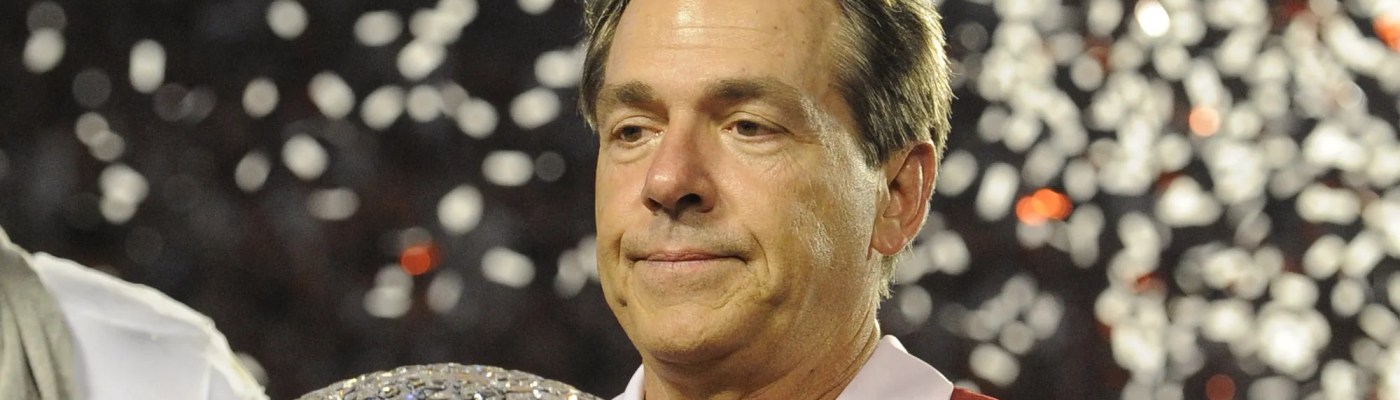
I was a year early on this. I was convinced it was coming after last season. I thought with Bryce Young and Will Anderson leaving, it was a good time for Saban to hang it up. But he came back for another year, was about as close as you can possibly get to winning yet another National Championship, but fell just short.
I thought Saban would’ve retired this year if they had been able to win the Natty. I thought he would’ve gone out on top, but since he didn’t I figured he’d probably come back one last year. So in that regard this is kind of a surprise to me, even though I’ve thought he was near the end of the line for the past year or so. In a way this is kind of sudden, I guess? At least as sudden as a retirement can be for a guy who is 72 years old.
At any rate, it’s official, and now we are all living in a post-Saban college football world. For a long stretch of his tenure at Alabama, a lot of us probably despised the guy because it seemed like they were a lock to win the Natty just about every year. But even in the midst of all that, you simply couldn’t help but have tremendous respect and admiration for what he was doing down there in Tuscaloosa. He truly had no equal.
Saban was so elite he made it seem like winning a Natty was no big deal. From 2009-2017, they won the Natty 5 times. 5 times in 9 years. Back then it was happening so regularly it honestly started to trick me into thinking winning a Natty was easy. Saban made it look easy. Like, why can’t everybody else just do it?
And it wasn’t just me, either: he tricked athletic directors around the country, too. Bill Connelly of ESPN had a great take on this:
For an entire era, Nick Saban completely broke the definition of success in college football.
“Mark Richt won at least nine games in 11 of 15 years at Georgia, with two conference titles and seven top-10 finishes, just one fewer than the legendary Vince Dooley had in 25 years. Richt was fired after the last of those nine-win seasons.
Les Miles never won fewer than eight games in 11 full seasons at LSU. He won a national title with five top-10 finishes, more than the Tigers had managed in the 35 years before his hire. He was fired after losing two games early in 2016.
After a run of six straight top-three finishes with two national titles, Dabo Swinney’s Clemson has merely averaged 10 wins over the past three years, and it kind of seems like a crisis. Lincoln Riley has won 65 games in six full-length seasons and Ryan Day has won 46 in four, and they’re both facing extreme pressure and doubt. And while I’m not going to pretend this is all because of one man in Tuscaloosa — losing three straight to Michigan, as Day has, will always test the patience of Ohio State fans, for instance — Saban’s relentlessly consistent success scrambled the brains of fans and administrators throughout the sport.”
This is a fantastic point: good coaches were fired because they looked mediocre in comparison to Saban. Boosters at LSU and Georgia looked at Miles and Richt respectively and asked, “Why aren’t you capable of doing what Saban is doing?”
Saban was the standard against which all other coaches were measured in college football for 17 years. And he had programs and fanbases around the country constantly saying, “If he can do it, then why can’t our coach?”
Because there was only one Nick Saban. He was one of one. He truly had no equal. He made good coaches look like bums in comparison.
He completely warped our perceptions and expectations as to what was actually possible and realistic for our programs. We thought that if he could do it, then so could we, but it just wasn’t true. There were certainly instances where Bama fell short, and Saban was bested by another coach here and there.
But over the long run? Over his entire tenure? Nobody could keep up with him.
Saban’s record at Alabama was 201-29, an 87% win rate. In the non-Saban years, from 1892-2007, Alabama had a 68% win rate.
Over 1/5th of Saban’s losses at Bama were in his first season, 2007. They went 7-6, and since 2007, he’s lost a grand total of 23 games.
And I bet if I really sat down and thought about it I could remember just about all of those 23 Bama losses. That’s how you know you were really running shit: when on the rare occasions your program does lose, it’s a big, memorable event.
Quickly I just wanted to run through a list of Saban’s accolades because while I think we all know he’s the best to ever walk the sidelines in college football, I want to pull a few stats that put into perspective just how unprecedented he was–beyond the 7 National Championships:
- Every Saban recruiting class at Alabama until 2021 won a National Championship. Even all the guys that went three-and-done.
- In other words, he never went more than 3 years without winning a Natty until these last 3 seasons. He won his first in year three, then won 2 of the next three. So already that’s the 2007-2012 recruiting classes all having been a part of a National Championship. Then he won in 2015, which meant 2013 and 2014 classes got rings. He won in 2017, which meant the 2016 class got one. Then the 2020 Championship meant that the 2018 and 2019 classes won Nattys. Nobody got left out–until the most recent three classes.
- This is the stat that’s going around everywhere, but it’s just unbelievable. I don’t think we fully appreciate just how crazy it is for Saban to have been able to say until this year, “Every one of my recruiting classes has won a National Title.” It’s the ultimate closing argument, for sure, because it shows just how different a level Bama was on compared to everyone else. Winning a Natty at Alabama is expected. It’s par for the course. It’s hard to wrap your head around, honestly.
- Under Nick Saban, Bama was ranked #1 in the nation for at least one week for 15 consecutive seasons, from 2008-2022. The previous record? 7 straight years by Miami from 1986-1992, but even that was with multiple head coaches. This is probably an unbreakable record considering the vast majority of head coaches don’t last anywhere near 15 seasons as it is, much less have a #1 ranked team in 15 straight seasons.
- Since 2008, a record of 37-15 against top-10 ranked opponents.
- Nearly twice the number of top-5 victories as the next closest coach. Saban has 30, Bobby Bowden had 18, and then Barry Switzer, Woody Hayes, Steve Spurrier and Lou Holtz all had 15.
- 30-15 record against top-5 opponents, a 66.7% win rate, by far the best ever. Bowden won 37.8% against top-5 teams, Switzer and Hayes 51.6%, Spurrier 42.9%, Holtz 41.9%.
- Saban coached teams have spent more weeks ranked #1 in the nation than any other PROGRAM in the nation: 109. The next-closest is Ohio State overall, but that’s Ohio State’s entire program history dating back over 112 seasons. Saban achieved that in just his time at LSU and Bama.
- 12 top-5 finishes in his 17 years at Alabama.
What really does it for me is just how great he was against top-5 opponents. Nobody comes anywhere close. He won nearly 67% of his games against top-5 teams. Most coaches out there don’t even win 67% of their games period.
For me, Alabama has been the absolute gold standard for excellence in not only college football, but in all of American sports, for basically my entire adult life. Year in, year out excellence.
As an Ohio State fan, there was a time right after the 2014 National Championship where I thought you could make an argument that Urban was either equal to Saban or had even surpassed him. At the time, Saban had 4 Championships and Urban had three, and went through Saban to win 2 of the 3. We had just watched Urban beat Saban in the inaugural college football playoff, and there was a case to be made that Urban was better.
But Urban simply couldn’t sustain it. I hold Urban Meyer in very high regard, and I still do think that when he’s at his best, there might not be anybody better. But Saban is just a machine, and Urban could never get to that super elite level and stay there like Saban could. Urban was just pedal to the metal, constantly redline, every day is max intensity–and he couldn’t sustain it. He burned himself out.
Honestly, I think a big part of the reason Urban burned himself out was because he was obsessed with keeping pace with Saban, and constantly compared himself to Saban. But again, Urban simply couldn’t sustain it.
Urban lasted BARELY 6 years at Florida–remember, after year 5 (2009) was when he had that health scare, and actually went as far as to announce his resignation, but then changed his mind and came back another year. Then, predictably, that year didn’t go well at all, and after 2010 was when he left Florida. So Urban barely made it 6 years at Florida. He lasted 7 years at Ohio State, and I think he was more sustainable at Ohio State than he was at Florida, but still, 7 years is 7 years. His resignation at Ohio State was due to the fact that he felt like he’d been hung out to dry by the athletic department and the university over the Zach Smith ordeal.
And so it’s really this longevity, or, more accurately, sustainability that impressed me so much with Saban. Alabama was really like a machine down there. Every year, it didn’t matter who they lost to the NFL, they were coming into the season ranked #1 and they were going to be in the mix for the National Championship until the very end. Year after year after year. Before he kind of pivoted to offense in the mid-2010s, every year it was like he had the same defense–hard-hitting, ferocious, violent, aggressive, attacking, elite. Every year he would find these bruising monsters at running back that would just bludgeon everybody–Mark Ingram, Trent Richardson, Eddie Lacy, TJ Yeldon, Derrick Henry, Damien Harris, Josh Jacobs, Najee Harris. It was like a damn assembly line popping these guys out.
Again, the remarkable thing was how long he sustained that excellence for. We just got used to it–it became so regular, so expected, that Bama was the best team in the country and if you planned on winning a National Title you were going to have to go through them.
In fact, let’s talk about that, because that’s one of the many incredible things about Saban’s time at Bama: from 2008-2023, in all but one season, Bama either won the National Title, or lost somewhere along the way to the team that won the National Title:
- 2008: Florida won the Natty after beating Bama in the SEC Championship
- 2009: Bama won Natty
- 2010: Down year for Bama, but Auburn still had to go through them to get to the SEC Championship. Had Auburn lost to Bama (Bama was at one point up 24-0), they would’ve dropped in the rankings and there’s a good chance they wouldn’t have been selected for the BCS National Championship game because TCU was 12-0 and ranked #3 in the country.
- 2011: Bama won Natty
- 2012: Bama won Natty
- 2013: The Kick Six game decided the SEC West, which Auburn then won and went to the National Championship, however they lost to Florida State. Had the Kick Six game gone the other way, Bama would’ve won the SEC and gone to the Natty, and probably won–remember, Auburn had a 21-3 lead on FSU but choked it away.
- 2014: Ohio State had to go through Bama in the CFP semifinal, which in retrospect was the real national championship game. Bama would’ve destroyed Oregon in the Championship, too.
- 2015: Bama won Natty
- 2016: Clemson beats Bama in the Natty on the final play
- 2017: Bama won Natty
- 2018: Clemson beat Bama in the Natty
- 2019: The LSU vs. Bama game, which LSU won, was basically the real SEC Championship. LSU beat Bama, went on to win the SEC and the Natty.
- 2020: Bama won Natty
- 2021: Georgia beat Bama in the Natty
- 2022: Bama missed the CFP, Georgia did not play Bama at all that year
- 2023: Michigan had to go through Bama in the CFP semifinal. Again, like 2014, the Bama-Michigan game was the real National Championship. Bama would’ve beaten Washington in the Natty.
2022 and 2013 were the only seasons where the team that won the National Championship didn’t have to go through Alabama. And, again, even in the 2013 season, had Auburn not beaten Bama on the Kick Six, it would’ve been Bama in the Natty, and then FSU would’ve had to go through Bama.
So basically for a decade and a half, you were not winning a National Championship unless you either were Alabama, or beat Alabama. Just think about that.
When Saban was at Alabama, you were going to have to see him at some point in your quest for a Natty.
I think of Kirby Smart at Georgia–he finally broke through and beat Bama in the Natty in 2021, and then won again in 2022, but how many National Titles has Saban deprived him of? 2017 for sure, when they played in the Natty and Bama won in overtime. This season, when Bama beat Georgia in the SEC Championship? I think Georgia would’ve beaten Michigan had they made the playoff (Georgia had injuries to a lot of key guys in that SEC Championship). In 2018, Georgia had a 21-7 lead on Bama in the SEC Championship but blew the game–they only mustered 7 second half points in one of the most soul-crushing Georgia losses ever (and they have had quite a few at the hands of Nick Saban). Now, even had Georgia won that 2018 game, I doubt they would’ve won the Natty. Bama got absolutely steamrolled by Clemson, 44-16, in the Natty. So I don’t think we can really say Saban deprived Kirby of another Natty in 2018.
But he definitely deprived him of 1, probably 2. Kirby could be sitting on 4 right now if not for Saban (and then Saban would have one fewer).
Then you also think about Kirby, who is now the top dawg in the SEC: he’s a Saban protege. So is Lane Kiffin, whose Ole Miss program is really looking to take that next step. And with Texas joining the SEC, Sark obviously had a lot of stops along the way before Alabama, but Alabama was the place that turned his career around. He’s the poster child of the Saban School of Coaching Rehabilitation.
Saban’s coaching tree is crazy, but if you just look at the number of coaches in the SEC alone who at one point worked for Nick Saban, you’ve got Kirby and Lane, plus Billy Napier was the wide receivers coach at Bama from 2013-2016, now head coach of Florida. Jimbo Fisher was fired this year (feels like it was so long ago, but it was in the middle of the 2023 season), but Jimbo worked for Saban way back in the LSU days. Previous SEC coaches with Saban ties like Jeremy Pruitt and Butch Jones (Tennessee), Will Muschamp (South Carolina, Florida). There’s plenty of others.
Altogether there are 13 current FBS head coaches from the Saban tree, and 9 former FBS head coaches.
The whole idea of the Saban School of Coaching Rehabilitation is crazy, too. I mean that alone proves he’s the GOAT, doesn’t it? Guys get fired, then go work for Saban, and then, voila, they’re attractive coaching candidates once again! Sark was absolutely radioactive after the way he flamed out at USC, the drinking, etc. Then he goes to Bama, then the Atlanta Falcons, then back to Bama, and it’s like he’s a completely different guy. He got the Texas job, which in my opinion is a top-5 job in the country, and he’s got them nationally relevant for the first time in a decade-and-a-half. All it took was a few years learning from the master.
Saban was so far above everybody else that these former head coaches were lining up to be his assistant or even his analyst–anything to just be around the guy and learn from him. Talk about just being the ultimate alpha among alphas. There’s virtually no coach in the sport who can actually look Nick Saban eye to eye as a peer–they pretty much all look up to him as a mentor, a role model, a living legend, or even a hero. I guarantee you there are Power Five head coaches that addressed him as “Sir.”
But before they were all in awe of him, they were all in fear of him.
I’ve thought for years that Bama won 99% of their games before they even took the field, just because of the Bama intimidation factor. I can’t prove it or back it up with numbers, but I guarantee you most of the teams they played were scared of them–especially back in the “Defense First” era earlier in his tenure when they used to just take people’s heads off. And it was not just because the Bama players were all bigger, stronger, faster, nastier and twitchier. It was Saban himself.
Imagine being a coach in your early 40s, relatively new to the profession, and it’s Nick Saban on the other sideline. There had to be a lot of guys that thought to themselves, “Holy shit, that’s Nick Saban.” They’d never admit it, but I bet it happened. Like NBA players today playing against LeBron for the first time–it’s gotta be a surreal experience. Eli Drinkwitz was 23 when Saban started coaching at Alabama. You can’t tell me it wasn’t surreal for him the first time he coached against Saban (in fact it was his first game ever as the Missouri head coach, in 2020, and actually the only time he ever coached against Saban).
I could go on and on about the Saban Aura and the overall gravity of the man, but I think we all understand it. It was probably, at least for me, after the 2020 Covid season where Saban officially transcended the sport and became a living legend.
Because before that, I think the general feeling towards Saban and Alabama was predominantly a jealousy-based hatred, or for some fanbases a rivalry “We hate that guy” mentality. Like Saban was still just the coach of another college football program–the best coach, and the best program, but still just another program standing in our way.
After 2020, I think most people just kind of threw their hands up and said, “This guy is just on another level. There’s nobody better, there’s never been anybody better–we can’t compete with this guy. We can’t compare ourselves to him.” At a certain point, you just couldn’t do anything but respect and admire him. Kind of like when Tom Brady went to the Buccaneers and won that Super Bowl with them, it was like, “Okay, this guy is just on a completely different level.” Eventually you just have to tip your cap and respect greatness.
The Covid season was, the further into the rearview mirror it gets, really a fluky, almost throwaway season. Half the programs in the country were half-assing it–shit, half the conferences in the country were reluctant to even play. There were guys being held out of games with Covid or exposure left and right, everyone had to wear a mask on the sidelines, there were no fans in the stands, there were no non-conference games until bowl season, campus life was probably radically different, schedules were different, etc. Of course, we all still watched the games and were invested because we needed something to look forward to, and needed to cling to some semblance of normalcy, but I think by now we can all agree, 2020 wasn’t a real season.
But in no way am I trying to take anything away from Bama and what they accomplished that year. Because they were, predictably, the team that navigated and handled the pandemic situation the best. By far. Of course they were the best team in the country that year, of course they were the one team that had their shit together–it’s because they had Saban. It was the season that cemented beyond all doubt that there was nobody on Saban’s level. Pretty much everybody else was in shambles that year, but not Bama.
When you look back at that season, the stats and numbers are kind of hard to take seriously–at the very least, you can’t compare that season on an apples-to-apples level with any other seasons.
But what we can take away from that season was that Alabama handled it the best by far. Amidst all the distractions and uncertainty and anxiety and disruptions and overall abnormality, Bama led by Nick Saban was still a machine. It was like the pandemic didn’t affect them at all. Somehow, they were able to thrive in an environment where everybody else could hardly even function.
Was Saban the goat before the Covid season? Yeah, probably.
But after the Covid season, there was no longer any doubt.
It wasn’t so much a football accomplishment for Saban as it was a testament to his effectiveness as a leader and a CEO. It’s a lot like the Lakers winning the Championship in the bubble: was it the most impressive basketball accomplishment ever? Certainly not. It was more a testament to the leadership and mental toughness of LeBron James–that he and his team were able to thrive in an environment where almost everybody else wilted and tapped out. You look at the two teams that met in the bubble finals: it was LeBron’s team, and then the team with the best organizational culture in the NBA, Pat Riley’s Miami Heat. Exactly who you’d expect to be the two teams left standing after three months in the bubble.
The 2020 college football season proved that there was nobody close to Nick Saban when it comes to being a leader of men and the CEO of a program. Football coaches talk all the time about keeping their guys focused and blocking out distractions. Well, there has never been a college football season with a greater distraction than the pandemic. It was a test that most coaches failed.
But not Saban. Saban passed with flying colors.
Probably the peak of Saban at Bama was 2009-2012. From 2009-2012, they won 3 Nattys in 4 years. From 2013-2023, 3 in 11 years. Obviously still nothing to scoff at all, and even at less than “Peak Bama,” they were still the best program in the country.
Saban as the savior of Bama and the greatest coach to ever live wasn’t really on anybody’s radar when he took the job there in 2007, though. Sure, he’d won a National Title at LSU in 2003 (a split with USC), but then after just 5 years at LSU, he left for the NFL, where he stayed for just 2 seasons with the Dolphins. After that brief stint in the NFL was Bama.
But Saban had kind of gained a reputation as a mercenary, or a flake. He was at Michigan State for 5 years, from 1995-1999. Then 5 years at LSU, then 2 years with Miami. Back in 2007, I doubt anybody including maybe even Saban himself thought he’d stay at Alabama for 17 years.
And I don’t think anybody really thought that when he was hired in early 2007 (after first famously saying, “I’m not going to be the Alabama coach”) that he would retire 17 years later as the greatest coach ever.
At that time, the best coaches in college football were guys like Pete Carroll, who was still at USC (and was let go by the Seahawks the same day Saban retired), Jim Tressel, Mack Brown, Bob Stoops. Yes, Saban had won a National Championship at LSU, but I’m not sure he was seen as superior to any of those guys.
And you also have to remember: this was right before Florida dismantled Ohio State in the National Championship game. The SEC had not yet begun its reign of dominance over the sport. It was not yet conventional wisdom that the SEC was by far the best conference.
A lot of the SEC taking over college football was really Nick Saban’s doing. Since 2006, the SEC has won 13 of 18 National Championships, but obviously 6 of those 13 were Saban’s. And then the one LSU won in 2007, you could argue that they only won that because they still had a lot of Saban’s players on the roster–he left LSU following the 2004 season. And if you don’t want to buy that, then you also have to factor in that LSU only got the chance to play for the Natty in 2007 because it was the most chaotic season ever. They had two regular season losses, LSU did. They only got in because on the final weekend of the season, West Virginia, who was #2 in the Nation, lost 13-9 at home to a 4-7 Pitt team.
And even that might not have been enough to get them in: Ohio State would’ve gotten into the BCS Championship game ahead of LSU because Ohio State only had one loss to LSU’s two. If only WVU had lost that weekend, it would’ve been #1 Mizzou vs. #2 Ohio State. But Mizzou got blown out by Oklahoma 38-17 in the Big 12 Championship game, which meant that both 1 and 2 lost on the final weekend of the season. So Ohio State, who was ranked #3 and idle that weekend (the Big Ten didn’t have a conference championship game until 2011), just backed into the National Championship by default. LSU then leapfrogged all the way up to #2 from #7 after winning the SEC Championship 21-14 over a 9-4 Tennessee team.
At the very least, that 2007 LSU team wasn’t some ridiculous juggernaut, nor was the Ohio State team they beat in the Natty. LSU was very fortunate to even be there.
Another 2 of those 13 were Urban Meyer, and obviously Florida has never been the same since he left. So were those two National Championships Florida won a product of the SEC just being better than everyone else, or was it that Urban Meyer was a great coach?
So now we’re left with Georgia’s two Nattys, Auburn’s in 2010 and LSU’s in 2019. The 2010 Auburn and 2019 LSU teams were pretty similar: they hit the super lottery at the QB position with transfer players, Auburn with Cam Newton and LSU with Joe Burrow. Those were one-off seasons where good programs became great for a single year and caught lightning in a bottle.
As for Georgia’s two Nattys, look, let’s be honest: they were very, very fortunate to win both. I’m not going to say they lucked into back-to-back Nattys because that’s not fair, but let’s just look at the facts: in 2021, when they played Bama in the SEC Championship, they got smoked 41-24. But Bama also lost John Metchie for good in that game, and then in the rematch in the Natty, Jameson Williams blew out his ACL early in the second quarter and then Bama basically had no more good receivers. I thought Alabama looked like the better team in that game until Jamo got hurt, and then their offense really couldn’t move the ball. Plus, we all know Saban’s track record against Kirby Smart both before that National Championship and after: that’s the only time Saban has ever lost to Kirby Smart.
And then last season, Georgia only repeated because Ohio State’s kicker couldn’t seal the deal. Ohio State was on the verge of blowing Georgia out in that game until Marvin Harrison Jr. was knocked out.
It’s not that crazy of an argument to say the SEC’s run of dominance these past 18 years were mostly a result of Nick Saban, Urban Meyer, and then a lot of good luck.
Obviously you still have to put yourself in position to benefit from good luck, and there’s a lot of bad luck or bad breaks that have gone against SEC teams over that same span (such as Auburn blowing a 21-3 lead to Florida State in the 2013 National Championship, or Alabama’s center forgetting how to snap the ball in the 2023 Rose Bowl CFP Semifinal against Michigan). So I’m not going to sit here and chalk it all up to luck. That’s just too overly simplistic and unfair.
But while we’re on the subject, let’s talk about how fortunate Nick Saban was along the way to have some major moments break towards him rather than away.
Because the Bama dynasty really existed on a knife’s edge for a decade and a half.
First up: 2009. Bama’s first National Title under Saban. Texas star quarterback and multiple-time Heisman contender Colt McCoy was knocked out of the National Championship on the first series of the game, and Bama went on to win 37-21. It seems like a lopsided score, but it was 24-21 Bama with under 3 minutes to play and Texas had the ball, but a pair of late turnovers deep in their own territory gave Bama two late scores that made the game seem like a blowout when in fact it wasn’t. Why do I think Texas would’ve won if McCoy hadn’t gotten hurt? Because they almost won even without him. Again, they had the ball down 3 points with under 3 minutes to go, with a true freshman at starting QB. If McCoy doesn’t get hurt, maybe Bama doesn’t win the Natty in Year 1 of Saban, and maybe the dynasty looks different through the years.
2011: #2 ranked Bama loses the “Game of the Century” at home to #1 ranked LSU in either the greatest defensive battle or the worst offensive battle we’ve ever seen (take your pick). The final score: 9-6, and the game went to overtime. All the game really proved was that LSU had the better kicker: Bama tried two kickers in the game and they went a combined 2 for 6, whereas LSU’s kicker was 3 for 3. You could tell Bama was the better team in the game as they had twice the number of score chances LSU did, but they just couldn’t convert them. Bama would get the opportunity for a rematch, though, in the BCS National Championship, defeating LSU 21-0 in dominant fashion and cementing Saban’s status as the best coach in the sport. This was also the first National Championship of the BCS era between two teams of the same conference, and it really provided the impetus and momentum towards adopting the College Football Playoff model.
However, Bama was lucky to even get the chance at a rematch with LSU. After losing to LSU, Bama only fell one spot in the rankings, from 2 to 3. Oklahoma State, who was 9-0, moved up to #2. However, during week 12, Oklahoma State would lose on the road to Iowa State in double overtime, in a massive upset, derailing their chance at a National Championship. Because there were no undefeated teams other than LSU (and Houston, but Houston as a non-Power Five team wasn’t seriously considered for the BCS Championship), and Alabama had only moved down one spot after their loss to LSU, Alabama just moved right back up to #2. They had pretty much outplayed LSU in their actual matchup, and LSU was considered the clear-cut best team in the country, so it made sense to give Bama the rematch. They probably were the two best teams in the country, and Bama proved they were superior by winning in such dominant fashion in the rematch. But still, they were very fortunate to even have the chance at a rematch. They can thank Iowa State.
Now, it’s worth noting that the only reason Bama, who was legitimately the best team in the country in 2011, needed luck to actually get a chance to play for the National Title was because the BCS system itself was ridiculously broken and everybody knew it.
Next up is Saban’s third title at Alabama, 2012. The Tide famously lost at home to Texas A&M in Johnny Manziel’s breakout game, and thus needed help to get back into the National Title picture. After losing and falling to 9-1, Bama dropped to #4 in the BCS rankings. Ahead of them were three undefeated teams: Kansas State at #1, Oregon at #2, and Notre Dame at #3. The following week, both K-State and Oregon lost, which moved Notre Dame up to #1 and Bama to #2, which put them in position to meet in the BCS Championship game assuming they won out. Bama would play Georgia, who was also 11-1 and ranked #3 in the nation, in the SEC Championship game. It was a thrilling, all-time classic of a game which Bama won 32-28 when Georgia ran out of time inside the Bama 10 yard line going in to score, so that was good fortune for Bama already (but maybe you wouldn’t classify it as “luck”). Winning that game, and the fact that Notre Dame went 12-0 in the regular season, solidified those two as the National Championship matchup. Bama would obliterate ND 42-14 in one of the most dominant Championship game performances of my lifetime.
But where the good fortune comes into play is that Bama need a lot to go their way in order to get back into the top 2. For one thing, 2012 Oregon was probably Chip Kelly’s best squad during his 5-year tenure there, and quite possibly the best Oregon team in program history. They got all the way to 10-0, were ranked #1 in the country, but lost at home to 14th ranked Stanford by a score of 17-14 in overtime. And this was an Oregon team that averaged 49.6 points per game. An early turnover on downs at the Stanford 7 yard line, and then a missed 42 yard field goal late in the third quarter basically doomed Oregon. Stanford tied the game up at 14 with a late touchdown drive, then Oregon missed a field goal in overtime and it was basically curtains.
Even this, though, wasn’t exactly “luck” on Bama’s part. I mean, teams get upset all the time. It happens. It happened to Bama that season. It’s part of the sport. But where Bama was really lucky is that Ohio State was on bowl ban, and Ohio State finished the year 12-0. If Ohio State hadn’t been on bowl ban, they would’ve gone to the National Championship game and played Notre Dame. Alabama with a loss would’ve been left out. Was 2012 Ohio State better than Bama that year? Absolutely not. That Ohio State team had close call after close call, and it was really one of the least impressive undefeated Power Five seasons I’ve ever seen. They would’ve gotten killed by Alabama. But they wouldn’t have had to beat Alabama. They would’ve had to beat Notre Dame. And I just don’t think the BCS would’ve kept an undefeated Ohio State out of the National Championship game, even for a reigning National Champion Alabama team everybody knew was better.
In the wake of the “Tattoogate” “scandal” at Ohio State that forced Jim Tressel out, they could’ve chosen to self-impose a one year bowl ban for the 2011 season, and then that likely would’ve been enough for the NCAA since the punishment the NCAA handed down a year later was a one year bowl ban for the 2012 season. 2011 was a lost season for Ohio State from the rip: they lost their head coach in late May of that year, lost Terrelle Pryor their starting quarterback who bolted to the NFL because he was implicated in the “scandal,” plus a slew of other players as well. A young Luke Fickell was thrust into a doomed situation as stopgap head coach, and the team went just 6-7. That’s the year Ohio State should’ve self-imposed the bowl ban, if they were smart. They probably knew they were getting Urban Meyer the following season, so you self-impose the bowl ban before Urban gets there–you don’t wait a year for the NCAA to do it. So essentially because Ohio State’s athletic director Gene Smith didn’t self-impose the bowl ban immediately for 2011, it resulted in two wasted seasons at Ohio State instead of just one.
Anyway, the point is, Ohio State mishandled the whole Tattoogate “scandal” and wasted an undefeated season in which they could’ve won a National Championship. They would’ve just had to have beaten a Notre Dame team that I didn’t think was very great–and which was proven by the way they got stomped by Alabama. It was Gene Smith’s incompetence that essentially led to Saban’s third championship at Alabama.
Moving on to Saban’s fourth title, 2015: this one wasn’t really a matter of luck, in my view. I just think Bama was fortunate to avoid playing Ohio State that year. Ohio State had beaten Bama in the playoff the year before, brought almost everyone back, and came into the 2015 season ranked #1 and favored to repeat. But they were incompetent on offense most of the season after losing coordinator Tom Herman, and wound up losing a miserable game at home in late November to Michigan State by a score of 17-14. Ohio State mustered just 132 yards of offense, and the loss effectively knocked them out of the playoff hunt. Michigan State would clinch the Big Ten East, beat Iowa in the Big Ten Championship and head to the playoff, where they promptly lost 38-0 to Alabama. I can’t really discredit this National Championship for Alabama other than saying I think Ohio State would’ve beaten them and that Ohio State was the real best team in the country. But of course this is a fan take and that Ohio State offense was really broken for large chunks of the season. I just think Ohio State lost at the wrong time and of course the Big Ten divisions are a mess that almost always result in the second best team in the conference not qualifying for the Big Ten Championship game.
2017, Saban’s fifth title at Bama, is a simple one: they were losing 13-0 to Georgia at halftime, then Saban benched starting QB Jalen Hurts, brought in the true freshman Tua Tagovailoa, and rallied to send the game to overtime. I’m not going to say Bama was lucky, though. Benching your starting QB at halftime of the National Championship game for a true freshman is an all-time ballsy move, and Saban deserves nothing but credit for doing it. It’s a move only he could make. And in fairness, Alabama actually should’ve had that game won in regulation but their kicker missed a chip shot as time expired that would’ve averted overtime altogether. I guess I just view this game as a monumental choke by Georgia more than anything, but really I have no gripes with it.
For Saban’s sixth and final title at Alabama, 2020, there’s really not a lot to say that hasn’t already been said. They were basically the only team that had their shit together that season–thanks to Saban–and more or less waltzed to the title. Would the season have gone differently for everyone else if not for the pandemic? Almost certainly, but you can’t hold it against Saban that he was the only coach that had his team firing on all cylinders that season amidst the virus.
Really, outside of 2009, I don’t think any of these Bama Championships were so driven by luck that I would go as far as to use the “a-word” (asterisk). 2011 and 2012, Bama was very fortunate to get a chance to play for the National Title, but I also think they were the best team in the country both years.
But if we’re going to be fair here, we also have to talk about the National Championships Bama should’ve won but didn’t due to bad luck. The 2013 Kick Six game comes to mind: the most miraculous play in college football history sent Auburn to the SEC Championship and then the National Championship. I will say, though, a lot of that was on Saban for electing to kick a 57-yard field goal instead of just going to overtime. It was only because Bama attempted such a long kick that Chris Davis even had the opportunity to run it back out of the endzone. But still, plays like that never happen–it’s a one-in-a-million thing.
Bama also lost the 2016 National Championship on the final play of the game. And the play Clemson ran to score probably should’ve been flagged by the refs as an illegal pick play.
I also think Bama would’ve won the 2021 National Championship if Jameson Williams didn’t blow out his knee early in the second quarter. We kind of went over this.
So when you take into account the Championships that maybe Bama was lucky to win alongside the Championships they lost due to bad luck, it basically evens out.
I just thought it was interesting how the Bama dynasty really sat on a knife’s edge and could’ve turned out a heck of a lot different if a few small things changed.
I don’t bring any of this up in an effort to try to discredit Saban, either. If he was just lucky and that’s why he won 7 National Championships, then why hasn’t anybody else done it?
In order to benefit from good luck, you have to actually put yourself in position for it first. And there has never been a coach in the history of college football that has had his team in position to win a National Championship more than Nick Saban.
It is not easy to win a National Championship. Even for the best programs, you still need a lot to go right for you. On top of things like injuries, coaching staff turnover, roster turnover, road games, the simple fact that there are other teams out there that are really good (especially in the SEC), the bottom line is that it’s just really, really difficult to get a bunch of 18-22 year old kids all on the same page, and all doing what they’re supposed to do. In my opinion, the reason the sport can be so volatile, and the reason upsets happen, is because of this very reason: kids are, for the most part, still developing emotionally (and physically), they’re very up and down, they can get rattled when things aren’t going according to plan–they’re just very unpredictable. And for Nick Saban to have the most consistent program in the country year in and year out, it’s just incredible.
Again, it is very, very difficult to bring it all together for a full season and basically be perfect en route to a National Championship.
If you had told me after Urban Meyer won the National Championship at Ohio State in 2014, that he would not win another one during his remaining time at Ohio State, I would have probably said that’s a bit disappointing. But the reality is, it’s very, very difficult to win a National Championship. You have to be just about perfect, and you need some luck to go your way on top of being perfect.
Look back at past decades of college football–there’s no decade where there was a single program as dominant as Alabama was during the 2010s. College football has never seen a program as dominant as Saban’s Alabama.
USC was great in the 2000s. They had a split Natty in 2003 (split with Saban’s LSU), they won outright in 2004, and they got back to the Natty yet again in 2005 but came up just short against Texas in that classic Rose Bowl game. Pete Carroll stayed at USC through the 2009 season, but after 2005, they never got back to a National Championship game again. What Saban has done at Alabama completely dwarfs what Carroll did at USC.
The only thing close to what Saban did in the 2010s was Tom Osborne’s Nebraska in the 90s. That was an unbelievable run of dominance, and their 1995 National Championship team may have been the best team in college football history. Nebraska won three National Titles in four years–1994, 1995 and 1997. The 1997 one was a split with Michigan. In 1993, Nebraska narrowly lost in the de facto National championship game to Florida State. The 90s Nebraska run is up there, but it’s not on the same level as 2010s Bama. Nebraska was elite for about 5 seasons–Bama was elite for nearly 15 years.
The sport has simply never seen anything like Saban at Alabama. I brought up just how precarious the Bama dynasty was to illustrate that, although Nick Saban made it look easy, it most certainly was not.
Changing gears a bit here, my immediate takeaway for how the Saban retirement affects the landscape of the sport: Georgia is about to turn into a monster.
An even bigger monster than they already are.
Kirby no longer has to coach and recruit against Saban. I feel like a big part of the reason Bama fell off a bit these past 5-6 years is because Georgia leveled-up and started taking a lot of recruits from them. But at the same time, Bama took a lot of recruits from Georgia as well. Both programs thwarted each other in pursuit of National Championships in recent years, and they’ve been splitting top recruits.
Now with Saban gone? It’s clear skies and smooth sailing for Kirby Smart. Obviously the south is super competitive in recruiting, but there’s no Nick Saban to compete with anymore, and that is massive.
I think Georgia is poised to dominate this sport arguably to the same level that Alabama did under Saban. They are now the 800 pound gorilla of the SEC. There is nobody else on their level. Maybe Texas? We’ll see. LSU, Ole Miss, Missouri—they’re not quite on that level.
You’re going to see Georgia atop the recruiting rankings year in and year out going forward. They’re going to top the talent composite every year now. And they’ve got a coach who isn’t even 50 years old yet. Georgia is poised to absolutely dominate college football for years to come.
Kirby is already going after Caleb Downs. He poached Travaris Robinson, the Bama DBs coach that recruited Downs and is considered one of the best recruiters in the country. Kirby is now poised to pillage and plunder the remains of Nick Saban’s program–whatever players or coaches Saban deprived him of in the past, he’s now going after.
Including the National Championships Saban deprived him of, too.
Saban has deprived Kirby of arguably 3 National Championships in the Kirby Smart era: 2017, when Alabama beat Georgia in the Natty; 2018, when Bama beat Georgia in the SEC Championship, and this past year, when Bama beat Georgia in the SEC Championship yet again.
It’s not a stretch to say Kirby could have 5 Nattys right now if not for Saban.
Kris Drew and Zach Smith were making this point on a livestream after Saban retired. They were basically saying the only thing standing in Kirby’s way from really reaching his Final Form was Nick Saban, and now that Saban is gone, who is on Kirby’s level? Who is going to stop him now?
I mean, shit: Kirby is basically Saban Jr. himself. Kirby first joined Nick Saban’s staff when he was 28 years old, when Saban was at LSU. Kirby then spent a year on Mark Richt’s staff at Georgia, but then took a job with Saban on the Dolphins in 2006. Kirby then followed Saban to Alabama in 2007, spent a year as the DBs coach, then was promoted to defensive coordinator in 2008, a job he held through the 2015 season. Kirby was basically Saban’s protege from the age of 28 until he took over at Georgia following the 2015 season.
So for anybody who thought we were lucky to be rid of Saban and maybe now other teams will get a chance at winning, guess again. Saban Jr. here to stay.
Remember the movie Godzilla from about 10 years or so ago? Obviously everybody knows the Godzilla franchise but I’m talking about this specific movie: the plot is basically that there’s three gigantic beasts running around, Godzilla and then two preying mantis bug monster things, a male and female. The military is trying to kill all three of them but their weapons don’t do shit, and eventually they realize the only solution is to have the monsters kill each other. The only thing that can kill one of these monsters is another monster.
Where’s the other monster in college football? Where’s the counterbalance to Kirby Smart now with Saban gone? Georgia is going to be like Godzilla rampaging around destroying everybody and there’s nobody out there who can stop him.
Look, I’m not saying that Kirby is a lock to go on a Saban-esque run here because what Saban did is completely unprecedented. It would be foolish to predict another Saban-style run.
But I have to confess, I don’t really see a whole lot standing in Kirby’s way here. He’s not even 50 years old and he already has two National Championships.
Would it really be all that shocking if Kirby gets to 6, 7 or even beyond?
The next topic I want to explore: Is Bama actually an elite job?
In the 10 years prior to Saban’s arrival, Bama had a record of 64-55 overall.
Saban turned Alabama into the premier program in the country, but is it actually the premier job in the country without him? I don’t know that it is.
It’s a much smaller time period but I think of Florida under Urban Meyer, and then even Steve Spurrier before him. Florida was not some juggernaut program until Spurrier came along, then after he left and Ron Zook took over, it kind of fell off a bit, and then Urban brought it back. Under Urban, Florida was the premier program in the country for like 3-4 years, but after he left, it fell off quickly.
All programs are heavily dependent on the coach. There isn’t a program that can overcome and withstand a bad coaching hire. You see the difference at Michigan between Jim Harbaugh and Brady Hoke before him. Rich Rod wasn’t a horrible coach, he just wasn’t a good coach while he was at Michigan. I cannot overstate enough the impact of great coaching.
Conversely, there are a lot of programs that can be made to look a lot better than they are in their default state when they get the right coach.
Now obviously Alabama had a lot of success historically, and way before Nick Saban ever got there. Bear Bryant won 6 National Championships (albeit in an era where choosing National Champions wasn’t always so cut and dry) and won over 80% of his games between 1958-1982.
Gene Stallings won a National Championship at Alabama in 1992. And Alabama claims 5 National Championships from before Bear Bryant ever got there, albeit only one in the poll era (1941).
So it’s not like Alabama is just Bear Bryant and Nick Saban and then outside of that they’ve been just okay. Gene Stallings won over 80% of his games plus that 1992 Natty, although he did kind of leave the program in disgrace after the 1996 season following an NCAA investigation into infractions. The fallout from that investigation was largely the reason that Alabama was so up and down in the ten years prior to Saban.
Look, Alabama is a great football program. I’m not trying to imply otherwise. Since Bear Bryant was hired as head coach in 1958, they’ve only had 5 losing seasons as a program, and four of those 5 were in the post-Stallings/pre-Saban years where they were dealing with the fallout from the NCAA punishments. (The seasons were: 1984, 1997, 2000, 2003, 2006.)
Honestly, the more I think about it, there really is no program that you can separate from its coaches. There are definitely programs where they’ve had the bulk of their success over a relatively short period of time, or they only had true success with one or two coaches in their history, and those programs you can say are not quite elite-level programs–again, like Florida. Florida outside of Spurrier and Urban is pretty mid.
Between 1990-2010, with a three year break from 2002-2004 when Ron Zook was the coach of Florida, Steve Spurrier and Urban Meyer went a combined 187-32-1, winning 85% of their games and three National Titles combined.
In every other season that the Florida Gators have played football, their overall record as a program is 546-404-36, which comes out to a 55.4% win rate. So under Spurrier and Urban, Florida’s winning percentage shot up by 30 percentage points. That is a massive difference, and it basically confirms for us something we probably already know: outside of the Spurrier and Urban years, Florida isn’t that great a football program.
For me, once Urban left Florida and they went downhill, that kind of surprised me because I came of age while Urban was at Florida and they were arguably the best program in the country. So in my mind, Florida was always this elite program. I started really being a serious college football fan around 2005-2006, which happened to be Urban’s first Natty year at Florida, plus I had some vague memories as a kid of watching Florida vs. Florida State in the mid-90s with my dad and my uncles, and that was basically the premier rivalry in the sport at the time. So in my mind, Florida was always a great program. It was only once I got older and looked at the numbers that I realized, outside of the Spurrier and Urban years, Florida is pretty mid. That kind of surprised me because I just figured, you’ve got the only SEC program in Florida, probably the most talent-rich state in the country, Florida should be elite every year.
Same kind of thing with USC. Now USC has a much more storied history than Florida does, but it was a similar type of situation: right when I came of age, USC was dominant. They were incredible under Pete Carroll. So in my mind, USC is one of those programs that should “always” be great–you have tons of talent in the state of California, plus who wouldn’t want to play in LA? So to me, even though USC has now been mid for much longer than it’s been great in my lifetime, I still picture USC as one of the great programs.
Alabama is a little bit different because I have a brief memory of the few years before Saban got there, and even his first season there, when they were not very good. In 2006 and 2007, they were irrelevant in the national landscape. I do remember when SportsCenter was covering Nick Saban getting hired there, they made this big deal about it (I remember Saban’s big straw hat he used to wear all the time), and I vaguely got the idea that Alabama used to be great, and Saban was supposed to come and bring them back.
It’s weird how your perception of a given program is so heavily shaped by how good or bad that program was when you first really started paying attention to college football. It’s like whatever everyone’s record was in 2006, I just kind of assumed that was how good (or bad) that program had always been.
Basically what I’m saying is, I never really perceived Alabama to be this elite program outside of Saban. When I was a kid, I had no idea who Bear Bryant was, I definitely didn’t know who Gene Stallings was–I didn’t know that Alabama was a true blue blood of college football way prior to Saban.
I still think there’s some credence to the idea that Alabama might regress a lot under Saban. I guess it really just boils down to whether recruits go there for the coach, or they go there for the school itself, you know? To me, that’s what really defines “blue blood status.” It’s your brand. Nationwide, is your brand bigger than the coach? Ohio State is a school that comes to mind. I think Ohio State is one of those programs–they can recruit at an elite level not just because players want to come and play for Ryan Day, but because they want to play at Ohio State. The brand is bigger than the coach. Obviously if they hire a shitty head coach recruiting is going to suffer and the team isn’t going to be great, but the bottom probably isn’t going to completely fall out like it would at a place like, say, Clemson if Dabo were to leave.
And as much as I hate to say it, I think Michigan is one of those brands as well. I’ve been arguing for years that Michigan’s perception as a “blue blood” program is inaccurate, and if you look at the numbers, they really don’t deserve to be called a blue blood program. But perception is reality, and people generally perceive Michigan to be a blue blood program. And now that they’ve won a National Championship, that perception is pretty much solidified for at least a couple decades.
Weirdly, I also think LSU is one of those programs where the brand is bigger than the coach. And maybe it shouldn’t be a surprise because outside of Alabama, nobody has won more National Championships in the BCS/CFP era than LSU. Bama’s got 6, then the next-most is LSU with 3. LSU is perceived as a cool and desirable brand around the country. They recruit extremely well pretty much no matter who the coach is, and what I think helps their brand is all three of their National Titles in the BCS/CFP era have been won by different coaches: Saban won the first one in 2003, then Les Miles won the second in 2007, and then Ed Orgeron won the third in 2019. That lends to the idea of LSU not being a coach-dependent program–they don’t just rely on one coach for all their success. The program transcends the coach (although you could make an argument that it was Saban that really got it started at LSU, then Les Miles won a Natty with Saban’s players, and then they basically had lightning strike when it just so happened that Ohio State’s backup quarterback transferred there and turned out to be the greatest quarterback in the history of college football).
I do also think there’s still a lot of residual “cool factor” from that 2019 season with Joe Burrow and Chase and Jefferson, plus how well all three of those guys are doing in the NFL. That 2019 LSU season really was one of the most iconic college football seasons we’ve ever seen. Those guys were absolute rockstars, it felt like every game they played was must-see TV, and I don’t think we’ve seen a team approach that level of “cool” since.
My general rule of thumb is that if you win a National Championship, you get Blue Blood Status for a minimum of 20 years from when you hoisted the trophy. If most people can still remember you winning a Natty, then you’re probably a blue blood program. Obviously there are some exceptions, like if in hindsight it just “feels” like it was a one-off Natty (like Auburn in 2010), you can lose that blue blood status pretty quickly. I don’t think anybody feels like Auburn is a blue blood today, although bad coaching hires and administrative decisions certainly have a lot to do with that as well.
Florida as well. They’ve lost their blue blood status even though they won a Natty less than 20 years ago, and it’s because they’ve been pretty mid.
The main thing is, do high school football players see you as a great program? That’s kind of why I use the 20 year mark, because after about 20 years, these high school recruits have no memory of you being elite. And I think I should amend that rule to say that you can lose your blue blood status even if you’re within 20 years of winning a Natty if your program goes into a multi-year slide and you’re mid for like 5-7 years. Because think about it, kids who are 17-18 right now, they have no memory of Florida or Auburn being elite. They were babies when Florida won their last Natty, and they weren’t even in kindergarten when Auburn won. Auburn was 14 years ago and Florida was 16 years ago. And basically both of those programs have been mid for a while now, so for a 17-18 year old kid, all they know is Florida and Auburn being mid.
Now there are some programs that have more staying power than others. Notre Dame, for example. Notre Dame is an extremely strong national brand even though they haven’t really been nationally relevant in decades. They won their last Natty in 1988. You’d basically have to be 45-50 years old to remember that. I think, personally, Notre Dame could run into some real trouble in the next 10-15 years because I think what keeps them relevant is that they were so consistently great for so long basically up to the mid-90s (basically from the 40s through the 80s) that they became a premier national brand, and they’re kind of just relying on dads and grandfathers who actually remember Notre Dame being great passing that fandom down to their kids. The issue is that they haven’t won a Natty in 36 years, and that’s kind of getting to the danger zone where basically in like 10 years, if they haven’t won a Natty, is the zoomer generation really going to be super compelled to pass down that Notre Dame fanhood to their kids? There’s always going to be the die-hards, but they’ve probably lost a ton of the fair-weather bandwagon fans who only show out when the team is doing well. A lot of these fans will straight-up jump ship to another team.
Kirk Barton talks about it all the time, growing up in Ohio in the 90s during the John Cooper era where Michigan owned Ohio State–he said there were people wearing Michigan gear all over the place in Ohio, and one of his goals when he went to Ohio State was to help Ohio State reclaim control of that rivalry and stick it to all those douchebags. And he said eventually by the late 2000s, after Ohio State had completely taken control of the rivalry, a lot of those people who back in the 90s and early 2000s were wearing Michigan gear, a lot of them started wearing scarlet and gray.
People are fair-weather fans, man. It sounds ridiculous, but it happens all the time. I’m from Chicago and you wouldn’t believe how many people magically became Cubs fans when they won the World Series in 2016. And how many of those people were Sox fans when they won the World Series in 2005? It happens. People cross the aisle. I mean shit, for every Michigan fan basking in the glory of the Natty win, you can probably go back and look through their tweets from 2019 and 2020 and to a man, they were all demanding Jim Harbaugh be fired. Now they’d take a bullet for the guy.
Okay, so how does this pertain to Alabama? I kind of went on a long-ass detour here, but it is relevant to Alabama.
I almost think having a coach as great and as transcendent as Saban kind of hurts the brand, in a weird way. I think because Saban has been around so long (his recruits this cycle were literally infants when he was hired at Bama), and because he’s become so iconic, so legendary, and so synonymous with Alabama, he’s almost transcended Alabama. He’s become bigger than Alabama. It’s Saban, not Alabama.
What is Alabama without Saban? I don’t know. In my honest opinion, the Alabama brand loses a lot of luster without Saban, just because Saban was so larger-than-life and so elite.
You’re already seeing a lot of these Bama players hit the portal or otherwise find a ticket out of T-Town.
A lot of them–perhaps even most of them–went to Alabama because of Saban, not because it was their lifelong dream to play for Alabama.
Right now is where the rubber meets the road: how appealing is Alabama really without Saban?
Personally, I think Bama is a top-10 program just because of the history, the prestige, the fact that it’s in the SEC, the fact that it’s proven you can win big there, and I’m sure they have a lot of money.
But they don’t have more money than, say, Texas, or A&M, or Ohio State, or USC, or even Oregon. Georgia probably even has more money than they do. Michigan, Miami as well.
We have to keep in mind that Alabama isn’t a very big state in terms of population. It’s only got about 5.1 million people, which is the 24th largest of the 50 states.
Now that’s important for a few reasons: for one, it’s no coincidence that the most populous states (California, Texas, Florida) produce the best high school football talent. And if you have a lot of high school football talent in your state, it puts you at an advantage over other schools. It gives you a natural recruiting base: it’s easy to visit and evaluate a kid who plays 30 minutes away than a kid who lives on the other side of the country. And there’s also a much greater likelihood the local and in-state kids grew up fans of your program. Recruiting isn’t all dependent on in-state talent, but it’s a big part of it.
Of course, having a high population isn’t everything in recruiting. New York has the 4th highest population in the country but it’s not really a high school football hotbed. This is because the vast majority of New York’s population is concentrated in the NYC area, which is extremely dense and not conducive to football. You need space to play football–large, open fields. Football is much more conducive to states which have large suburban and rural populations, because those are the areas football thrives. This is why Cali, Texas, Florida, Pennsylvania, Ohio and Georgia produce a lot of football talent: their populations are not just crammed into high rise apartment buildings and most of the kids in those states aren’t going to urban schools that don’t even have room for a football field.
The state of Alabama is structured (in terms of urban/suburban/rural split) in a way that is conducive for football, which is why despite having a lower population, Alabama produces a good amount of highly talented high school football players. It also helps that Alabama is in the South, where football is just so much more ingrained in the culture than it is in other parts of the country. The tradition of football in Alabama is huge, as it is in the South writ large, which gives Southern states a natural advantage over the rest of the country: the best athletes in the South choose football over other sports.
A state like Illinois, which ranks 6th in population yet isn’t exactly considered a hotbed of football recruiting, you have a lot of great athletes choosing basketball over football. Illinois still produces a lot of good football players, but not nearly as many as a similarly-sized state like Pennsylvania, which produces way more quality high school football talent. Illinois is much more of a basketball state than a football state when it comes to what young athletes are choosing.
These state-to-state differences matter quite a bit, especially in the midwest where it tends to vary. Think of Indiana, what’s the first thing that comes to mind? Hoosiers. The Hoosier State. Larry Bird. Basketball. Bobby Knight. Indiana is a basketball state. It produces a lot of good football players, and it’s also the home of Notre Dame as well so it’s not to say there’s no football at all in Indiana, but compare it to Ohio: Ohio is probably the one northern/midwestern state that is remotely comparable to the South when it comes to eating, sleeping and breathing football. Ohio is home to the Pro Football Hall of Fame, has two NFL teams, is home to the legendary Paul Brown who is basically the father of the modern game, and is the birthplace of a quite literally unbelievable number of great head coaches at both the professional and college level through the years.
Feast your eyes on this map of the many prominent coaches born either in Ohio or damn close to it. It’s honestly kind of mind-blowing the more names you go through:
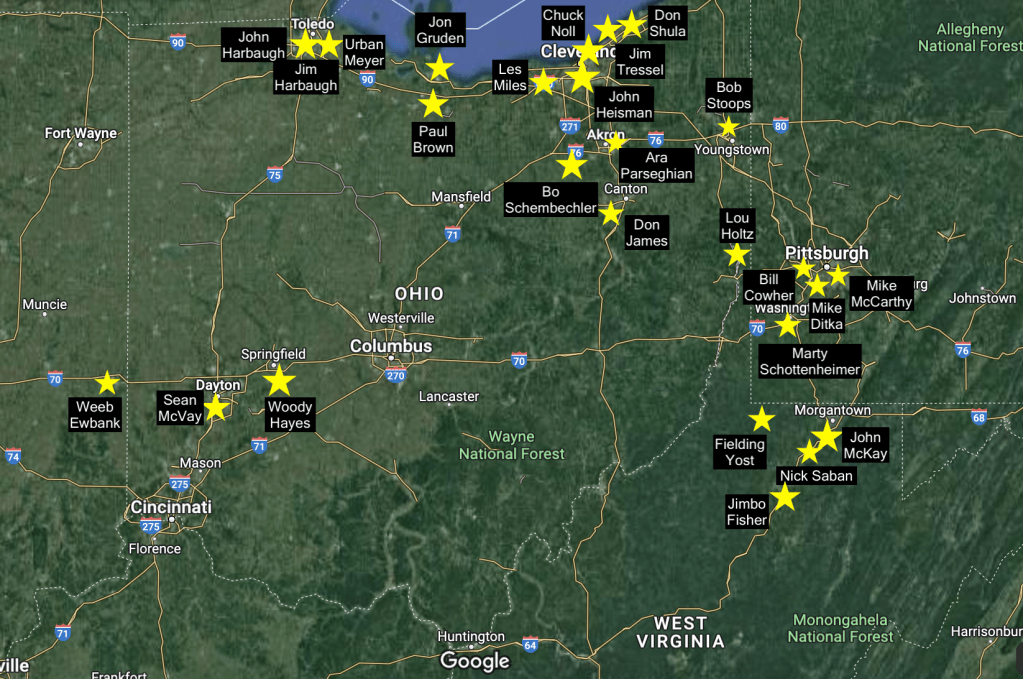
We are talking about here, by my count:
- 12 of the 57 Super Bowls (4 Noll, 2 Shula, 1 Harbaugh, 1 Gruden, 1 McVay, 1 Cowher, 1 Ditka, 1 McCarthy)
- 35 College football National Championships (7 Saban, 6 Yost, 5 Hayes, 4 McKay, 3 Meyer, 2 Parseghian, 1 Harbaugh, 1 Brown, 1 Miles, 1 Tressel, 1 James, 1 Holtz, 1 Stoops, 1 Fisher)
Technically Miami University in Ohio is called the Cradle of Coaches, but in reality the moniker applies to the entire state of Ohio along with Western PA and northern West Virginia.
And there are plenty more names I could list off here, too, I just chose the most notable.
Bill Belichick isn’t from this area, he was actually born in Nashville Tennessee while his dad was on the coaching staff at Vanderbilt, but his father, Steve Belichick, is from Cleveland, Ohio (born in Western, PA but raised in Cleveland). The elder Belichick’s coaching career took him to several different places, but he eventually settled down as a scout for the Navy football team in Annapolis, Maryland, which is where Bill Belichick grew up. But my point is, had Bill Belichick been born just a few years earlier, he would’ve been on this map, too. His family was from this area (Bill was born in 1952, his dad was the head football coach at Hiram College, which is about midway between Cleveland and Youngstown OH, in 1948).
I don’t even really remember where I was going with this–it does tie in to Nick Saban because he’s from this magical area where great coaches are forged. Oh, yeah, I remember: Ohio is a big-time football state. Always has been, always will be. It’s deeply ingrained.
Couple this with the fact that Ohio is the 7th-largest state by population in the US with nearly 11.8 million people, it has a good mixture of urban, suburban and rural areas; and the state itself is decently wealthy being the 7th-largest GDP of all the US states at $822 billion per year, it’s pretty obvious why Ohio State is an elite blue blood program in college football and basically always has been. You also consider that the GDP per capita in Ohio is about $70,000 whereas Alabama is about $55,000, which ranks 4th-last of the 50 states–Ohio is just a wealthier state than Alabama, and money is extremely important in college athletics. Now there are still plenty of states ahead of Ohio in terms of GDP per capita, but it’s wealthier than Alabama is. And Georgia and Florida, too.
Another major factor here: student body size at the university. Alabama’s total enrollment as of the fall semester in 2022 was about 38,000. Ohio State’s was over 60,000. That’s a big deal, because not only does that mean Ohio State rakes in more tuition money and has a larger budget, that also means nearly double the number of alumni produced every year, fanning out across the country and into the corporate world. Those alumni then get jobs, move up the corporate ladder, and start giving money back to Ohio State. The ones who are fortunate enough to strike it rich will become big boosters for the athletic department. The more alumni you have, the greater the odds that one of them becomes a billionaire booster.
But ultimately, more alumni translates into more fans: there’s simply more Ohio State graduates in America than there are Alabama graduates, which is a big reason why Ohio State is estimated to have the largest fanbase of any college football program–and by a wide margin, too. In 2022, Ohio State’s fanbase was estimated at 11.26 million people nationwide. The next-largest was Notre Dame at 8.21 million. Alabama’s was 8th at 5.34 million.
More fans equals more viewers, and Ohio State will always get the benefit of the doubt from the TV executives because they draw the most viewers.
In fact, the average Big Ten school is considerably larger than the average SEC school, which is why despite the fact that the SEC has been the best conference in college football, it’s actually the Big Ten that makes the most money and has the largest TV contract. There are simply more alumni of Big Ten programs out there in the country, which makes Big Ten games a larger TV draw on average.
The point of this exercise is not to just compare the Ohio State and Alabama football head coaching jobs, but to illustrate the disadvantages Alabama has relative to other programs–because Ohio State isn’t the only one that’s in a larger, more populous, wealthier state with a larger and weather alumni and fanbase. The same can be said of Texas, Texas A&M and several other schools as well. Nick Saban’s greatness masked these built-in deficiencies that exist at Alabama.
The reason Sark said “no thanks” to the Bama job when they came asking for him last week wasn’t just because Sark didn’t want to follow in Saban’s footsteps–it’s because the Texas job is actually better than the Alabama job. I feel weird just typing that sentence, but it’s the truth. You have to separate Nick Saban from the University of Alabama and just evaluate the Bama job for what it is.
I guess Mike Norvell even said no to Bama, which to me was kind of surprising because I would’ve thought Alabama is a better job than Florida State for one major reason: you’re in the SEC as opposed to the ACC. But word is that FSU gave Norvell a pay bump, and probably they assured him they wouldn’t be in the ACC for much longer.
I understand why Dan Lanning, who was Alabama’s first choice to replace Saban, said no. Oregon just has more money than Alabama does. You could say Lanning declined because he felt he was building something special at Oregon, and that’s probably part of it, but really a big part of it is that Oregon has that Nike money coming in from Phil Knight, and in the NIL era, that’s a major, major advantage.
I’m already getting way too deep into the weeds and if I go on long enough I’ll eventually try to develop a scientific formula in a spreadsheet for ranking the major college football head coaching jobs, but I’ll stop short of that and just say that I don’t think the Bama job is as good as we thought it was when Saban was there.
Apparently, the word now is that a lot of those Bama players under Saban were taking discounts to play there because Alabama’s NIL infrastructure simply isn’t as good as a lot of the other top programs. These players were going to Alabama for one reason only: Nick Saban. He had a proven and unmatched track record of not only winning, but developing players and sending them to the NFL. So players would figure they could take less in NIL from Alabama for the prospect of greater NFL earnings long-term. You bet on yourself, but you also bet on Nick Saban.
And so a big reason a lot of these players are hitting the portal now that it’s opened up for them in the wake of Saban’s retirement: the main reason they originally went to Alabama has now just walked out the door, and they’re sitting here with NIL deals that are less than what they could be getting at other schools. Isaiah Bond hit the portal and within what felt like hours he posted a Snap story behind the wheel of a Lambo in Austin, TX.
Bama’s big edge as a program these past 17 years, it turns out, was Nick Saban. Who knew?
When you take Nick Saban out of the equation, what makes Alabama a more appealing destination for players than a place like Texas or Ohio State or Georgia?
I’d say they’ve got world-class facilities, they play in the SEC, they’re a tremendous brand (although again, how much of that was Saban?), they’ve got a storied history even before Saban. But other than the history aspect, you can get all of that stuff at Texas and Georgia in the SEC, and Ohio State plays in the Big Ten which for most players is good enough considering the SEC and the Big Ten are the only two relevant conferences now. As long as you play in one of them you’re happy.
I just don’t see where Alabama has an advantage over these other Big Boy programs now that Saban is gone.
I could spend a while discussing where Alabama ranks in the pecking order of CFB jobs, and how Alabama is going to fare under Kalen DeBoer in the post-Saban era (spoiler alert: regression is inevitable).
But I really want to go back to the question I posed earlier: what truly made Nick Saban so much better than everybody else?
And it’s actually an interesting question because very few people out there are actually capable of answering it. To answer that you’d have to have worked for him and then worked for other coaches to compare and contrast, and since I’ve not done that I can only speculate.
I truly have no idea how Saban did what nobody else could, and I’m sure books will be written about it in the years to come–books which I will eagerly read when they’re released.
We’ve all heard the mantras and quotes: “Process-oriented thinking”, relentless effort, “Make their asses quit,” and things like that. We’ve all seen Saban barely crack a smile after winning a Natty, and heard the stories of him going back to work a day or two later (this is why I chose the header photo above–nothing encapsulates the man better than him hoisting the National Championship trophy with confetti flying, with a completely indifferent expression on his face). We’ve all seen him irate on the sidelines, screaming until the veins pop out in his neck because somebody did something they weren’t supposed to do, even though Alabama was winning 52-3 late in the 4th quarter.
For my money, I think it has to do with leadership. College football isn’t so much an Xs and Os sport as it is a discipline and execution sport. Which coach can take a group of 18-22 year old kids and get them all on the same page and all doing what they are supposed to do?
I’m of course loath to say anything nice about Michigan, but I will admit they were an extremely well-coached and buttoned-down team this year. They didn’t make mistakes. They out-executed everybody they played.
It should go without saying that when you out-execute everyone and don’t make mistakes, you’re going to win the vast majority of your games. Discipline goes a heck of a long way in college football.
Obviously recruiting is a major part of it as well, and Saban was the best at recruiting. But like we went over above: recruiting is about credibility, and at a certain point Saban’s record spoke for itself and his program sold itself to recruits. Recruiting became a momentum thing. The results were undeniable: you want to go to the NFL, nobody produces more NFL players than Nick Saban. You want to win? Nobody wins more than Saban. That’s easy.
But still, that cycle had to begin somewhere, and not only that, it took a herculean effort to maintain that level of excellence and ward off complacency.
And so what I’m more interested in is how he got to that point in the first place; how he built Alabama into the machine that it became.
My two cents: Saban demanded not only excellence, but perfection, at all times and didn’t tolerate anything less.
And more than that: he didn’t just talk about it, he lived it. There were standards at Alabama and if you were not meeting those standards, you were held accountable. A lot of coaches can talk about it, but very few of them actually live that.
At the core of that is being unafraid of confrontation and not giving a shit what anyone thinks of you. I’m sure there were lots of players and coaches that despised Nick Saban because he was an asshole to them–he was extremely demanding and nothing was ever good enough for him.
Perfection is an impossible goal to attain, and so by definition if you demand perfection out of your players and coaches, you will always be pushing them and dog-cussing them for failing to live up to your expectation.
In short: I don’t think Saban let anything slide. Anything. Again, the famous shots of him blowing up on his players late in the 4th quarter up by 45: he never let anything slide.
A lot of coaches out there will let things slide when their team is up 45 with 2 minutes to go in a game against a directional group of five school.
Not Nick Saban, because the standard for him was perfection, and nothing less than perfection was acceptable. Ever.
I just don’t think there are a lot of people out there capable of running an organization like that: ripping people a new one for every little missed detail and fuck-up, knowing that your leadership method will not make you any friends, and knowing that for the vast majority of the season it will not be fun–it will be grueling, miserable, and tedious. People always talk about “attention to detail,” but this is what it actually is: not letting ANYTHING slide, even the tiniest little screw-up or shortcoming.
Again: perfection, and nothing less.
If the expectation that you lay out for your organization is perfection and nothing less, then that’s how it has to be.
You look at the two greatest football coaches of our era and probably ever: Saban and Belichick. They’ve got a lot in common. They both seem more or less joyless, super serious, hardly ever smiling, intense, extremely demanding, cold and unforgiving.
At times it seemed like both Saban and Belichick were completely devoid of human emotions.
A lot of us probably remember the story of Jonas Gray, the Patriots running back who during a game in 2014 ran for 201 yards and 4 touchdowns. Nobody had ever heard of him before that game, and yet that was basically the last we ever saw of him. He slept through his alarm and was late for a team meeting the following week and Belichick was basically done with him at that point.
Most other coaches might let that slide, but not Belichick. Zero tolerance for anything short of perfection. He and Saban are cut from the same cloth.
I also think about how after Tom Brady and Gronk left New England and went to play for the Buccaneers, they said something along the lines of, “We just wanted to have fun playing football again.” And obviously the implication was that it wasn’t fun in New England. It wasn’t fun under Belichick. Obviously the “Patriot Way” worked to an incredible degree, but it wore guys out.
What Saban and Belichick embody is simple: the relentless pursuit of perfection and zero tolerance for anything less.
It’s that latter part where so many other coaches fail: they simply aren’t willing to be mean enough to truly enforce a zero tolerance standard.
It’s about accountability, and most people simply aren’t wired to demand accountability from their subordinates at all times with no prejudice or favoritism or looking the other way. There’s an element of compassion that takes over, which leads to letting things slide, and which I believe guys like Nick Saban and Bill Belichick are consciously aware of and understand as the biggest threats to the relentless pursuit of excellence.
I’m sure a lot of people have heard of “The Peter Principle” which basically states that in a corporate hierarchy, employees rise to the level of their own incompetence–in other words, you get promoted until you are finally in a role that you are incapable of doing. Then you stay there, or you get demoted.
I have my own little derivative of that, and it’s basically that you will rise up the corporate ladder until you finally reach a role in which you are not a big enough asshole for. And by asshole I don’t just mean that as a pejorative, I mean you let nothing slide, you demand excellence at all times, you have zero tolerance for incompetence and laziness, you are not concerned at all with making friends or having fun, you do not care if your employees hate you, you will not hesitate to chew somebody out–you rule with an iron fist.
My theory about the corporate hierarchy is basically that everyone needs to be accountable to somebody, and in order to hold somebody accountable, you basically have to be an “asshole.” And so the further up the corporate ladder you go, the bigger the assholes you’ll find at every step of the way. Your boss is an asshole, his boss is an even bigger asshole, and your boss’ boss is an even bigger asshole than both of them. You get all the way up to the CEO, who you would think is the biggest asshole of all, but in fact the CEO is actually accountable to the board of directors, who are collectively the biggest assholes of the bunch.
It sounds funny, but it’s really not a joke. I truly do believe that in general, nice guys finish last and assholes finish first. You hear so many stories about people at the top of their fields–business leaders, football coaches, movie directors, you name it–most of them are assholes. Demanding, ruthless, assholes.
And so, when you think about it in this light, it shouldn’t really be any surprise that the best coach in college football also happens to be the biggest asshole of them all. I mean, shit, you ever hear stories about Urban Meyer, he’s a legendary asshole. But evidently not quite as big an asshole as Saban.
Again, I don’t mean asshole in the pejorative sense. I think by now it should be obvious that I have a tremendous deal of respect and admiration for Nick Saban, but that’s also because I’ve never met the man and never worked for him. He seems to me like one of those guys who his players and assistants hate when they’re actually at Alabama either playing or working for him, but at the same time they’re bought into the whole process because they know it works and it will ultimately benefit themselves. And then it’s only after they’ve left Alabama and they are no longer a direct subordinate of Nick Saban that they come to appreciate the way he does things and actually can start to look at him a friend (or at least something resembling a friend; I’m not sure if Saban actually had the time for friends during his coaching career).
I don’t think Saban possessed any sort of “secret” that he kept all to himself and that made him so much better than everybody else.
I just think he was willing to be an even bigger asshole than anybody else, and most coaches out there simply do not have the stomach for that. (And another thing I just thought of: negative recruiting. It works, but you have to be an asshole to do it; you have to view recruiting as a cutthroat business and you have to not care at all about making enemies and screwing people over).
The one thing that makes it all work, though? Credibility. The more Saban won, the more of an asshole he could become. The less bullshit he had to put up with. The less ground anybody had to challenge him. People come to the conclusion that obviously what this guy does is working so I should just shut my mouth and do what he says.
I’ll bet where a lot of guys go wrong is that they mimic the Saban “rigorous asshole who lets nothing slide” routine and try to run their programs like the drill instructor from Full Metal Jacket, yet they haven’t actually built up the credibility to do so. That’s when you start losing people–at that point, you’re just some obnoxious moron.
I feel like it happens a lot in the NFL when former Belichick disciples get head coaching jobs–they try to be like Belichick, and do crazy, off-the-wall stuff, but it doesn’t work because they’re not Bill Belichick. Like they’ll cut some notable player because he’s not a “good fit for the system” or something, and it backfires catastrophically. They end up losing the locker room pretty quickly because you can’t do the things Belichick does unless A. you actually are Bill Belichick, or B. you have 6 Super Bowl rings like Belichick does.
So you can’t just be an asshole for the sake of it. For one thing, you people have to actually see that you’re getting on their case about a valid complaint. And second, they actually have to believe that you know what you’re doing. So credibility is key, and credibility can only come with winning.
Now obviously there’s more to it than just ruling with an iron fist and being a credible asshole. You can’t just take the biggest asshole from corporate America and put him at Alabama and he’s going to start winning National Championships. You also have to be a brilliant football mind, which Nick Saban of course is.
But I don’t think we’re going to sit here and say, “Yeah, Nick Saban was the most brilliant football mind in terms of Xs and Os.” I don’t think that’s true. I could be wrong, but I don’t ever recall hearing about how brilliant and innovative and cutting-edge Saban’s defensive schemes were.
Saban was never really a scheme guy–he was a “my players are bigger, stronger, faster and meaner than yours are” guy. He was a “my team is going to push you around and hit you and bully you until you quit” guy.
His team made the other team quit. That’s how he won.
The reality is, the brilliant “scheme guys” usually end up flaming out as head coaches and end up working for Saban (e.g. Kiffin and Sark). That’s where they learn what being a great head coach is really about.
But even then, they can’t replicate Saban’s success.
Again, my belief is that there is not some secret leadership principle that only Saban knows–I think he’s actually been pretty open about why he is so successful. He does talks and interviews and seminars all the time, or at least he used to–I’m not sure how much he does nowadays.
The simple reality is that the vast majority of people aren’t willing to be as big of an asshole is he is. They’re not as ruthless. They don’t have the stomach for it.
When you demand perfection, then it logically follows that you’re going to have to be an asshole to your subordinates pretty much all the time, because perfection is an impossible goal to attain.
But clearly it’s not some Saban secret because in my opinion, Bill Belichick has won in the NFL with a very similar management style.
They must have figured something out during their days in Cleveland:

 Fade the Public